Listen to this essay
23 minute listen
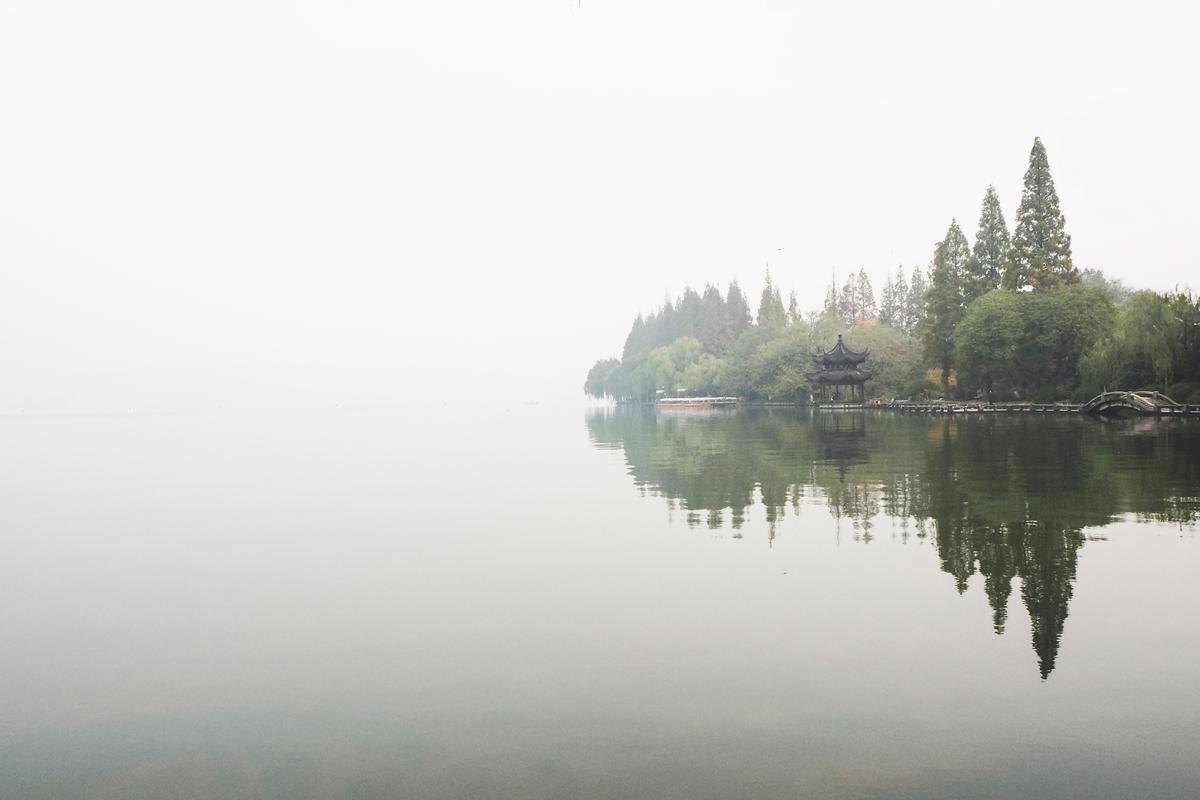
This week I have been in the city of Hangzhou in China for a workshop. Every morning, I have walked the shore of Xihu, or West Lake, the graceful expanse of water lapping the city’s western edge.
Looking out across the water from the promenade, lined with thick-branched camphor trees, I see layers of forested hills and majestic pagodas rise softly through the mist. The human structures enhance the harmony of the hills and water. Along the promenade, groups of men and women practise tai chi, fending off the morning chill with puffer jackets and berets. Their movements are slow, deliberative, meditative and accompanied by Chinese classical music that drifts across the lake to the cormorants fanning their wings in the weak morning sunlight.
Looking behind me, the concrete and glass tower blocks of the modern city of Hangzhou stir into wakefulness. In the 12th century, this city was Lin’an, likely the largest city in the world, with 1-2 million inhabitants and a prosperous proto-industrial economy. Marco Polo, that renowned visitor from the backwaters at the other end of Eurasia, described it as the ‘City of Heaven’ and ‘beyond dispute the finest and noblest in the world’. The afterglow of that splendour can be seen in its historic quarter with low-rise Song Dynasty architecture and bustling street markets, its rooftops a sea of curved grey eaves and tiles washing against the rise of the hills.
I first visited China in the early 1990s as a backpacker fresh out of my PhD, when it was just beginning to open economically to the world. Since then, the economy has grown spectacularly, and hundreds of millions of people have been lifted out of poverty. After China’s 20th century of troubles, Hangzhou is once again a prosperous place, increasingly so as the centre of China’s AI boom. This growth has had its costs. As cities like Hangzhou rapidly expanded, dense urbanisation and lung-choking pollution followed. Carbon dioxide emissions have risen in parallel, such that China now accounts for about a third of global emissions, albeit at much lower per-capita levels than North America. The new affluence seen in shopping malls increasingly pulls on invisible planetary supply chains, driving deforestation and resource extraction in distant continents.
Still, Hangzhou and many other cities and landscapes across China are now greening. Bare hillslopes have been reforested to reduce soil loss and flood risk. Electric vehicles increasingly dominate the streets. Air and water are cleaning up with impressive speed. And China’s carbon emissions are set to plateau and decline in the coming years as the country’s power and transport systems green and electrify.
Degradation of the natural world is a systemic risk to human prosperity
Standing between the human-nature harmony before me and the complex realities and contradictions of the modern world behind me, I reflect on the tensions posed by rapid human development. The increasing global pressure on local and planetary life-support systems threatens to unravel the progress in human wellbeing that has been secured, as well as the welfare of the myriad fellow species on this Earth.
For much of the modern era, the global narrative of economic development has been imagined as a human story unfolding against a backdrop of nature as an externality to be exploited. Forests, rivers, soils and species appear as resources to be managed, inputs to be optimised, or constraints to be overcome. Human wellbeing advances; nature reduces. In some ways, this narrative has delivered. The condition and welfare of billions of humans have been improved beyond recognition.
Yet this model of progress is breaking. The defining pressures of the 21st century suggest that reducing nature to an exploitable commodity is no longer viable. Climate change, biodiversity loss, disrupted ecosystems and rising natural-disaster risks all point to degradation of the natural world as a systemic risk to human prosperity. My field of ecology teaches us that human lives are not merely supported by nature: they are entangled with it, emerge from it, are enmeshed in it, nourished by it, and dependent on it in countless ways, from local to planetary. Humanity is an intimate part of nature, so development that undermines the living world ultimately undermines itself.
But what if the story of human development were not a trade-off? What if we could craft a narrative of development that did not ignore the interconnections between human prosperity and the flourishing of the rest of the living world? If so, how could we define and measure this expanded notion of development?
These questions motivated a paper we published last year in Nature, led by the US ecologist Erle Ellis, with colleagues from the UN Human Development Report Office, and several other academics in fields ranging from history to anthropology and psychology. We argued that what is missing from contemporary debates is not more evidence of environmental decline (we have plenty of that) but an aspirational narrative of what progress should look like in a human-dominated planet. It called for a reframing of development as flourishing with nature.
To achieve that, we proposed a new ranking of countries called the ‘Nature Relationship Index’, which the UN will report annually, starting in late 2026. We believe flourishing is possible for both us and the nonhuman natural world. Following up on these plans is at the heart of the work that brought us to Hangzhou this week. It’s early days and the final ranking is not ready to share yet, but already our work has thrown up a few key debates and surprises.
Incorporating nature relationship into the measure of development must not mean a retreat from human development, nor a nostalgic return to some past condition that ignores the grinding poverty that has been the reality for most of humanity for most of history. Humans are now a planetary force, and most ecosystems are shaped by human activity. The question is how to direct that influence, and whether it supports long-term mutual flourishing with the natural world, or long-term mutual decline.
The Human Development Index shifted the narrative toward the quality of human life
Narratives matter here because societies do not act on data alone. Environmental discourse today is rich in warnings and speaks fluently about planetary boundaries, carbon budgets, extinction rates and ecological overshoot. These concepts have an important role, but they function mainly as limits, telling us what must not be exceeded, what must be constrained. Stories of limits can sometimes spark new innovation. But such narratives can be balanced by aspirational stories of what we are trying to achieve, in addition to what we are trying to avoid.
Some of the most influential policy metrics of recent decades succeeded because they offered a different account of success. Our project is inspired by the example of the Human Development Index. Introduced in 1990 by the UN Human Development Report Office, it shifted attention away from economic flows alone, like gross domestic product (GDP), which is still widely applied by nations despite being derided even by the economists who created it. The Human Development Index has shifted the narrative toward the quality of human life, combining income with health and education.
Its influence lay in its visibility: annual reporting by the UN Human Development Report created a shared benchmark. Countries began to compare themselves with peers. Even institutions long associated with growth-centred thinking began to engage seriously with broader measures of wellbeing. The Human Development Index helped weaken the monopoly of GDP on the imagination. It made room for a richer conversation about what development is for and what progress means.
Since 1990, the rankings have shifted. Most countries that have avoided civil war have increased their index value, but not always. The US topped the ranking in 1990, but in 2023 – the most recent dataset – it had fallen to 17, replaced at the top by Iceland, Norway and Switzerland. Some East Asian countries, such as China, have risen to Western levels. Meanwhile, India lags behind at 130 (out of 193 countries in the latest list), despite its globally significant economy. Other countries like Niger and Afghanistan linger at the bottom of the ranking. The positive news is that, overall, the mean index value of all countries has increased, from ~0.61 in 1990 to ~0.76 in 2023.
My colleagues and I believe that a similar metric is now needed to help societies understand success in their relationship with the rest of the living world: a Nature Relationship Index. It would complement the Human Development Index by asking how well societies sustain the living systems on which human wellbeing depends. It is not about how individuals in a society feel about nature, but about how nations are doing on their path to greater flourishing within the natural world.
The insight that human wellbeing depends on healthy land, water and other species is not new. Our co-author, the Maori scholar Krushil Watene, reminds us that many cultures have long understood humans as part of a wider community of beings, bound by reciprocity and care. Ancestral civilisational philosophies such as Daoism, along with Indigenous and local knowledge systems around the world, express this understanding. These approaches are not a panacea: many ancestral or Indigenous cultures also struggled to find the right balance between human need and ecosystem stewardship, but we can draw on their centuries and millennia of experimentation and learning.
What is new in our work is the context. Development today is negotiated through nation states, international institutions, corporations and global markets. In this world, ideas gain power when they are paired with indicators. Numbers have agency in some contexts where stories alone sometimes cannot; sometimes they can shape budgets, priorities and reputations. In recent years, the UN’s Sustainable Development Goals have sought to provide such numbers and narratives, but the abundance of these goals and metrics makes them hard to distil into a simple, compelling metric.
Beyond expanding the narrative of development to include flourishing with the rest of nature, our paper asked a key question. How might the narrative of the Nature Relationship Index be made visible and comparable? This is why we gathered in Hangzhou, two years on from a first meeting in Oxford, to plot these next steps, along with UN Human Development Report Office personnel and policy partners.
Norway and Canada are both heavily reliant on fossil-fuel extraction and exports, despite abundant local nature
There are many potential pitfalls in such an ambitious plan, and the process has been cautious by design. The metric should be simple to understand in broad principle, even if some details in the calculation become necessarily technical. It should be reported annually for every country. Metrics can illuminate, but they can also mislead: a poorly chosen indicator can reward the wrong behaviour, obscure harm, and lead to perverse outcomes. We also did not want a metric that appears to reward poverty and state dysfunction as a ‘healthy’ human-nature relationship: a collapsing nation state with surging poverty might have a lower ecological footprint, but this is not a development to aspire to. This framework must not romanticise poverty or penalise prosperity, but instead distinguish between development that flourishes through living systems, and development that progressively erodes them.
On the other hand, a wealthy country that ranks high on the Human Development Index, with good healthcare, education and material comfort, might still score poorly if its prosperity depends on highly destructive global supply chains or heavy carbon emissions. Think of Norway or Canada, both heavily reliant on fossil-fuel extraction and exports, despite abundant local nature. Or prosperous cities with urban environments largely detached from accessible nature, like Tokyo. Conversely, a lower-income country might retain rich ecological mosaics and lower consumption pressures, yet rank only moderately if weak institutions fail to safeguard rivers, forests or public access to green space.
The emerging framework that we proposed last year and are now solidifying in Hangzhou centres on three core dimensions.
The first dimension asks whether nature is thriving and accessible to people. This includes the condition of landscapes themselves, particularly whether rural areas retain diverse, semi-natural mosaics rather than being simplified into lifeless monocultures. It also includes access to nature in cities, recognising that urban green space supports mental and physical health and regulates the climate. The potential for everyday contact with the wider living world for most of humanity offers an opportunity to reduce ‘species-loneliness’, or human disconnection from the community of fellow species that has been the norm for all our prehistory and most of our history. For a given level of economic prosperity, we think a city with tree-lined streets and safe, accessible parks is more developed than a concrete metropolis divorced from life-sustaining nature.
The second dimension considers whether nature is treated with care. Here, the focus is on minimising the impacts on climate and biodiversity while a country is developing. This includes using the latest sophisticated data on long and entangled consumption supply chains and how they embody carbon emissions and natural habitat loss, as well as local greenhouse gas emissions. This analysis allows for spatially explicit tracking of the biodiversity and carbon stock implications of different commodity consumption choices. Brazil, for example, has a large domestic consumption footprint; its high-meat diet is fed by cattle ranches that eat into its savannas and rainforests. Others, like much of Europe, have displaced consumption footprints, with decisions on what to consume affecting landscapes and seascapes in remote parts of the planet. In a globalised economy, environmental damage is often displaced rather than reduced, and this dimension seeks to make those connections visible.
The third dimension asks whether nature is safeguarded for the future, examining aspects such as how much natural area is protected, and how clean rivers and air are. This is not only focused on human consumption of these resources, but also on how the wider living world is affected, as in the case of polluted rivers.
When it comes to human co-flourishing with the living world, we are all developing countries
These dimensions can play off each other. For example, intense monoculture (fewer thriving landscapes, increased local pollution) may increase food yields and potentially reduce pressure on agricultural expansion, thus enabling more protected areas. Increased economic development might provide resources for improving air and water quality but increase consumption pressures on biodiversity. But we hope that, overall, these three dimensions together are simple and intuitive enough to have traction.
At the Hangzhou workshop, we’re playing in real time with datasets and maps, trying out different options for component metrics. Every evening, a larger international online workshop has given feedback and asked probing questions. Data availability is a key constraint: there are many things we would like to be measured but are available for only a fraction of countries, and hard to measure every year.
However, we’re poised to complete this process and publish the ranking later in 2026, in time for the next UN Human Development Report. Early results suggest that the index captures meaningful differences, and may produce unexpected outcomes. It does not simply mirror wealth, and position on the Human Development Index. High-income countries that perform strongly in conventional economic measures may rank lower if high-consumption lifestyles are coupled with biodiversity loss outsourced through international trade, poor urban access to nature or weak ecological restoration. Equally, some middle-income nations may perform comparatively well where landscapes remain ecologically diverse, cities retain substantial green infrastructure, and environmental pressures are moderated. A country with cities dominated by concrete, traffic and isolated private wealth might therefore rank below one with cities that are less affluent but more liveable ecologically: where rivers remain clean enough to support life, tree cover softens summer heat, public parks are safe and abundant, and surrounding agricultural landscapes retain hedgerows, wetlands and biodiversity rather than being reduced entirely to industrial monoculture.
What’s clear, though, is that nowhere will (yet) score highly across the board. As my friend the ‘renegade economist’ Kate Raworth likes to say, when it comes to reaching a goal of human co-flourishing with the living world, we are all developing countries, and we all have a distance to travel.
The Nature Relationship Index shifts focus to the quality of the relationship being cultivated with the living world. A society that protects ecosystems while externalising environmental damage elsewhere would not score highly on care. A country that expands protected areas while allowing cities to become ecologically sterile might perform unevenly across the dimensions. Likewise, societies that reduce emissions and restore landscapes while maintaining high levels of human wellbeing would rise in the rankings.
In this sense, the index attempts to make visible forms of success that conventional economic metrics often overlook. It asks not only how wealthy or healthy societies are, but what kinds of landscapes, cities and planetary relationships their prosperity produces.
Societies can compare themselves in terms of wellbeing rather than economic power alone
We are living through a period of geopolitical tension, in which old norms of international relations are being weakened, where multilateral institutions are under strain, and trust between states is fragile. In such conditions, global frameworks can appear unrealistic and developing the Nature Relationship Index may seem disconnected from geopolitical realpolitik. Yet interdependence has not disappeared just because cooperation falters. Countries continue to trade, to consume, to emit, and to alter and be affected by Earth’s systems at local and planetary scales, even if some leaders choose to wilfully ignore plain science. Carbon dioxide, biodiversity and water flows ignore borders even when political boundaries harden around them.
In times of strain, we need to find ways to maintain and strengthen the shared understanding needed to govern our fundamental interconnection. Measures like the Human Development Index matter because they have lifted attention beyond immediate rivalry for economic power. They allowed societies to compare themselves in terms of wellbeing rather than economic power alone.
Environmental disruption today is increasingly a civilisational challenge. Climate, food systems, health and long-term stability depend on the integrity of the living world. Stewarding the natural world is a shared condition for security and flourishing, not a competing interest.
After the workshop, on my last day in Hangzhou, I take a long walk around the landscape at West Lake, with its balanced arrangement of buildings, bridges, lakes and trees. This place is iconic, immortalised through a millennium of Chinese poetry, painting and philosophy as an ideal of harmony between human presence and the more-than-human world. Yet the landscape is not ‘natural’ in the Western conservationist sense of a place separate from people. The lake itself was reshaped in the 9th century by the Tang governor Bai Juyi, who dredged the silted basin and built the first causeway. Over centuries, successive generations added pavilions, bridges, gardens and tree-lined paths.
What emerged was a cultivated landscape in which human artifice sought to deepen rather than dominate the poetry of nature. The famous ‘Ten Scenes of West Lake’, later inscribed by the Qing Kangxi Emperor, evoke this sensibility in their titles alone: ‘Breeze-ruffled Lotus at Quyuan Garden’, ‘Orioles Singing in the Willows’, ‘Autumn Moon over the Calm Lake’. The aesthetic tradition surrounding the lake expresses the old ideal of tian ren he yi, the unity of heaven and humanity, in which flourishing emerges through attunement rather than separation.
Standing here in the city’s soft morning, with the pagodas and wooded hills before me and the glass towers of the modern city behind, it feels as though two eras of development are meeting in the same landscape. Ancient philosophies of human-nature reciprocity alone probably cannot govern a planetary civilisation of 8 billion people linked through global trade, financial systems and technological infrastructure. Neither are contemporary societies likely to navigate ecological crisis through data and technocratic management alone.
Yet there is an intriguing continuity between the ancient landscape traditions embodied at West Lake and the modern search for new development metrics. Both are ultimately attempts to answer the same civilisational question: what does a good relationship between humans and the living world look like? The older traditions answered through poetry, philosophy, garden design and ritualised landscapes. Modern institutions partially answer through indicators, rankings and policy frameworks. The forms are radically different, but both seek to orient collective behaviour toward particular visions of flourishing.
If the Nature Relationship Index succeeds, it will not be because a single number captures the complexity of humanity’s entanglement with the living world. It will succeed, rather, if it changes what societies notice and value. Indicators shape attention, and attention shapes aspiration. And aspiration, over time, shapes the landscapes and futures that societies build.
This essay was developed within a partnership between the Leverhulme Centre for Nature Recovery and Aeon.