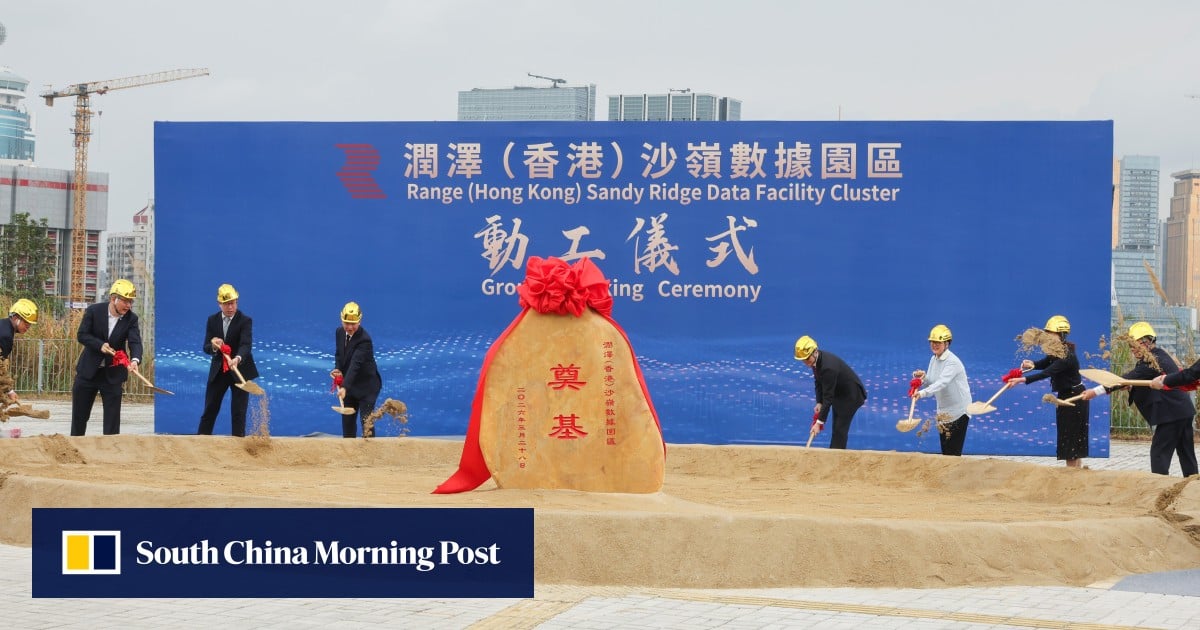
Tech chief Sun Dong says project will further solidify city’s leading position as data connectivity hub linking China and the world
Construction has begun on a major data centre in the Northern Metropolis, with Hong Kong’s innovation and technology minister saying the project will supercharge the city’s computing power and drive the national AI push.
A groundbreaking ceremony was held on Saturday at the Range (Hong Kong) Sandy Ridge Data Facility Cluster, which spans more than 110,000 square metres.
Secretary for Innovation, Technology and Industry Sun Dong said the project marked a leap forward in the city’s innovation and technology development.
He added that the move was an important step in the city’s contribution to national high-quality development and integration into China’s AI Plus initiative.
“The cluster is a key project for innovation and technology development in Hong Kong’s Northern Metropolis, and will further solidify the city’s leading position as a data connectivity hub connecting China and the world,” he said.
“The cluster will strengthen the deep integration of artificial intelligence (AI) and industrial development, which resonates with our country’s strategy of implementing AI Plus.”
Facts Only
Construction has begun on the Range (Hong Kong) Sandy Ridge Data Facility Cluster.
The groundbreaking ceremony took place on Saturday.
The data centre spans more than 110,000 square metres.
The project is located in Hong Kong’s Northern Metropolis.
Secretary for Innovation, Technology and Industry Sun Dong attended the ceremony.
Sun Dong stated the project will supercharge Hong Kong’s computing power.
The initiative is described as contributing to China’s "AI Plus" strategy.
The cluster is intended to strengthen Hong Kong’s role as a data connectivity hub.
The project is part of Hong Kong’s innovation and technology development plans.
The facility aims to integrate artificial intelligence with industrial development.
Executive Summary
Construction has begun on a major data centre in Hong Kong’s Northern Metropolis, marking a significant step in the city’s push to enhance its computing power and support national AI initiatives. The Range (Hong Kong) Sandy Ridge Data Facility Cluster, spanning over 110,000 square metres, held its groundbreaking ceremony on Saturday. Innovation and Technology Secretary Sun Dong emphasized the project’s role in solidifying Hong Kong’s position as a global data connectivity hub linking China with the world. The development aligns with China’s broader "AI Plus" strategy, aiming to integrate artificial intelligence with industrial growth. While the project is framed as a boost to Hong Kong’s tech ambitions, its success will depend on factors like infrastructure execution, regulatory frameworks, and geopolitical dynamics, which remain uncertain.
The initiative reflects Hong Kong’s efforts to leverage its unique position between China and international markets, but questions linger about how it will navigate competition from other regional tech hubs and potential data sovereignty concerns. The project’s scale and stated goals suggest confidence in Hong Kong’s ability to contribute to national tech priorities while maintaining its global connectivity.
Full Take
This narrative presents Hong Kong’s new data centre as a strategic leap forward, aligning with China’s national AI ambitions while reinforcing the city’s global connectivity role. The strongest version of this argument highlights Hong Kong’s unique geographic and regulatory position as a bridge between China and international markets, leveraging its infrastructure to attract investment and talent. The framing emphasizes economic and technological progress, appealing to both local stakeholders and national priorities.
However, the pattern scan reveals potential elements of **ARC-0024 Ambiguity**—the broad strokes of "AI Plus" and "data connectivity hub" lack concrete metrics for success, making it difficult to assess real-world impact. There’s also a subtle **ARC-0043 Motte-and-Bailey** dynamic: the "leading position" claim is assertive (bailey) but could retreat to a more modest "contributing role" (motte) if challenged. The narrative assumes seamless integration with China’s tech ecosystem, glossing over geopolitical tensions or regulatory hurdles that could complicate cross-border data flows.
Root cause: The paradigm here is techno-nationalism, where infrastructure projects are framed as both economic catalysts and tools of strategic influence. The unstated assumption is that Hong Kong’s autonomy in data governance won’t conflict with Beijing’s centralization goals—a tension that could resurface as the project matures.
Implications: For human agency, this could mean expanded opportunities in AI and tech sectors, but also potential constraints if data policies tighten. The primary beneficiaries appear to be government-aligned entities and large tech firms, while costs—such as privacy trade-offs or market distortions—may fall on smaller players or civil society. Second-order effects could include increased competition with Singapore or Tokyo as regional data hubs, or heightened scrutiny from Western regulators over data security.
Bridge questions: How might Hong Kong balance its role as a global data hub with China’s data sovereignty laws? What safeguards exist to prevent this infrastructure from becoming a tool of surveillance or censorship? Would evidence of foreign firms avoiding the hub due to geopolitical risks change the assessment of its success?
Counterstrike scan: A coordinated influence campaign would amplify the "global connectivity" angle while downplaying risks, using vague terms like "leading position" to create unverifiable momentum. The actual content aligns partially—it’s promotional but not deceptive. No overt manipulation detected, though the lack of critical voices suggests a controlled narrative.
Patterns detected: ARC-0024 Ambiguity, ARC-0043 Motte-and-Bailey
Sentinel — Human
The article appears likely to be human-written, with personal voice, idiosyncratic emphasis, and slight variance in sentence length. However, it is important to note that stylometric analysis has its limitations and this assessment should not be considered definitive.