“Sociable” is the latest commentary on important social media developments and trends from industry expert Andrew Hutchinson of Social Media Today.
Meta has outlined how its latest advances in artificial intelligence for cement and concrete development are helping to drive industry-wide efficiencies and benefits in the U.S.-based construction sector.
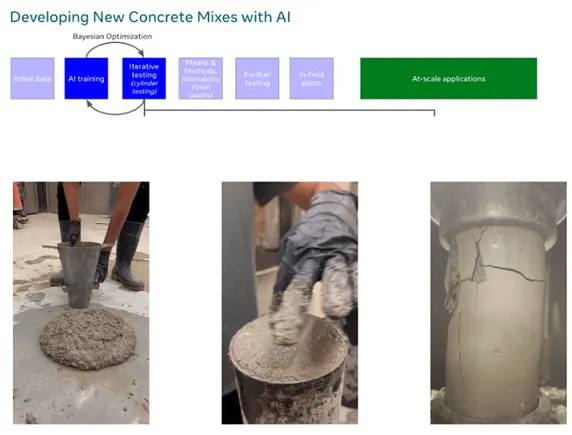
In a March 30 post on the Meta Engineering blog, Meta provided an overview of the projects it’s undertaking to bring AI into concrete development, through new approaches such as adaptive experimentation, which, as explained by Meta, “uses Bayesian optimization to intelligently navigate the vast space of possible concrete formulations.”
According to Meta, the U.S. imports nearly a quarter of its cement for construction projects, which Meta wants to address using AI in order to reduce costs and improve efficiency.
Meta said its “AI for concrete” project is part of a broader commitment to applying machine learning where it can drive measurable, real-world impact.
As per Meta: “Over the next few years, Meta is planning to further collaborate with the construction industry to develop new AI tools. As more platforms like Quadrel build on BOxCrete, AI-optimized mix design becomes accessible to producers without requiring them to change their existing workflows. The team is also planning on continued academic collaboration with the University of Illinois Urbana-Champaign to explore how AI can address not just domestic material substitution, but broader challenges in concrete sustainability and performance.”
Meta said these projects will help U.S. producers compete on cost, reduce emissions and build supply chain resilience.
These projects highlight another way that Meta’s evolving AI tools could impact business in a range of ways, which is another reason the company has gone so all-in on AI development.
Meta has committed to spending $600 billion on AI-related developments in the U.S. over the next three years alone, as it continues to reshape its business around the latest AI push.
The concern, then, is that AI tools will have a huge hill to climb to reach profitability. Meta and other AI providers face a difficult task in demonstrating practical value in order to generate business interest and justify that outlay.
Meta’s cement and concrete reformation projects show that there are likely more applications in this context as these advanced processing models enable new discoveries across a range of industries.
But will that be a pathway to more money for Meta? Will these tools be able to win over traditionalists, and reform whole industries around new approaches?
Meta still has a way to go on this front, but if it can build tools that lead to all-new, inarguably beneficial approaches, there may well be gold in Meta’s growing AI mountains.
Facts Only
Actor: Meta, University of Illinois Urbana-Champaign, Quadrel (platform)
Action: Integrating AI into cement and concrete development
Event: Ongoing collaboration, developing new AI tools
Timeline: Current; next few years
Location: U.S.-based construction sector
Executive Summary
Full Take
As Meta continues to invest heavily in AI, questions arise about the profitability of AI tools and their potential to win over traditionalists in various industries. The company's projects in cement and concrete development serve as a case study for these challenges, as they involve complex processes that require significant adaptation. These projects align with the ARC-0024 Ambiguity pattern, as Meta presents AI as a solution to improve efficiency and reduce costs but does not clarify exactly how this will be achieved or what obstacles might be encountered. The success of these projects could have far-reaching implications for both Meta's business model and the construction industry at large.
Questions for further inquiry: What specific challenges might Meta face in implementing AI solutions for cement and concrete development? How can we evaluate the effectiveness of AI tools in this context? Who will bear the costs of adapting to these new technologies, and what potential benefits may outweigh those costs?
Sentinel — Human
This article appears to be written by a human journalist. It exhibits human-like writing style, clear narrative, and personal voice, with only minor stylometric signals suggesting potential AI involvement.