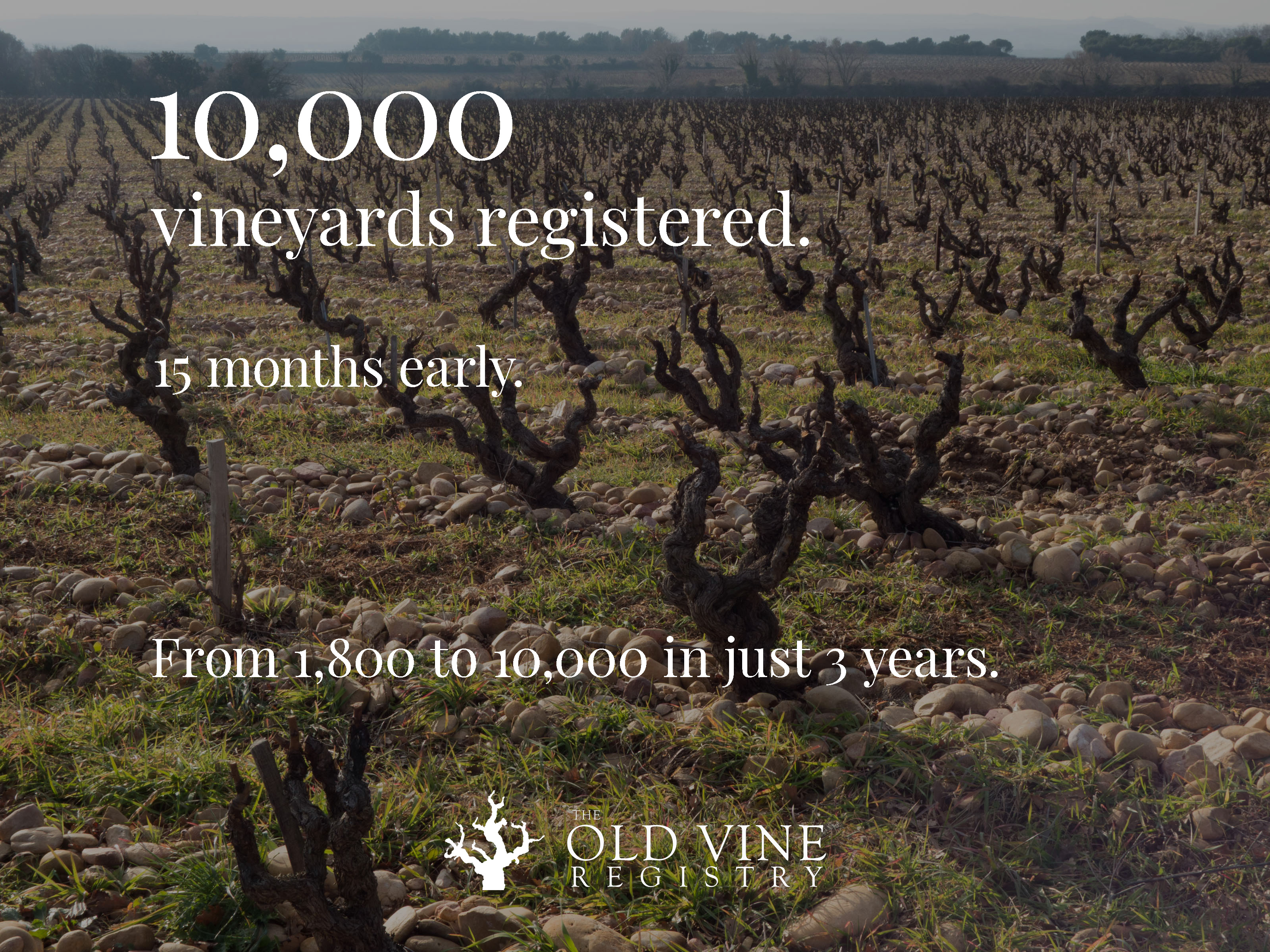
I’m proud and excited to share the following press release that went out on the wire this morning. Soon after launching the Old Vine Registry three years ago, we set the audacious goal of registering 10,000 vineyards by June of 2027. We just crushed that goal 15 months early. It’s a result of countless hours of my own work, as well as the work of a small team of occasional volunteers around the world.
SAN FRANCISCO, CA (March 26, 2026) — In just three years, a global effort to document the world’s oldest vineyards has reached a major milestone. The Old Vine Registry, the world’s leading public database dedicated to historic vineyards, announced today that it has surpassed 10,000 registered vineyards worldwide, achieving a goal originally set for 2027 more than a year ahead of schedule.
Launched in 2023 as a crowdsourced effort to identify and document living vineyards older than 35 years, the registry now spans 42 countries, representing more than 40,900 hectares of historic plantings and 1,144 grape varieties.
The project was created with a simple premise: we cannot protect what we do not first identify.
“Old vineyards are among the wine world’s most valuable agricultural and cultural assets,” said Alder Yarrow, Architect and Manager of the Old Vine Registry. “But until recently there has been no global effort to systematically document where they are, what they contain, and how old they are. The registry exists to change that.”
The initiative aligns closely with the goals of the International Organisation of Vine and Wine (OIV), which in October 2024 adopted Resolution OIV-VITI 703-2024, formally defining “old vines” as those 35 years or older and recommending that wine regions promote the cataloguing of historic vineyards.
“When we launched the registry, I thought there might be tens of thousands of old-vine vineyards worth cataloguing around the world,” Yarrow said. “As the data has come in, it’s become clear that the real number may be in the hundreds of thousands. Reaching 10,000 vineyards this quickly shows how much momentum there is across the global wine community to document and celebrate these historic plantings.”
The registry has grown rapidly through contributions from growers, researchers, importers, and regional wine organizations around the world. Importers, including Skurnik Wines, Becky Wasserman & Co., and Kermit Lynch Wine Merchant, have helped document historic vineyards within their portfolios, while regional bodies such as Wines of Moldova, the Armenian Wine and Vine Foundation, and the Empordà Denomination of Origin have contributed data from their regions.
Beyond documenting vineyards, the project aims to raise awareness of their value and encourage their preservation.
“When vineyards are identified and documented, they become visible,” Yarrow said. “And when something becomes visible, it becomes something people value, celebrate, and ultimately protect.”
The 10,000th vineyard recently added was Beaumont Wine Estate’s Hope Vineyard, in the Bot River region of South Africa, planted to Chenin Blanc in 1974. With this milestone now reached, the Old Vine Registry is inviting growers, regions, and researchers worldwide to continue contributing vineyards to the database. New targets for vineyard counts remain to be set.
“We want every region with historic vineyards to be represented,” Yarrow said. “The more we document these places, the stronger the case becomes for preserving them.”
The registry can be explored, and vineyards submitted, at www.oldvineregistry.org.
About the Old Vine Registry
The Old Vine Registry is the world’s first and largest database cataloguing vineyards aged more than 35 years of age around the world. The registry aims to be a resource for the wine industry, academia, and consumers to discover and learn about old vineyards, as well as a conduit for the sale of wines made from these vineyards. Originally started by Jancis Robinson, the Registry launched as a crowd-sourced, public resource on the web in June of 2023, funded by a donation from Jackson Family Wines and managed by Alder Yarrow of Vinography.Com. The site is owned by The Old Vine Conference, a not-for-profit organization dedicated to building a credible category for old vine wines and a community that sustains and communicates its value.
As of 2026, the registry includes more than 10,000 vineyards across 42 countries, representing over 42,000 hectares of historic plantings.
Media Contact:
Alder Yarrow, Architect & Manager, The Old Vine Registry
oldvineregistry at gmail dot com
415.730.3209
Facts Only
The Old Vine Registry was launched in 2023 as a crowdsourced database for vineyards older than 35 years.
The registry has surpassed its goal of registering 10,000 vineyards by June 2027, achieving this milestone in March 2026.
The registry now includes vineyards from 42 countries, covering over 40,900 hectares and 1,144 grape varieties.
The project was created to document and preserve historic vineyards, with the premise that identification is necessary for protection.
Alder Yarrow is the Architect and Manager of the Old Vine Registry.
The International Organisation of Vine and Wine (OIV) adopted Resolution OIV-VITI 703-2024 in October 2024, defining "old vines" as those 35 years or older.
Contributors to the registry include growers, importers like Skurnik Wines and Kermit Lynch Wine Merchant, and regional bodies such as Wines of Moldova and the Armenian Wine and Vine Foundation.
The 10,000th vineyard registered was Beaumont Wine Estate’s Hope Vineyard in South Africa, planted in 1974.
The registry is funded by a donation from Jackson Family Wines and managed by Alder Yarrow of Vinography.com.
The Old Vine Registry is owned by The Old Vine Conference, a not-for-profit organization.
The registry can be accessed and contributed to at www.oldvineregistry.org.
Media contact for the registry is Alder Yarrow, reachable at oldvineregistry@gmail.com or 415.730.3209.
Executive Summary
The Old Vine Registry, a global database documenting vineyards older than 35 years, has surpassed its initial goal of registering 10,000 vineyards by June 2027, achieving this milestone 15 months early. Launched in 2023, the registry now includes vineyards across 42 countries, covering over 40,900 hectares and 1,144 grape varieties. The initiative, managed by Alder Yarrow, aims to identify and preserve historic vineyards, aligning with the International Organisation of Vine and Wine's 2024 resolution defining "old vines" as those 35 years or older. Contributions from growers, importers, and regional wine organizations have fueled rapid growth, with the 10,000th vineyard being South Africa's Beaumont Wine Estate’s Hope Vineyard, planted in 1974. The registry, funded by Jackson Family Wines and owned by The Old Vine Conference, serves as a resource for the wine industry, academia, and consumers, while advocating for the preservation of these agricultural and cultural assets.
The project highlights a global momentum to document and celebrate historic vineyards, though the actual number of old-vine vineyards may far exceed initial estimates. While the registry has made significant progress, challenges remain in ensuring comprehensive representation across all wine-producing regions. The initiative’s success underscores the value of visibility in fostering preservation efforts, but its long-term impact on protecting these vineyards depends on continued collaboration and awareness.
Full Take
The Old Vine Registry’s achievement of documenting 10,000 vineyards ahead of schedule is a testament to the power of crowdsourced conservation efforts. At its strongest, this narrative highlights a global recognition of the cultural and agricultural value of old vineyards, aligning with the OIV’s formal definition and recommendations. The registry’s success in mobilizing growers, importers, and regional organizations demonstrates a shared commitment to preserving these historic sites, which might otherwise be overlooked or lost. The premise—that visibility leads to valuation and protection—is compelling, especially in an era where agricultural heritage is increasingly threatened by industrialization and climate change.
However, the narrative also invites scrutiny of its underlying assumptions. The registry’s definition of "old vines" as 35 years or older, while backed by the OIV, is somewhat arbitrary. Why 35 years? What cultural or scientific rationale justifies this threshold, and how might it exclude vineyards that are slightly younger but still historically significant? Additionally, the registry’s reliance on crowdsourcing raises questions about data accuracy and completeness. Without rigorous verification, the database could inadvertently include inaccuracies or omit critical vineyards, particularly in regions with less digital infrastructure or awareness of the project.
The broader implication here is the tension between preservation and commercialization. While the registry aims to protect old vineyards, it also serves as a "conduit for the sale of wines made from these vineyards." This dual role could create conflicts of interest, where the economic incentives of promoting old-vine wines might overshadow the conservation goals. Who benefits most from this initiative? Growers and importers gain marketability, consumers gain access to unique wines, but the long-term preservation of these vineyards depends on more than just documentation—it requires sustained economic and political support.
Root cause: This narrative reflects a growing trend of leveraging digital tools for cultural preservation, but it also exposes the limitations of such efforts when they intersect with market forces. The assumption that visibility alone ensures protection may underestimate the systemic pressures facing historic vineyards, such as urban development, climate change, and shifting agricultural priorities.
Bridge questions: How might the registry’s definition of "old vines" exclude or include certain vineyards in ways that don’t fully capture their historical or ecological value? What mechanisms are in place to ensure the accuracy and completeness of the crowdsourced data? How can the initiative balance its dual roles as a conservation tool and a marketing platform without compromising its core mission?
Counterstrike scan: If this were part of a coordinated influence campaign, the playbook might involve leveraging the emotional appeal of preserving "heritage" vineyards to drive consumer interest in old-vine wines, thereby benefiting specific importers or regions. However, the content does not exhibit signs of manipulation; it transparently acknowledges its funding sources and the dual role of the registry. The focus remains on documentation and awareness, with no overt attempts to exploit the narrative for commercial gain beyond the stated mission.
Patterns detected: none
Sentinel — Human
This analysis suggests that the article is likely to be human-written, with evidence of a unique voice, personal anecdotes, and varied sentence structure.