While More People Identify Vaccine Myths as “Definitely False” than “Definitely True,” At Least Half Are Uncertain About What to Believe
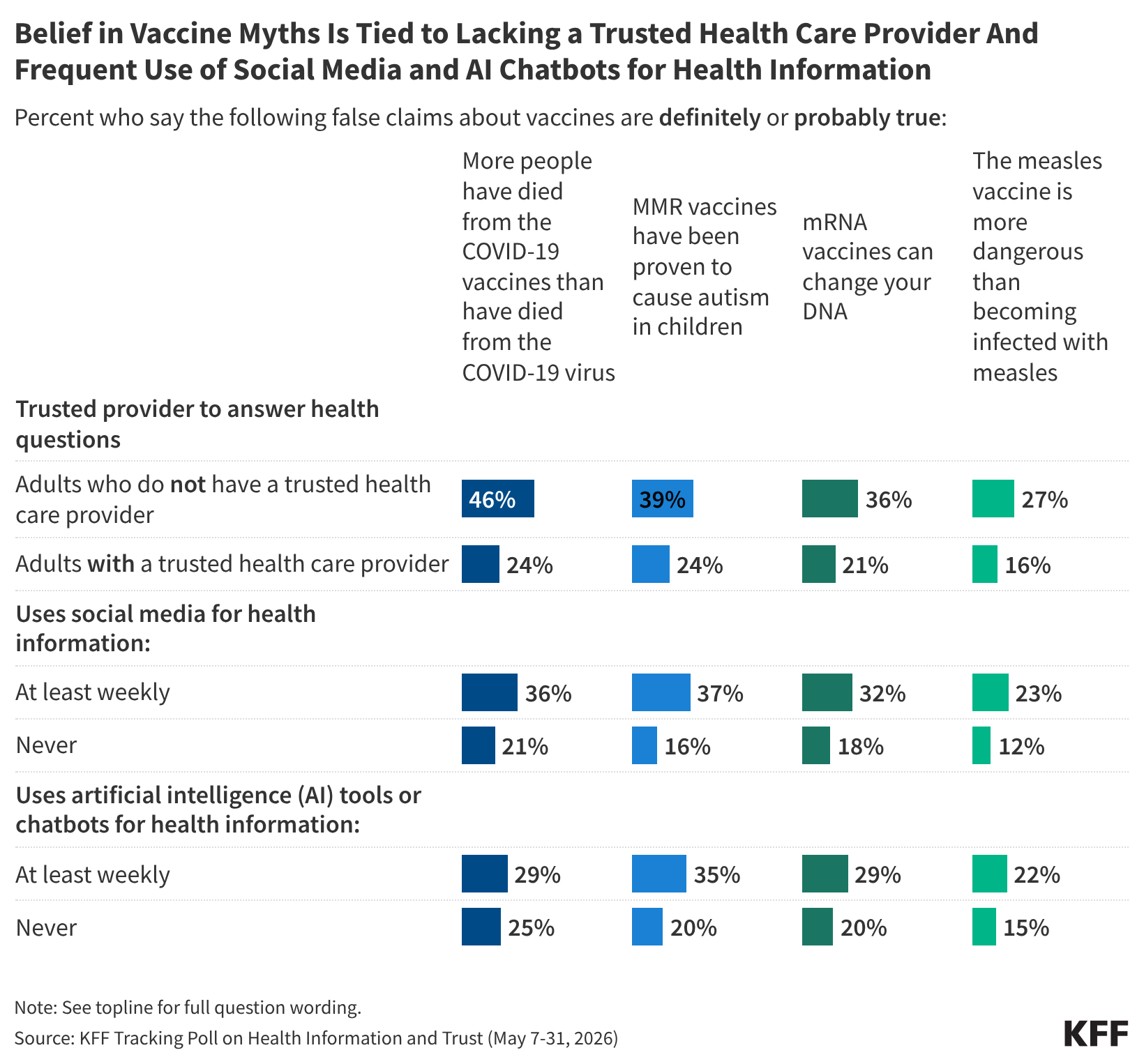
People who don’t have a trusted health care provider are more likely than people with one to believe or lean toward believing several common myths about vaccines, a new KFF Tracking Poll on Health Information and Trust reveals. Similarly, people who use social media or artificial intelligence (AI) chatbots at least weekly for health information are more likely than those who don’t to endorse these false vaccine claims.
One example: Among adults who say they do not have a doctor or other health provider they trust to answer questions about their health, about 4 in 10 (39%) incorrectly believe that it is either “definitely” or “probably true” that MMR vaccines have been proven to cause autism in children, compared to a quarter (24%) among those who say they have a trusted provider.
Similarly, more than a third of people who report using social media (37%) or AI chatbots (35%) at least weekly for health information incorrectly say this myth is true, about twice the share among those who never use social media (16%) or AI (20%) for health information.
The poll finds a similar pattern for most of the other vaccine myths tested for people without a trusted doctor as well as for people who frequently use social media or AI for health information. The differences remain significant even when controlling for other factors such as age, race and ethnicity, education, partisanship, and insurance status.
Exposure to each of these false claims has been fairly steady in KFF polls over the past several years, though the share who report hearing the myth that mRNA vaccines can alter a person’s DNA dropped by 9 percentage points since April 2025 (from 45% to 36%). Exposure to the myth that measles vaccines are more dangerous than measles rose between 2024 and 2025, but has remained steady since then (29% now).
Across the four false vaccines claims, far more people say the claims are “definitely false” than say they are “definitely true,” but at least half of the public is less certain what to believe, falling into the malleable middle and saying each of these claims are either “probably true” or “probably false.”
While many parents who skip or delay recommended vaccines for their children express uncertainty over vaccine myths, they are also about twice as likely as parents who keep their children up to date on vaccines to believe or lean toward believing false claims about the measles and COVID-19 vaccines.
The pattern is true for each of the four false claims: that MMR vaccines cause autism in children (57% among those who delay or skip vaccines v. 30% among those who stay up to date), that more people died from COVID-19 vaccines than the virus itself (55% v. 29%), that mRNA vaccines alter DNA (52% v. 23%), and that measles vaccines are more dangerous than measles (43% v. 18%). This relationship remains significant even when controlling for factors like age, education, and partisanship.
The poll also includes a new analysis that identifies patterns of belief across the four false claims and sorts them into a new belief typology. A small share (8%) are consistent or leaned myth believers (saying all four claims are either “probably” or “definitely true”) and just over half (55%) are consistent or leaned myth deniers (saying all four claims are either “probably” or “definitely false”). About 3 in 10 (31%) are in the mixed middle, providing a range of true and false answers and lacking certainty on at least half of the claims.
Designed and analyzed by public opinion researchers at KFF, this survey was conducted May 7-31, 2026, online and by telephone among a nationally representative sample of 2,480 U.S. adults in English and in Spanish. The margin of sampling error is plus or minus three percentage points for the full sample. For results based on other subgroups, the margin of sampling error may be higher.
Sentinel — Human
This text exhibits the high structure and specific data sourcing of human-authored journalistic reporting, grounded in verifiable statistical context.