Open to all readers.
By Karl Sinclair
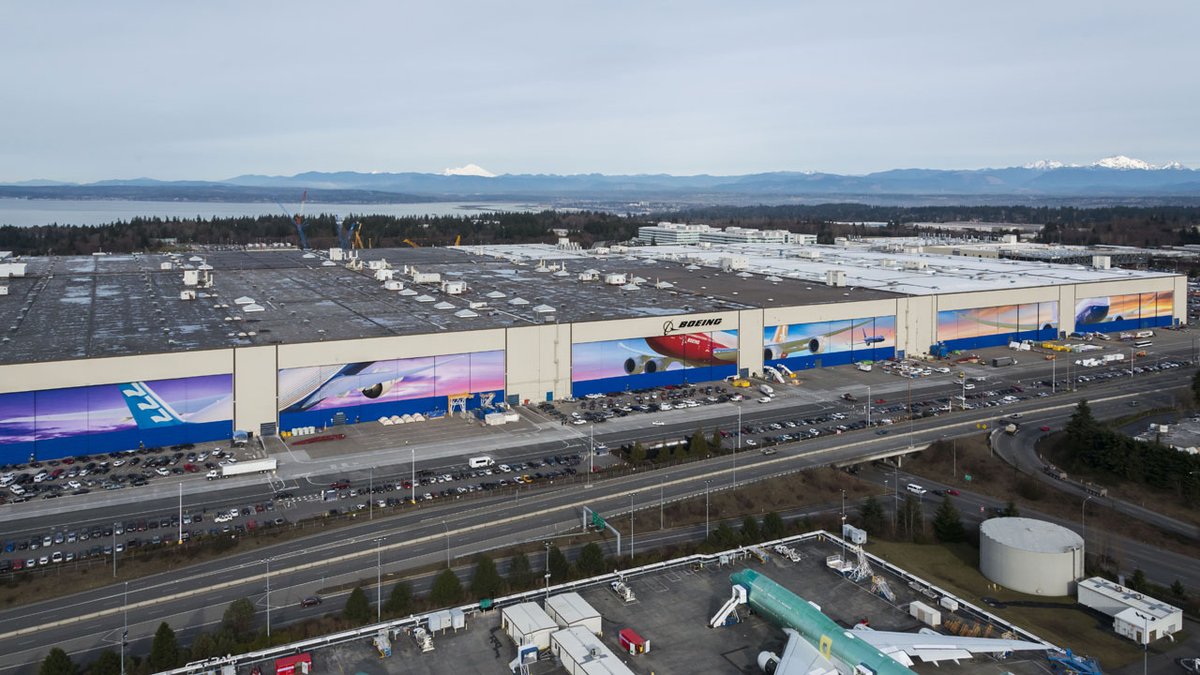
July 5, 2026, © Leeham News: Boeing officially activates its 737 North Line tomorrow, the first time in more than 50 years the company has assembled the 737 outside of its Renton, Washington factory.
The North Line is in Boeing’s Everett widebody assembly plant in the space previously dedicated to 787 Line 1. Line 1 was closed during the Covid-19 pandemic and consolidated with Line 2 in Charleston (SC). The space was subsequently used for 787 rework to fix a production flaw on more than 100 787s.
Today, the 737 North Line is key to Boeing’s march to return to a production rate of 52/mo, last seen in March 2019 when the MAX was grounded for 21 months following crashes of two five-month-old 737-8s operated by Lion Air and Ethiopian Airlines. The Renton factory production will be capped at the current rate of 47/mo, five aircraft below the 2019 rate.
Boeing wants to eventually boost the production rate to 63/mo and even higher, to match Airbus’s plans to assemble 75 A320s a month. The North Line is the key to these goals. It’s also a critical piece of returning Boeing Commercial Airplanes (BCA) and with it, The Boeing Co, to profitability.
An in-depth financial analysis by LNA concludes that this will be no small feat.
Since the 2019 MAX grounding, Boeing Commercial has lost ~$46bn. Total company debt hit $63.5bn in 2020. As Boeing struggles to return to profitability, the North Line, with a target production rate of 5/mo next year, isn’t enough to return BCA to black ink.
Each 737 final assembly line has the capacity to produce 15.6 737s a month under the new protocols to maintain quality and safety standards. The North Line will operate at Low Rate Initial Production, which executives say will put pressure on the financial margin (a polite way of saying it will initially be at a loss).
The North Line’s capacity should be similar to that of Renton’s lines: 15.6/mo. This would bring total production to 63/mo. The 787’s space has enough room for two lines, bringing capacity to a theoretical 78.2/mo. Any more than this — Airbus is considering a rate of 83/mo — will require more space. The Everett factory may have room.
At what point does the North Line enable BCA to return to profitability? Is it 10/mo or 15/mo? Or more?
Information regarding individual program profitability is scant, at best. This requires some analysis of the data that is presented in the company’s financial results.
In FY2025 10-Q filing, Boeing provides reconciliation data on revenues and operating earnings and losses.
Note the following legend item:
(1) Primarily includes costs of products and services and general and administrative expenses.
(It is unclear whether, in its definition, Boeing refers to products and services as variable costs and general and administrative as fixed costs. Therefore, we will retain Boeing’s nomenclature throughout.)
In FY2025, BCA generated $41.494bn in sales, on 600 deliveries. Costs (excluding R&D) amounted to $46.371bn, for a shortfall of $4.877bn.
Year-over-year, it was an improvement over FY2024, when the loss was $5.583bn ($28.444bn less $22.861bn in revenues).
Interestingly, in FY2023, BCA reported a small gain on revenues of $33.901bn (528 deliveries), with costs of $33.5bn, resulting in a positive result of $401m before R&D expenses were added.
However, the true cash outlay for the year amounted to a $4.459bn loss, based on a unit-cost basis, as reported by BCA in its Unit Cost Basis figures.
For FY2025, Boeing reported a total of $6.09bn for company-wide General and Administration (G&A) Expenses (up from $5.021bn in FY2024).
If those expenses were divided evenly among all three divisions, about $2bn would be allocated to each unit. However, BCA is typically the largest and most resource-needy unit of the three; a more equitable 60/20/20 split could be used.
This results in a top-end G&A cost estimate of about $3.6bn for FY2025, allocated to BCA, and gives a range of between $2bn to $3.6bn in General and Administration expenses for Boeing Commercial in FY2025.
Recall the following note from the 2025 Annual Report:
Other Segment Items: Primarily includes costs of products and services and general and administrative expenses, can be expressed as:
Other Segment Items = (costs of products and services) + (general and administrative expenses)
Therefore
Costs of products and services = Other Segment Items – (general and administrative expenses)
Then we get our range by substituting a $2bn and a $3.6bn G&A cost allocation.
Since R&D is already subtracted from the reconciliation, we simply take FY2025 Revenues at BCA and subtract the costs of products and services, which has been separated from general and administrative expenses.
Following that formula, if 60% of all company-wide General and Administration costs were then allocated to BCA, the division would have lost $1.277bn from production costs alone.
This averages out to a shortfall of $2.128m per delivery.
Similarly, if company-wide expenses were allocated on an even basis, with BCA bearing ~33% of the ~$6bn costs (or ~$2bn), the shortfall after production costs increases to $2.877bn or $4.795m per delivery in FY2025.
To underline, Boeing Commercial delivered 600 aircraft in FY2025, generating $41.494bn in sales, with a per unit loss of between $2.1m and $4.8m per aircraft before company-wide expenses were allocated.
One could conclude that, under the FY2025 rate structure (revenues and expenses), 600 deliveries are not enough to even cover production costs.
Hence, Boeing management is taking steps to ramp up production, with the North Line and in Charleston (SC), and the 787 Program (more on that later).
Given the secretive nature of the industry concerning pricing and variable costs, we need to make some assumptions to get a rough idea of where profitability lies for Boeing Commercial Aircraft.
Using the FY2025 results as a baseline, BCA must make up between $1.277bn and $2.877bn in product and service costs before accounting for any General and Administration cost allocations and R&D expenses.
The 777 and 777X program are in a combined production wind-down (777 Classic) and wind-up (777X) mode. The best the company can hope for is that the loss doesn’t deepen beyond $2bn and that by 2028, when meaningful deliveries begin, costs are stabilized.
Boeing stopped delivering the 767 freighter this year. The military variant continues at a low rate of production of about 2/mo. There were 30 deliveries in FY2025 of both types.
The best-case scenario is that all stored 737 MAX and 777X aircraft are delivered to customers without incurring any more losses and that the programs ramp up in a smooth, uninterrupted manner.
It is far more likely that the roughly 70 737s and 777-9s in inventory will produce negative operational margins, the 767 (KC-46) will continue to cost the company money until a new and improved contract is signed, and the certification efforts for the MAX 7, 10, and 777X will also bear a negative impact.
Thus, in the short term, it is difficult to account for all of the different costs that these efforts will incur.
However, using the FY2025 as a baseline, we can project some production figures to get BCA back into the black.
The following is a table using estimates of what BCA earns, based simply on the costs of production.
For example, in FY2025 Boeing delivered 447 737 MAXes to customers.
If the costs of production alone earned a $20m margin per delivery and BCA was able to increase annual 737 deliveries by 25 aircraft to 472 handovers (~2/mo), $500m would be generated to reduce the shortfall range of $1.277bn to $2.877bn, calculated above.
It is widely estimated that BCA earns a gross margin (what a company earns after covering direct production costs) of about $25m per aircraft. This is assuming normal production times, not hampered by groundings, parked inventory, delivery stoppages or regulatory snarls.
At a minimum, Boeing would require a delivery tempo increase that covers about $1.3bn, which it could achieve if it was earning $25m per MAX and increasing production by 50/yr (roughly 4/mo).
This would earn the division about $1.25bn for an increase of 50 deliveries.
To completely break even, based on the FY2025 figures, Boeing needs to cover a $7.079bn loss–a tall order, all other thing remaining equal.
Note: During FY 2025, Boeing wrote off $4.9bn during the third quarter, as indicated above. Had the company retained that amount in the Deferred Production Balance, the shortfall to cover would have been reduced by that figure to about the $2.2bn mark.
As always, when dealing with Program Accounting and margins, a large portion of the accounting function relies on estimates which change from quarter to quarter.
In fact, since sales are reported upon delivery, the margin numbers could vary from delivery to delivery to the same client.
For instance, a 737 MAX which was produced and had to sit in inventory for six months awaiting BFE (or some other component from the supply chain) which was late in arriving will cost the company more than an aircraft that comes straight off the production line with all of its features installed and is handed over in short order.
Changing the accounting block figures also has an effect on costs. Extend the block by 100 units and input costs are decreased, as program accounting will average costs over the life of the program.
Circling back to what the Everett expansion means to the company, relies completely on how quickly the team there can reach higher production tempos.
5/mo in 2027 (60/yr) would gross the company an additional $1.5bn with a bump in overhead costs due to an increase in facilities expenses.
The 737 program, much like the A320neo family at Airbus, is the segment which drives profitability. Despite the higher margins that a widebody delivery brings, significantly greater narrowbody production rates are the bread-and-butter of profits.
The potential raw numbers from the fourth line addition (180 deliveries per year at its maximum output), would add $4.5bn in gross margin at full production.
This propels BCA to ~63/mo and a whopping 750 deliveries per year, assuming full production in Renton of 47/mo.
To summarize, there are many moving parts when trying to calculate a delivery tempo which moves Boeing Commercial back into the black.
Given the many changes the company is going through in the near term (certification efforts, production facilities expansion, installing new final assembly lines, supply chain ramp-ups, inventory re-work), the situation could be described as highly fluid at best.
700 total deliveries in 2026 may not be enough to move the division into profitable territory, especially if BCA has to incur another write-off.
However, it could be a profitable rate for Boeing in 2030, when the system stabilizes and higher priced aircraft are coming off of four 737 MAX production lines in the Pacific Northwest.
But this is not the whole picture. The financial performance of the 787 and 777 lines also must be considered in the recovery of BCA. LNA examines these tomorrow.
Scott Hamilton contributed to this article
From the article:
“700 total deliveries in 2026 may not be enough to move the division into profitable territory, especially if BCA has to incur another write-off.
“However, it could be a profitable rate for Boeing in 2030, when the system stabilizes and higher priced aircraft are coming off of four 737 MAX production lines in the Pacific Northwest.”
===
So, the company is potentially looking at (at least) another four years of loss from the bread-and-butter 737MAX.
Here’s an interesting converse question (purely for benchmarking purposes):
What rate would Airbus have to drop down to on the A320/A321 in order to stop generating a profit on that product line?
Similar question for Embraer — which makes a profit at its relatively low rates.