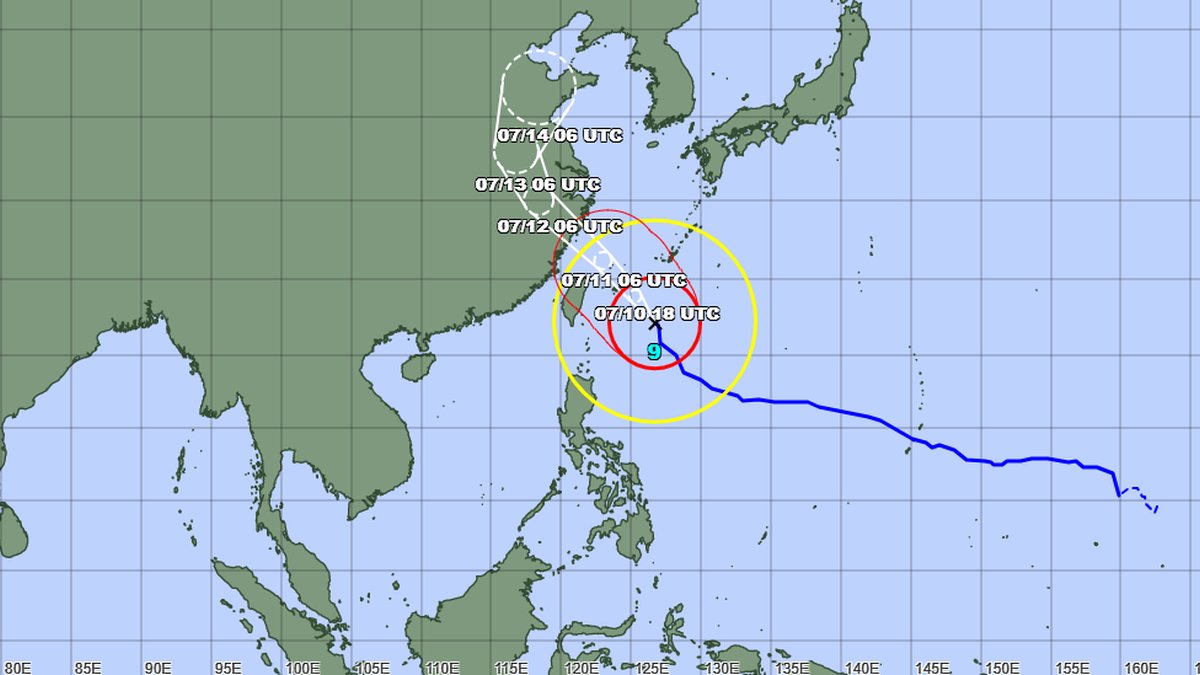
A large and powerful typhoon approached a remote chain of islands in Japan’s southwest on Friday, prompting authorities to warn of violent winds, torrential rain, landslides and flooding in what could be the region’s most destructive storm in years.
Typhoon Bavi is expected to pass very close to Japan’s Sakishima Islands, a remote island chain near Taiwan that is part of Okinawa Prefecture, early on Saturday morning, according to meteorological authorities.
Maximum sustained winds were topping out at 162 kph (100 mph), and local residents on Ishigaki, one of the islands in the chain, were taping up windows and draping windproof nets across homes and shops.
Read more: Catastrophic Storms to Test China’s Resilience in 2026, Scientists Warn
In the Philippines, 10 people died in a landslide on the southern island of Mindanao after heavy rains from a southwest monsoon system enhanced by Bavi, a disaster official said.
Airlines grounded dozens of flights in the region. Japan Airlines said it had canceled more than 100 flights for Friday and Saturday, affecting nearly 20,000 passengers. Rival carrier All Nippon Airways canceled more than 160 flights through Sunday, disrupting travel for roughly 20,000 people.
Nearly 900 buildings in Okinawa Prefecture were without power as of 0600 GMT.
On Ishigaki, a popular tourist destination, residents stocked up on supplies, emptying shelves of instant noodles at a local supermarket. Some public beaches, coastal parks and the local ferry terminal appeared closed.
“I heard that this one will be pretty big,” said Hiroshi Nomura, as he strung windproof nets across his bicycle rental store. “I’m a little concerned about whether our typhoon preparations are enough.”
At the supermarket, local resident Eiken Ishigaki filled his shopping basket with snacks and beer, concerned about potential power outages and expecting to be stuck at home on Friday night and Saturday.
Kazuo Akaishi, a tourist from Ibaraki Prefecture northeast of Tokyo, was waiting at the ferry terminal, hoping to leave for a nearby island. But he had been forced to extend his stay on Ishigaki, as all services for Friday and Saturday appeared to have been canceled.
“I’ve never experienced a direct hit like this. I’ve been here when typhoons passed nearby, but nothing this severe,” said the 47-year-old tourist.
Taiwan Readies for Deluge of Rain
In neighboring Taiwan, financial markets closed for the day, with a large swathe of the north and east also off work. The Taipei city government set up stations for residents to collect sandbags.
Bavi is not expected to make landfall in Taiwan but it will dump huge amounts of rain on the island — some areas could get up to one meter (3.3 feet) of rain — starting late on Friday.
The government said more than 2,000 people have been evacuated, mainly from the mountainous eastern coast, and nearly 29,000 military personnel were on standby to help relief efforts.
“Although the typhoon has weakened slightly and has been downgraded to a moderate typhoon, its storm radius is large and it may still bring strong winds and heavy rain to many areas,” Taiwan President Lai Ching-te wrote on his Facebook page.
Taiwan’s airlines have canceled all of their flights on Saturday from the main international airport at Taoyuan outside Taipei. Cathay Pacific Airways, Hong Kong’s flagship carrier, also canceled weekend flights between Hong Kong and Taiwan and some to the eastern Chinese coastal cities of Hangzhou, Ningbo and Fuzhou.
TSMC, the world’s largest contract chipmaker, said it would delay the scheduled release of its June sales data from Friday to Monday.
Late on Saturday or early Sunday, Bavi is forecast to make landfall around the eastern Chinese city of Wenzhou, home to 10 million people.
“All of the boats from the nearby villages have returned to the harbor,” said Wenzhou fisherman Ye, 57, making repairs to his boat which had been hauled ashore. “Everyone is getting ready for the typhoon.”
(Reporting by Joseph Campbell and Kim Kyung-Hoon in Ishigaki; Additional reporting by Ben Blanchard in Taipei, Joe Cash in Beijing, Julie Zhu in Hong Kong and Go Nakamura and Ella Cao in Wenzhou, China; Writing by Chang-Ran Kim; Editing by Lincoln Feast, Tom Hogue and Raju Gopalakrishnan)
Topics Catastrophe Natural Disasters
Was this article valuable?
Here are more articles you may enjoy.
Facts Only
* Typhoon Bavi approached a remote chain of islands in Japan’s southwest on Friday.
* Authorities warned of violent winds, torrential rain, landslides, and flooding.
* Maximum sustained winds reached 162 kph (100 mph) on Ishigaki.
* Local residents on Ishigaki taped windows and draped windproof nets across homes and shops.
* Ten people died in a landslide on the southern island of Mindanao due to heavy rains enhanced by Bavi.
* Airlines grounded numerous flights; Japan Airlines canceled over 100 flights for Friday and Saturday, affecting nearly 20,000 passengers.
* All Nippon Airways canceled more than 160 flights through Sunday.
* Nearly 900 buildings in Okinawa Prefecture were without power as of 0600 GMT.
* Residents on Ishigaki stocked up on supplies, including instant noodles and beer.
* Taiwan’s government set up sandbag collection stations.
* More than 2,000 people were evacuated in Taiwan from mountainous eastern coast areas.
* TSMC delayed the release of June sales data until Monday.
* Bavi was forecast to make landfall around Wenzhou, China, late Saturday or early Sunday.
Executive Summary
Full Take
Sentinel — Human
The text appears to be a composite news report drawing from multiple international sources regarding a typhoon event, exhibiting the complex structure and localized reporting typical of professional journalistic coverage.