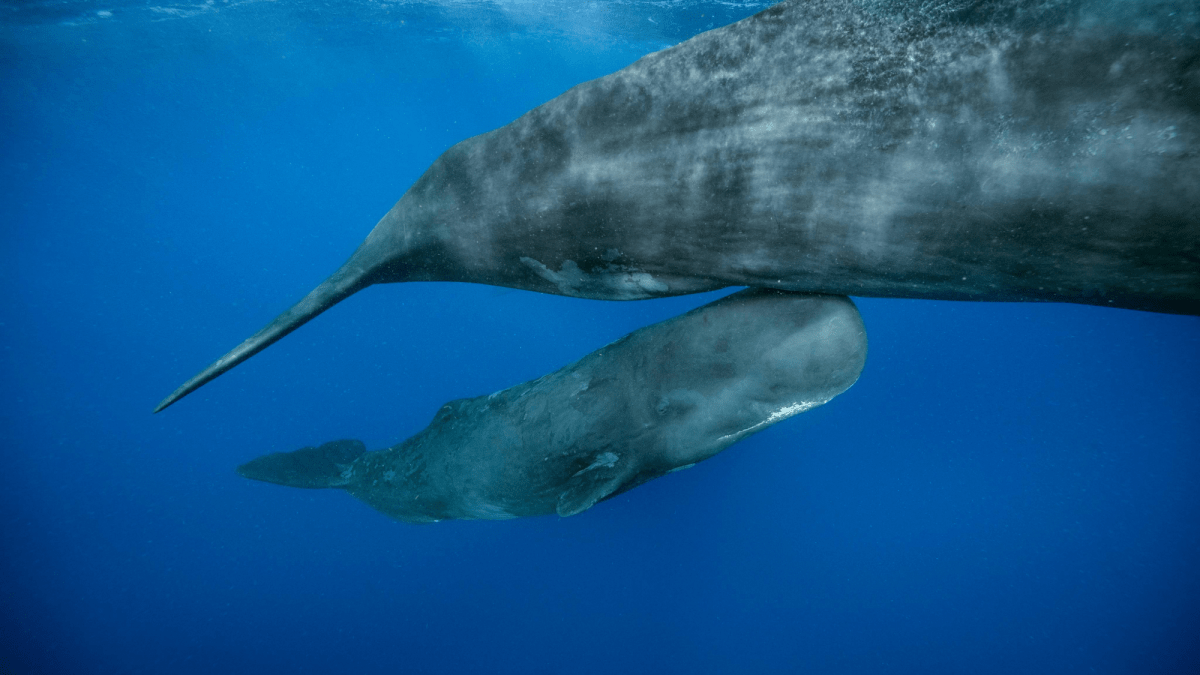
Luck filled the air on a warm July day off the coast of Dominica in the Caribbean. Well, luck and some high-tech drones capturing the incredibly rare sight of a sperm whale (Physeter macrocephalus) being born.
“I’ve been following sperm whale lives for 20 years, across thousands of hours, but have never been there when a whale was born,” Dr. Shane Gero, the biology lead for the whale research organization Project CETI, tells Popular Science. “We found the whales and they were being kind of weird. It’s not often you have the entire family together. So I knew something was up. And then, there was a big gush of blood, the little head popped out, and the flukes came out of the water.”
Gero and his colleagues detail the exciting birth and their findings in a study published today in the journal Scientific Reports. The findings represent the most in-depth, published observations of a wild cetacean—the group that contains whales, dolphins, and porpoises—birth to date.
Family ties
Project CETI (Cetacean Translation Initiative) is a nonprofit registered in the United States and Dominica and the National Geographic Society. It has been applying advanced machine learning and robotics to listen in, take video, and translate sperm whale sounds. The team includes over 50 scientists across seven disciplines, representing 12 institutions and seven countries.
On July 8, 2023, the CETI team observed the birth within a group of 11 whales that they had previously studied. Sperm whale families are composed of grandmothers, mothers, and daughters who live together for life, while the young males leave in their teenage years. While the males typically lead solitary lives, some of the younger males were actually present for this birth. Designated as Unit A, this particular family unit is made up of two female lines.
“There’s Fruit Salad and her offspring and Lady Oracle and her offspring,” Gero explains. “As a result, when a mom is giving birth, there are related females near her and unrelated females near her.”
Equipped with aerial drones, underwater audio devices, and onboard photography, the team spent about six hours with the whales. They observed the delivery phase for 34 minutes, from the time the flukes emerged until the baby was out. Within one minute of delivery, the adults lifted the newborn calf out of the water and onto the heads and backs of the adult females. About two hours after birth, the sperm whale unit began to separate, while the newborn calf stayed with its mother Rounder, half-sister Accra, and aunt Aurora.
One year later, the team observed the newborn—whose sex has not been positively identified—with Accra and Aurora. This sighting suggests that the baby will likely live to adulthood after surviving its first year of life. The first year is particularly dangerous for whales due to a combination of factors, including boat strikes, entanglement in fishing gear, and ingesting plastic.
Listening in
Throughout the birth, the team recorded vocalizations known as codas. Cetaceans use these structured sequences of clicks to communicate. The clicks are part of a growing sperm whale phonetic alphabet that researchers at CETI are deciphering. Based on earlier research, biologists believe that codas may relate to the social identity of the wider cultural clan to which these sperm whales belong. In this particular situation, the vocalizations may help support social bonding during birth.
The team also saw shifts in vocalizations at key events during the birth. These sounds included both slower, longer codas, and novel sounds resembling human “A” and ‘“I” vowels, known as coda-vowels. The vocalizations could be heard over hundreds of feet, and the team believes that they could have been heard by nearby groups of short-finned pilot whales (Globicephala macrorhynchus) and Fraser’s dolphins (Lagenodelphis hosei).
Further study will match the vocalizations with the activity and hopefully give more insight into what went on during the birth.
Fluke’s first
From a human perspective, whales are born backwards, emerging flukes first. According to Gero this helps the whales lift up the newborn so that they don’t breathe in water and reduces the risk of drowning. This coordinated lifting that the team observed has only been scientifically documented in three other toothed whale species—false killer whales (Pseudorca crassidens), orcas (Orcinus orca), and beluga whales (Delphinapterus leucas). This behavior could date back over 34 million years to the last common ancestor of these toothed whale species.
“This is something that is rarely being seen in the wild. There’s only a handful of times where people have seen the sperm whale being born, and a lot of that had to do with the whaling era,” says Gero. “She didn’t have to roll over just at the time for us to video that from the sky, but she did. It was pretty unbelievable what we were able to capture.”
Beyond the excitement of scientific discovery and seeing something few humans have laid eyes on, Gero says that the day was humbling and a prime example of what can be accomplished when people of all scientific disciplines—and whales—work together.
“There were biologists, roboticists, computer scientists, and engineers, but everyone still felt the weight of the privilege of being there when this animal was born,” he says. “I think fundamentally, the message that comes out of this is that cooperation and working together within a society is how we overcome unimaginable obstacles. And that, to me, is a pretty good message right now.”
Facts Only
Event: Sperm whale birth
Date: July 8, 2023
Location: Off the coast of Dominica, Caribbean
Family Unit: Unit A (Fruit Salad and her offspring, Lady Oracle and her offspring)
Behavior observed during birth: Adults lifting newborn calf out of water to prevent drowning
Recording: Vocalizations known as codas
Executive Summary
On July 8, 2023, a sperm whale (Physeter macrocephalus) was born off the coast of Dominica in the Caribbean, an incredibly rare event that was captured on video by Project CETI. The birth occurred within a family unit known as Unit A, which consists of two female lines: Fruit Salad and her offspring, and Lady Oracle and her offspring. During the birth, the adults lifted the newborn calf out of the water to prevent it from breathing in water, a behavior that has only been scientifically documented in three other toothed whale species. The team also recorded vocalizations known as codas during the birth, which are believed to relate to the social identity of the wider cultural clan to which these sperm whales belong.
The study detailing this event was published today in the journal Scientific Reports and represents the most in-depth observations of a wild cetacean birth to date. Project CETI is a nonprofit organization that uses advanced machine learning, robotics, and onboard photography to listen in, take video, and translate sperm whale sounds. The team includes over 50 scientists across seven disciplines, representing 12 institutions and seven countries.
Full Take
The sperm whale birth captured by Project CETI is significant not only for its rarity but also for the insights it provides into the social behavior of these intelligent creatures. The team's findings suggest that codas, the vocalizations they recorded during the birth, may help support social bonding within sperm whale families. This research could have important implications for our understanding of cetacean communication and culture.
Furthermore, the coordinated lifting behavior observed during the birth may be a primal instinct shared by several toothed whale species, potentially dating back over 34 million years to their last common ancestor. This finding underscores the importance of preserving these magnificent creatures and their habitats for future generations.
However, it's important to acknowledge that while this research is groundbreaking, it also raises questions about the potential impact of human presence on sperm whale behavior. The team was able to capture the event due to their advanced technology, but it's worth considering whether such close observation may alter the natural behaviors of these animals.
Sentinel — Human
This text is likely written by a human journalist, as indicated by its varied sentence lengths, distinctive voice, and lack of patterned argumentative structure.