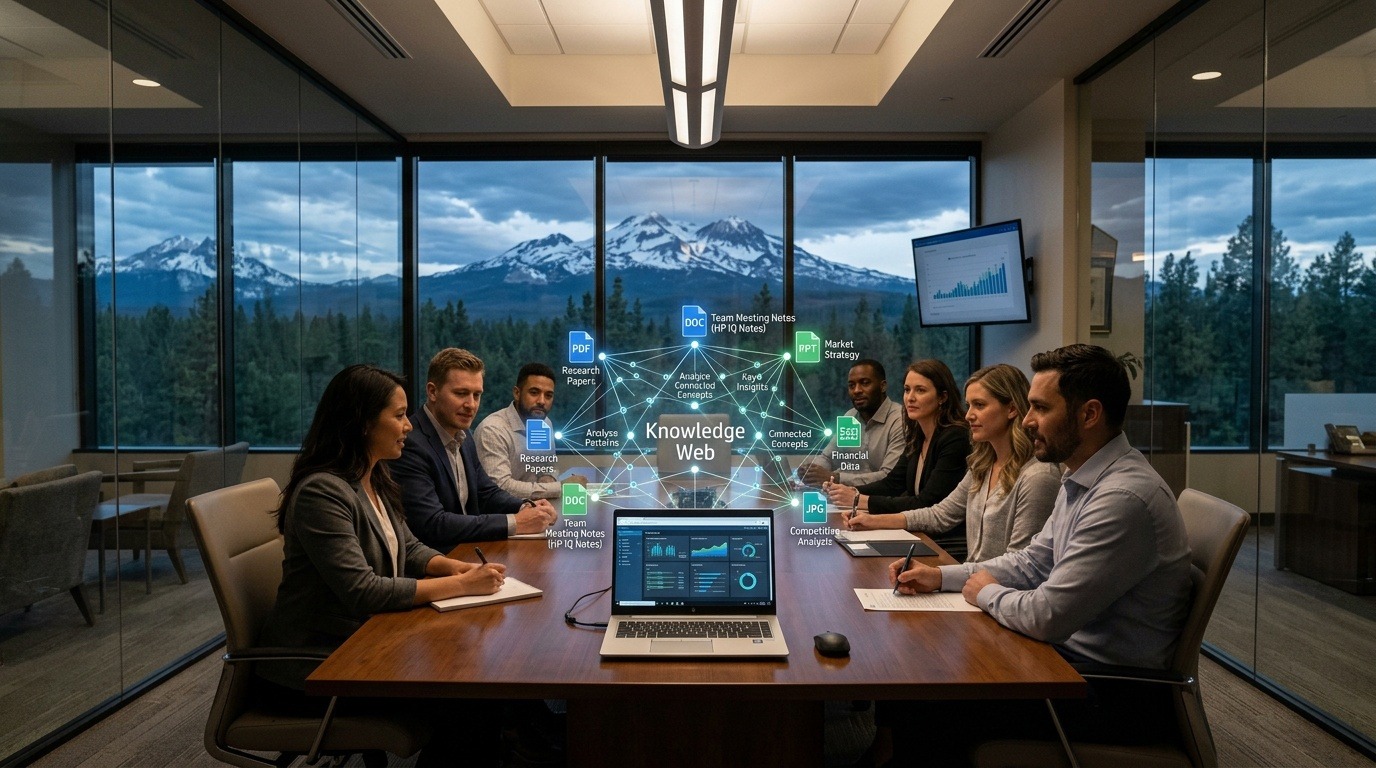
The history of the PC is littered with “revolutionary” features that ended up being little more than expensive paperweights. We’ve seen it with 3D screens, we’ve seen it with dedicated social media buttons, and lately, we’ve been seeing it with the initial wave of AI PCs. For the last year, the industry has been screaming about NPU TOPS and dedicated Copilot keys, yet the average buyer is looking at these machines and asking one simple question: “What does this actually do for me?”
Microsoft’s execution of the Copilot+ PC launch was, to put it mildly, problematic. Between the privacy nightmare of Windows Recall and the artistic curiosities of Cocreator—which few corporate accountants or engineers actually need—the AI PC has felt like a solution in search of a problem.
That changes today. With the introduction of HP IQ, HP isn’t just following a trend; they are correcting a market failure. By bringing local, on-device intelligence to the HP EliteBook 6 G2q, HP is finally giving us a reason to care about the NPU.
The Problematic Pedigree of the AI PC
When the first AI PCs arrived, the marketing was heavy on “magic” and light on “workflow.” Microsoft pushed features that felt like consumer novelties. Recall was designed to remember everything you did, but it was so poorly handled from a security standpoint that it became a PR liability. Then there was Cocreator, which is fun for turning doodles into masterpieces but does very little to help you get through a strategy briefing.
Purchasers have struggled to justify the premium price of these units. If AI capabilities require a constant, high-bandwidth connection to the cloud—costing the company a fortune in subscription fees—then the ROI isn’t there. Furthermore, the latency involved in sending data to a remote LLM negates the “instant” feeling we expect from a premium workstation.
Worse yet is the “disconnected” problem. The moment an executive steps onto a plane or into a secure facility without Wi-Fi, their “AI PC” reverts to being a regular laptop. The intelligence stays in the cloud.
HP IQ: Intelligence Where the Work Happens
HP IQ is a direct response to this execution gap. Instead of relying on a distant server, HP IQ brings intelligence to the edge—right where work happens. It leverages the HP Workforce Experience Platform (WXP) to integrate AI into the actual fabric of the enterprise. This isn’t about generating cat pictures; it’s about managing the cognitive load of the modern professional.
The brilliance of HP IQ lies in its locality. Because it runs on-device using a 20-billion-parameter local model, it addresses the three biggest hurdles to AI adoption: Privacy, Cost, and Connectivity. When your data stays on the EliteBook 6 G2q, you aren’t paying for cloud tokens, and you aren’t leaking trade secrets to a third-party training set.
Breaking Down the IQ Feature Set
To understand why this is the “True AI PC” we’ve been waiting for, we have to look at the specific tools HP is debuting. These aren’t toys; they are productivity multipliers accessed via the new Visor interface.
- Ask IQ: Responds to text and voice inputs, surfacing contextual answers and guidance based on your local environment.
- Analyze: Helps employees interact with personal files (including PDF, TXT, DOC, PPT) to get summaries and actionable insights without cloud round-trips.
- Notes & Knowledge: Keeps a running record of interactions so employees can pick up where they left off, organizing notes for easier searching and sharing.
- Meeting Agent: Quickly captures ideas or records notes during a meeting without forcing app switching, helping participants stay focused.
The Hardware: HP EliteBook 6 G2q Specifications
The hardware is no longer the bottleneck. The HP EliteBook 6 G2q is being positioned as perhaps the most powerful true AI PC ever created. HP didn’t just add a sticker; they built a platform capable of sustaining advanced, agentic AI workloads locally.
Key Technical Specs:
- Processor: Snapdragon® X2 Elite or X2 Plus.
- AI Performance: Up to 85 TOPS (NPU only), nearly double the initial Copilot+ standard.
- Battery Life: An industry-leading 28 hours of runtime.
- Connectivity: HP Go 5G with automatic carrier switching and Wi-Fi 7.
- Memory/Storage: Configurable with up to 64 GB LPDDR5X-9600 RAM and 2 TB PCIe Gen 5 storage.
- Security: HP TPM Guard, the world’s first hardware link between the TPM and CPU to stop physical BitLocker bypass.
For the enterprise, the management of these devices is just as critical as the performance. HP IQ can be configured through the HP Workforce Experience Platform (WXP) and deployed through standard tools like Microsoft Intune. This ensures IT managers can secure and update their AI fleet within the existing HP Wolf Security ecosystem.
Why Local AI Wins the ROI Argument
The hidden cost of the AI revolution is the “Cloud Tax.” Every time an employee queries a cloud-based LLM, there is a micro-cost. Scaled across 10,000 employees, those pennies become a significant line item. By moving the heavy lifting to the local NPU, HP IQ effectively eliminates those variable query costs for core productivity tasks.
Furthermore, there is the “Energy Tax.” On-device AI is significantly more power-efficient for routine tasks than spinning up a massive GPU cluster in a data center. This results in better battery life and a smaller carbon footprint for the corporation—a win-win that fits perfectly into modern ESG goals.
The Future of the Disconnected Worker
We often forget that “Mobile” often means “unreliable internet.” Whether it’s spotty hotel Wi-Fi or a secure government facility, the cloud is not always accessible. HP IQ ensures that the “AI” part of the PC doesn’t disappear when the signal does.
The ability to analyze a confidential strategy deck or summarize a meeting transcript while totally disconnected is a massive competitive advantage. It turns dead time—like long-haul flights—into high-value work windows. This is where the EliteBook 6 G2q will likely become the preferred tool for the “power traveler” and the security-conscious executive.
Wrapping Up
The AI PC is currently in its “awkward teenager” phase—lots of potential, but not quite sure what to do with its hands. Microsoft gave us the vision, but HP is providing the execution.
By focusing on local, on-device intelligence that addresses real-world pain points like document analysis and meeting focus, HP IQ moves the conversation away from “What is an NPU?” to “How much time did I save today?” The HP EliteBook 6 G2q, coupled with the HP Workforce Experience Platform, represents the first real maturing of the AI PC category. For the first time, we have an AI PC that doesn’t just remember what you did, but actually helps you do what comes next.
- The Silicon Fortress: Why HP’s Quantum-Resistant LaserJet Pivot is the Canary in the Cyber Coal Mine - April 15, 2026
- The Sleeping Giant Wakes: Why AMD’s MLPerf Breakthrough Signals the Beginning of the End for NVIDIA’s AI Monopoly - April 6, 2026
- HP IQ: Finally, an AI PC That Actually Does Something Useful for the Enterprise - April 3, 2026
Facts Only
HP introduced HP IQ, an on-device AI platform for the HP EliteBook 6 G2q.
HP IQ uses a 20-billion-parameter local model to perform AI tasks without cloud dependency.
The platform includes features like Ask IQ, Analyze, Notes & Knowledge, and Meeting Agent.
The HP EliteBook 6 G2q is powered by Snapdragon X2 Elite or X2 Plus processors.
The device offers up to 85 TOPS NPU performance, nearly double the initial Copilot+ standard.
Battery life is rated at 28 hours, with 5G and Wi-Fi 7 connectivity.
Memory and storage options include up to 64 GB LPDDR5X-9600 RAM and 2 TB PCIe Gen 5 storage.
Security features include HP TPM Guard, a hardware link between TPM and CPU.
HP IQ can be managed through HP Workforce Experience Platform (WXP) and Microsoft Intune.
The system aims to reduce cloud-based AI costs and improve privacy by processing data locally.
The EliteBook 6 G2q is designed for enterprise use, including secure and offline environments.
Previous AI PC features like Windows Recall and Cocreator faced criticism for limited utility and privacy concerns.
Executive Summary
Full Take
The narrative around HP’s AI PC pivot is compelling because it directly addresses the shortcomings of earlier cloud-dependent AI implementations. The strongest version of this argument is that local AI solves real enterprise pain points—privacy, cost, and connectivity—while avoiding the pitfalls of cloud-based solutions. HP IQ’s focus on productivity tools like document analysis and meeting assistance aligns with tangible workflow needs, unlike Microsoft’s more gimmicky features. This shift reflects a broader pattern in tech where initial hype around AI often outpaces practical utility, only to be corrected by more grounded applications.
However, the article’s framing leans heavily on contrasting HP’s approach with Microsoft’s failures, which could be seen as a strawman to elevate HP’s solution. The emphasis on "true AI PC" implies that previous attempts were inauthentic, which may oversimplify the complexities of AI integration. Additionally, the claim that HP IQ eliminates cloud costs entirely assumes that all AI tasks can be handled locally, which may not hold for more complex or large-scale applications.
The root cause of this narrative is the tension between innovation and practicality in tech adoption. Early AI PCs were marketed as revolutionary but lacked clear use cases, leading to skepticism. HP’s approach reframes AI as a productivity tool rather than a novelty, which could resonate with enterprises tired of unfulfilled promises. The implications for human agency are significant: if local AI reduces dependency on cloud services, it could democratize access to AI tools while mitigating privacy risks. However, the success of this model hinges on whether businesses see enough value to justify the premium hardware costs.
Bridge questions: How will HP demonstrate measurable ROI for enterprises adopting HP IQ? What trade-offs exist between local AI capabilities and the scalability of cloud-based solutions? Could this shift toward local AI lead to fragmentation in AI standards and compatibility?
Counterstrike scan: If this were part of an influence campaign, the playbook would involve positioning HP as the pragmatic alternative to Microsoft’s flawed AI vision, leveraging enterprise frustrations with cloud dependency. The actual content aligns with this strategy but stops short of outright disparagement, focusing instead on technical merits. No overt manipulation patterns are detected, though the framing does favor HP’s narrative.
Patterns detected: none
Sentinel — Human
This text presents a highly structured, persuasive analysis grounded in specific technical claims, characteristic of expert human journalism focusing on enterprise technology strategy.