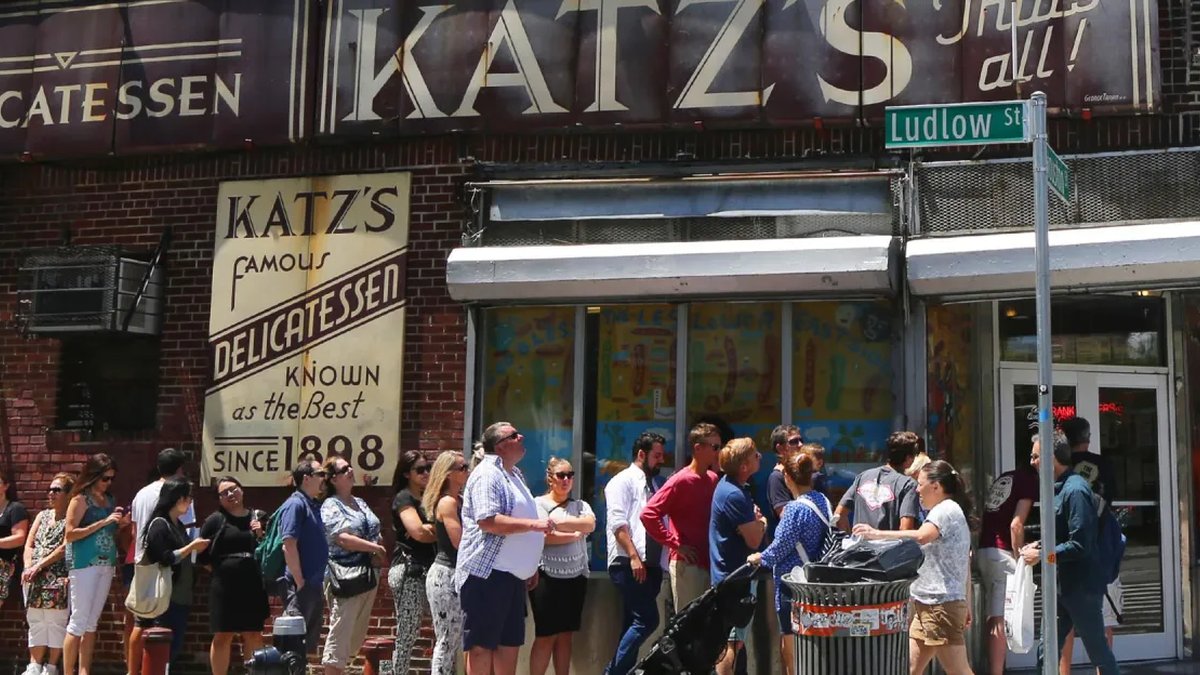
How long would you wait in line for dessert? For food lovers craving this summer’s TikTok-viral dot cakes, the lines in front of Manhattan’s Butterfield Market have been forming as early as 6 a.m. and lasting for hours. This phenomenon is nothing new to NYC, or any other city home to a viral food moment; Broad City poked fun at internet-viral food trends with its fictional “churron” churro-macaron hybrid (remember when Babish actually brought it to life?) and Saturday Night Live parodied the act of waiting in a big dumb line as a painstaking, inevitable human experience.
The Latest Gig Economy Hustle? Restaurant Line-Sitting
From coast to coast, folks are getting paid to wait in line for hours on end to secure dot cakes or Lucali pizza
That was before the business of line sitting also blew up on social media.
“Line sitting” (or “line waiting” and “line standing”) is exactly what it sounds like: the act of being paid to wait in line for someone else’s Broadway tickets, sample sale access, churron, or table at a popular restaurant. According to full-time, professional NYC line waiter Robert Samuel, there’s been more public interest than ever in the unique job. “It’s always been a thing,” Samuel told Eater by phone shortly after wrapping up a line waiting gig, “but I think social media makes it bigger than it used to be. That’s why there’s more people out there doing it. I blame TikTok more than any other platform.”
Samuel was born and raised in Brooklyn, and established his line waiting business Same Ole Line Dudes after clocking the line-spawning demand for coveted products (the iPhone sparked the first line wait venture for Samuel) and experiences. Now, it’s been nearly 15 years, and his business shows no signs of slowing down. “We currently have about 35 [line waiters] on average that take requests throughout the city,” he says, “and sometimes even beyond, for anything that requires a wait.”
In his business’s early years, he says Cronuts were the big ticket item. “We had a client who wanted to impress these business people visiting from Japan. They wanted to close a deal with something they’d never seen before, and I guess that was Cronuts. They sent six of our [line sitters] to get a dozen, because you can only buy so many per person at a time.”
Same Ole Line Dudes charges $25 per hour with a two-hour minimum, and rates can also increase for rush fees (between $15 and $25), holiday rates, inclement weather, and the occasional overnight wait for, say, the croissant cereal from L’Appartement 4F. Samuel says that there’s also been a significant uptick in the “freelance” line standers from sites such as TaskRabbit or Craigslist, and emphasizes that this might not necessarily occur because lines are getting longer (although it also feels that way sometimes), but rather, because social media is bringing both more visibility — and thus, virality — to a larger audience. Recently, a new website went viral for paying people who live by popular restaurants to put up cameras in their windows and livestream lines at hot spots like Golden Diner and L’Industrie in NYC. Waiting-in-line culture is so omnipresent that Los Angeles influencers are making dining guides exclusively and specifically for places with long lines (inversely, there’s also a TikTok account focused on NYC restaurants with no lines).
On TaskRabbit, a website that connects individuals with freelance “Taskers” who are available to complete tasks like repairing a faucet, delivering furniture, or waiting in line, the going rate for line sitters is listed as “between $28 and $90” per hour nationally. The largest number of line-sitting taskers is in New York City (over 4,900); a search in other major cities such as Los Angeles, San Francisco, and Chicago yielded a couple hundred Taskers per city who marked themselves as either practiced line sitters or folks willing to perform the duty. The reviews for the more experienced sitters reveal a common thread of what the people hiring them are looking for: good communication, timeliness, and the trust that they will handle your dot cake (if need be) with care.
Los Angeles-based line sitter Korem A. has completed over 84 line waiting tasks on TaskRabbit, including waits for restaurants and pop-ups. “I’ll wait for you like I would for myself,” she writes, “with care and responsibility”; Ahmed H. is a Tasker in San Francisco who, per his bio, has only completed one line-waiting task so far — but he’s also able to commit to more line-waiting tasks within a short two-hour notice. “I am patient, reliable, and always on time,” his profile reads, “I understand that waiting in line can take time and attention.” These taskers have a potential upper hand against a business like Same Ole Line Dudes, which Samuel says generally asks for a few days’ notice. “We can always talk about rush prices, but people also have to understand that we can’t just drop everything to get them that Greek yogurt. We’re also delivering with a [degree] of professionalism, because we’ve been around for a long time.”
The dot cakes are the hot item right now in NYC. “We had a customer who wanted two [dot cakes] of every flavor,” Samuel says, “so she hired five line sitters.” At $11 per dot cake and $50 (minimum) per line sitter, that’s a significant markup. For food items that might be subject to melt, Samuel’s sitters make a point to notify the client of the ideal time that they should swing by the location to pick up their treats, “although if they want us to bring it to them,” he laughs, “we will deliver it in its altered state.”
Top restaurant requests for Same Ole Line Dudes include Italian and pizza places like Via Carota, Lucali, and Emilio’s Ballato, but Samuel says that not every restaurant is welcoming of his line sitters. “I don’t want to name any names,” he tells Eater, “but there is a very in-demand steakhouse in the West Village that has been giving us pushback.” It feels like an odd move to Samuel, who sees it as no different from “someone sending their secretary to go put a name down” or “a mom sending her younger, more able-bodied son to put a name down for them for later.” A Lucali staff member told Eater that they now experience a steady mixture of [Same Ole Line Dudes] and line sitters from Craigslist or TaskRabbit.
When asked about this new influx of line sitters, Samuel doesn’t seem too concerned. However, he does think the advent of delivery platforms diminished his business somewhat over the years. “We used to have a return customer who lived in Harlem, but wanted Adel’s Famous Halal from 6th Avenue, which obviously wasn’t the kind of place you [call in to order]. He scheduled with us every week, until one day he stopped. I wonder if that’s because it’s on Uber Eats.” Even so, Samuel says business always finds a way of picking up. “This is New York, so there’s always something else that pops up in its place.”
The only downside to Samuel’s lucrative idea is that it has rendered non-monetized line waiting — not professionally, but in life — really annoying. “It’s like asking a doctor to do a surgery for free,” he laughs, “This is my profession. If I’m waiting in a line, I’m getting paid.”
Facts Only
* Lines for dot cakes at Manhattan's Butterfield Market have formed as early as 6 a.m.
* "Line sitting" is defined as being paid to wait for access to items or services.
* Robert Samuel runs the business Same Ole Line Dudes.
* Same Ole Line Dudes charges $25 per hour with a two-hour minimum, plus rush fees.
* The business has seen demand for items like Cronuts in the past.
* Line sitting tasks are also found on platforms like TaskRabbit and Craigslist, with rates between $28 and $90 per hour nationally.
* New line-sitting websites emerged for livestreaming waits at restaurants.
* Taskers hired for line waiting prioritize good communication and timeliness.
* Same Ole Line Dudes handles orders for Italian and pizza places, though some establishments have pushed back.
* The business was impacted by the advent of delivery platforms for some customers.
Executive Summary
Full Take
Sentinel — Human
The text reads like a journalistic piece utilizing personal interviews and localized examples to explore a specific economic trend, characteristic of human investigative reporting.