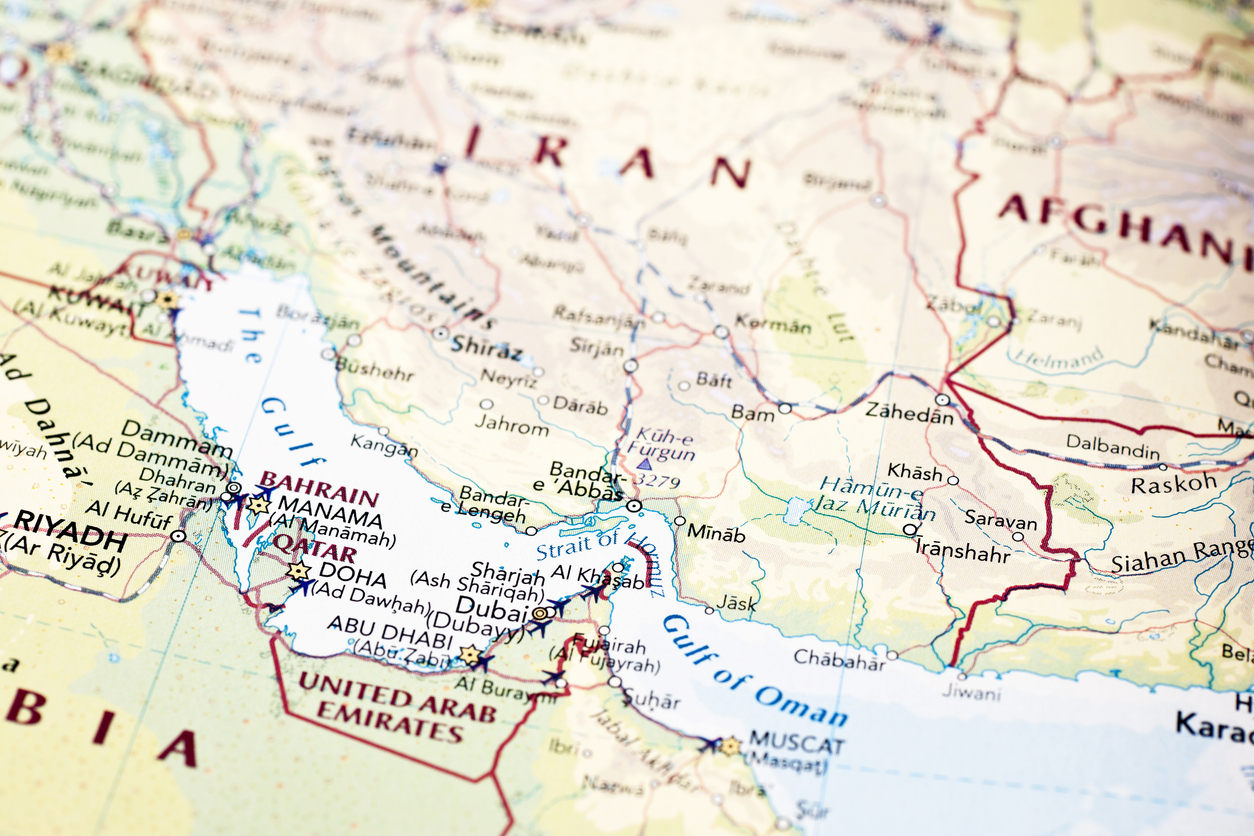
Following US-Israeli strikes against Iran, Tehran has threatened to attack any vessel that passes through the Strait of Hormuz. Though no formal blockade is in place, the warning has effectively shut down one of the world’s busiest energy shipping lanes.
This disruption adds to existing security pressures on key maritime corridors in the region, including cargo routes through the Red Sea and the Suez Canal, where Houthi attacks have forced many operators to reroute and driven up insurance and freight costs.
Beyond the immediate economic fallout, however, Iran’s de facto blockade highlights a broader strategic challenge: it shows how a single country can hold critical shipping lanes hostage and exert geopolitical pressure at relatively low cost.
Tehran’s chokehold on global trade
Iran has long understood its unique geographical position and the critical importance of maritime trade. Over several decades, the Iranian government and industry have utilized aspects of the maritime sector to protect economic security and circumvent sanctions. This includes the longstanding use of shadow fleets, the manipulation of Automatic Identification Systems (AIS) data, and a general disregard for established maritime law and regulations.
Now, Iran is turning its geographic advantage into a lever for global economic pressure. Following the Iranian threat against vessels in the Strait of Hormuz, major shipping companies—including Maersk, Hapag-Lloyd, and CMA CGM—have halted their routes through the strait. Last week, this was further compounded by Maersk’s decision to completely suspend its FM1 service, connecting the Far East to the Middle East, and its ME11 service, which runs from Europe to India via the Suez Canal and the Red Sea. The ME11 had only recently been relaunched and was advertised as significantly reducing transit times.
Iran is now utilizing its de facto control over shipping lanes and its years of experience in evading sanctions through maritime trade to escalate the conflict into a potential global economic turning point.
Insurance is technically available for vessels in the area, but likely prohibitively expensive even for firms willing to take the risk. As a result, vessels are weighing anchor in regional ports, hoping to avoid the worst.
The most immediate impact is on energy pricing, as Middle Eastern oil and gas can no longer be safely transported via these routes. Waiting in port may allow operators time to reassess the situation, but given the scale of the conflict, it could still leave vessels vulnerable.
Oil tankers aren’t the only vessels in the area, however. Many operators utilize this route for Asia-Europe trade, providing additional port calls and refueling opportunities.
Energy prices are just the tip of the iceberg
From a maritime perspective, solutions are few and far between. Vessels caught on either side of the Strait of Hormuz when the conflict began are now waiting in nearby ports for safe passage.
Vessel routes are determined far in advance—often several months ahead—making it difficult to redirect and find suitable berths to either unload or wait out the conflict, further compounding logistical pressures. Ports are now congested as vessels overstay their scheduled berth bookings, while additional ships weigh anchor, hoping for a swift resolution and reopening of the strait.
Safety remains a major concern for vessels—not just due to missiles or drones, but also due to GPS jamming, which disrupts navigation systems. Though the source of the jamming remains uncertain, the impacts are direct, with vessels unable to accurately broadcast their location. Combined with ships intentionally “going dark” by turning off AIS, it is increasingly difficult for vessels to track each other.
This creates risks not only for vessels in transit but for all ships operating in the area. The large vessels utilized for transport in the Middle East cannot quickly change direction. Being unable to accurately locate other ships dramatically increases the risk of collision—and considering many vessels in the area transport petroleum or chemical products, an accident could trigger a major ecological disaster.
Redirection creates additional challenges
As other routes are utilized, there will be longer delivery delays and higher costs for transport and insurance.
The “solution” for many shipping firms has been to redirect vessels around the Cape of Good Hope. This adds not only additional transit times but also higher fuel costs due to longer periods at sea and more challenging weather and sea conditions.
Depending on how long the conflict lasts, additional bookings will create a crunch. Vessel numbers and capacity are limited, and many capable ships are already committed months in advance. Redirecting ships already en route will take time, energy, and money.
The closure of Middle Eastern shipping routes has a particularly acute impact on Europe, as these corridors serve many of the continent’s major ports. The already high costs of detours and delays are compounded by the fact that the European Union has been working to lower maritime emissions by including them in its Emissions Trading System, adding another layer of cost.
Longer detours around the region further drive up transport expenses, and even a swift end to the conflict would offer little relief. These costs are already baked in, with the ripple effects of rerouted shipping, repriced services, and recalculated insurance premiums well underway.
A playbook for creating economic havoc
The larger issue this raises is the continued demonstration of how a single country can shut down critical shipping routes traversing its territory.
Despite severe bombardment and decades of sanctions that have crippled its economy, Iran can effectively hold the Strait of Hormuz hostage. Maritime traffic has virtually halted without the need for an intensive naval presence or significant additional military expenditure.
The Strait of Hormuz is only one of several major shipping line chokepoints. Similar congestion points exist naturally, such as the Strait of Malacca, while others—like the Panama Canal and the Suez Canal—are major feats of engineering.
With over 80 percent of the world’s trade conducted via ship, halting even one of these routes for a short period can create economic shocks—and a prolonged closure could easily trigger sustained global disorder at best, and a major crisis at worst.
Iran is demonstrating that mass-produced drones, limited firepower, and credible threats may be enough for any country positioned along a critical maritime chokepoint to shut down major shipping lanes. The consequences could be far more severe if such leverage were wielded by a nation with a stable economy or a state-of-the-art navy.
The ability to hold and maintain control of shipping lanes creates immense economic pressure with few practical countermeasures, quickly turning global trade into a geopolitical hostage situation, not just for those directly involved in the conflict, but for the global economy at large.
The damage has already been done
This disruption comes at the same time that European countries face increased energy costs due to the ongoing Russian invasion of Ukraine. The United Kingdom, for instance, is expected to see a sharp increase in inflation figures, which will be further exacerbated as energy prices rise. Alongside increasing oil prices, the cost of transporting goods via ship will also increase.
From the operating side, how vessel owners and operators act in the coming weeks will be telling. In the immediate term, vessels could increasingly “go dark” and attempt to maneuver their way around the conflict. This has been done before but is a risky approach, considering it obscures visibility not only for hostile actors but also for other vessels in a high-traffic area.
If the conflict drags on, vessel flagging could become more important. Vessels have been using Chinese designations, for instance, to dodge Houthi attacks in the Red Sea. It is possible this will become necessary for traversing the Strait of Hormuz as well. However, changing flags also comes with its own complications: it alters the regulatory and legal regime for the vessel, as well as the flagging countries’ protection obligations.
Regardless of how long the Iran war lasts, the economic damage has already been done. Oil prices continue to push above $100 per barrel, vessels remain stranded, and shipping costs remain high. Iran has shown how easily a strategically positioned country can create global economic shocks. The geopolitical genie is out of the bottle: by capitalizing on geography to disrupt global trade, countries can strengthen their strategic position at relatively low cost.
Alex Mills is an international trade expert specializing in financial services, maritime law, and ESG. They have a decade of experience across the private and public sector, including in UK and US government.
Facts Only
Iran has threatened to attack any vessel passing through the Strait of Hormuz following US-Israeli strikes.
Major shipping companies, including Maersk, Hapag-Lloyd, and CMA CGM, have halted routes through the Strait of Hormuz.
Maersk has suspended its FM1 service (Far East to Middle East) and ME11 service (Europe to India via Suez Canal and Red Sea).
Insurance for vessels in the area is available but prohibitively expensive.
Vessels are waiting in regional ports to avoid the conflict.
Oil tankers and Asia-Europe trade routes are affected, disrupting energy and goods transportation.
GPS jamming and vessels "going dark" by turning off AIS have increased navigation risks.
Shipping firms are redirecting vessels around the Cape of Good Hope, adding transit time and fuel costs.
Ports are congested due to vessels overstaying berth bookings or waiting for safe passage.
Oil prices have risen above $100 per barrel due to the disruption.
The European Union’s inclusion of maritime emissions in its Emissions Trading System adds further cost pressures.
Iran has previously used shadow fleets and manipulated AIS data to evade sanctions.
Executive Summary
Iran has threatened to attack any vessel passing through the Strait of Hormuz following US-Israeli strikes, effectively disrupting one of the world’s busiest energy shipping lanes. Major shipping companies, including Maersk, Hapag-Lloyd, and CMA CGM, have halted routes through the strait, compounding existing pressures on maritime corridors like the Red Sea and Suez Canal, where Houthi attacks have already driven up costs. The immediate economic impact includes rising energy prices, as Middle Eastern oil and gas can no longer be safely transported, and increased shipping expenses due to rerouting around the Cape of Good Hope. Beyond the immediate fallout, Iran’s actions demonstrate how a single country can leverage geographic chokepoints to exert global economic pressure with minimal military expenditure. The broader implications highlight vulnerabilities in global trade, where critical shipping lanes can be held hostage, creating cascading disruptions in supply chains, insurance costs, and energy markets. The situation underscores the fragility of maritime trade and the potential for geopolitical conflicts to trigger widespread economic instability.
The conflict has also exposed logistical challenges, including port congestion, GPS jamming disrupting navigation, and the risks of vessels "going dark" to evade threats. While some operators may attempt to change vessel flagging to avoid attacks, such measures come with regulatory and legal complications. The economic damage is already evident, with oil prices surpassing $100 per barrel and shipping costs rising. Iran’s strategy capitalizes on its geographic advantage, showing how low-cost threats can create outsized global economic shocks. The long-term consequences depend on the conflict’s duration, but the immediate effects—higher costs, delayed deliveries, and strained supply chains—are already being felt worldwide.
Full Take
The strongest version of this narrative highlights Iran’s strategic leverage over global trade by exploiting geographic chokepoints, demonstrating how a single actor can disrupt critical shipping lanes with minimal military effort. The analysis credibly outlines the immediate economic fallout—rising energy prices, rerouted shipping, and port congestion—while also framing the broader vulnerability of global supply chains to geopolitical manipulation. It effectively illustrates the cascading effects of such disruptions, from insurance costs to ecological risks, without overstating the case.
However, the narrative leans into a pattern of **catastrophizing** (ARC-0012), emphasizing the potential for "sustained global disorder" and "major crisis" without sufficient counterbalancing perspectives on resilience or adaptive measures in global trade. While the risks are real, the framing risks amplifying fear without exploring mitigating factors, such as alternative routes, diplomatic interventions, or historical precedents where similar disruptions were managed. Additionally, the focus on Iran’s "low-cost" strategy could inadvertently **sanewash** (ARC-0031) the complexity of its military and economic capabilities, downplaying the internal pressures Tehran faces from sanctions and domestic instability.
The root cause here is the intersection of geopolitical conflict and the fragility of globalization’s just-in-time logistics. The assumption that critical chokepoints are inherently vulnerable—while true—ignores the adaptive capacity of markets and alliances. Historically, such disruptions (e.g., the 1973 oil crisis, Suez Canal closures) have spurred innovation in energy independence and route diversification. Yet the narrative echoes a broader pattern of **geopolitical fatalism** (ARC-0047), where the actions of a single state are framed as inevitably destabilizing, without sufficient agency granted to countervailing forces.
The implications for human agency are significant: while consumers and businesses bear the costs of higher prices and delays, the analysis doesn’t explore how collective action—such as coordinated naval escorts, multilateral sanctions, or energy policy shifts—could mitigate these risks. The beneficiaries of this narrative are those advocating for energy independence or military deterrence, while the costs fall disproportionately on global South economies reliant on affordable shipping.
Bridge questions: How might historical examples of chokepoint disruptions inform today’s response? What role could diplomatic or economic coalitions play in de-escalating maritime threats? Would a shift toward regionalized supply chains reduce vulnerability to such geopolitical leverage?
Counterstrike scan: A coordinated influence campaign would amplify the narrative of inevitable chaos, using emotional triggers (e.g., "global economic havoc") to justify preemptive military action or protectionist policies. The actual content aligns partially with this pattern by emphasizing vulnerability but stops short of prescribing specific policy responses, instead focusing on descriptive analysis. No overt manipulation detected.
Sentinel — Human
The article shows strong signs of human authorship, with domain expertise, stylistic idiosyncrasies, and specific attributions. Minimal stylometric or coherence red flags suggest low synthetic risk.