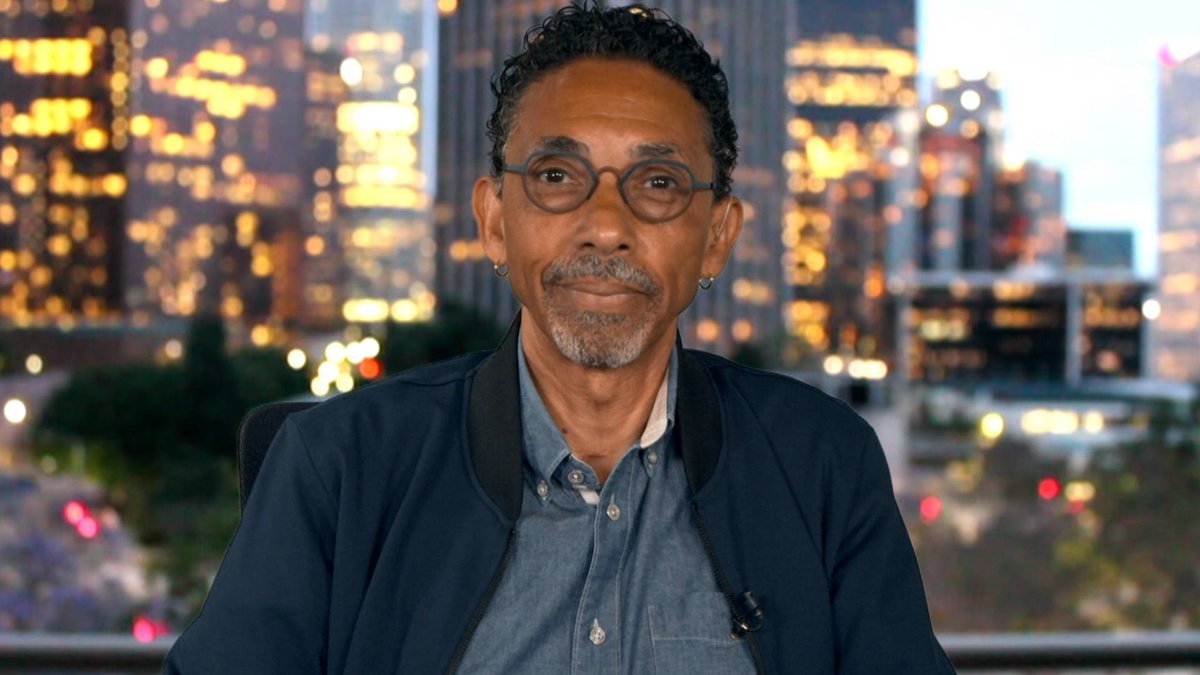
Ahead of the July Fourth holiday and the 250th anniversary of the Declaration of Independence, we speak with the acclaimed scholar Robin D. G. Kelley, who examines how Black radicals have interpreted the document throughout U.S. history in a new essay for Hammer & Hope. Although the declaration famously asserts that “all men are created equal,” Kelley says that clearly did not extend to Indigenous or enslaved Black people. “When the drafters developed this declaration, they assumed that human beings were basically white men,” he says. But despite the “hypocrisy” of the declaration, many Black radicals still found value in its words, including a “justification for rebellion,” says Kelley.
Transcript
AMY GOODMAN: This is Democracy Now!, democracynow.org. I’m Amy Goodman, with Nermeen Shaikh.
NERMEEN SHAIKH: As we head into the July Fourth weekend marking the 250th anniversary of the founding of the United States, we turn now to the relationship between Black radicals and one of the nation’s most important founding documents, the Declaration of Independence.
UCLA historian Robin D. G. Kelley’s new essay in Hammer & Hope is titled “'Do You Understand Your Own Language?': Black radicals read the Declaration of Independence.” It begins with Kelley writing that every so-called Independence Day, he makes his kids listen to passages from Frederick Douglass’s famous speech, “What to the Slave Is the Fourth of July?”
AMY GOODMAN: And you can hear that speech tomorrow on Democracy Now!, read by the late great James Earl Jones.
But born into slavery around 1818, Frederick Douglass became a key leader of the abolitionist movement. On July 5th, 1852, in Rochester, New York, he gave one of his most famous speeches addressing the Rochester Ladies’ Anti-Slavery Sewing Society. I want to play a brief excerpt of that reading, read by James Earl Jones at a performance of Voices of a People’s History of the United States, based on the late Howard Zinn’s iconic book.
FREDERICK DOUGLASS: [read by James Earl Jones] What, to the American slave, is your Fourth of July? I answer: a day that reveals to him, more than all other days of the year, the gross injustice and cruelty to which he is a constant victim. To him, your celebration is a sham.
AMY GOODMAN: And you can hear that full speech tomorrow, read by James Earl Jones, here on Democracy Now!
For more on the significance of this speech, we’re joined in Los Angeles by Robin D. G. Kelley, professor of U.S. history at UCLA, author of many books, including Freedom Dreams: The Black Radical Imagination.
Professor Kelley, welcome back to Democracy Now! Why you had your children read this speech every year, and what does it mean to talk about why you say Black radicals read the Declaration of Independence?
ROBIN D. G. KELLEY: Right. Well, first of all, thanks for having me. Yeah, sometimes I make them listen to James Earl Jones’s version when I listen to Democracy Now! I never miss it.
Yeah, it’s interesting, because, on one hand, that speech is very important as a critique of the contradictions between a declaration that’s claiming that all men are created equal, that’s built on this Enlightenment ideology of kind of mass equality, on the one hand, but, on the other hand, that’s not the history of the United States. And so — and I don’t make them listen to all of it, but I think the part where Douglass goes on to talk about this being a sham, you know, mere bombast, is significant.
I also have them — or, I read to them David Walker’s Appeal, where, you know, the title of my piece comes from David Walker’s Appeal to the Colored Citizens of the World, published in 1829, where he basically says, “Look, your declaration is hypocrisy,” essentially. But then he also warns white readers. He says, “Look, the part of the declaration you need to be careful about is the right of people to basically overthrow their government. And what we’re seeing in the United States is a corrupt government built on slavery, and I guarantee you that these enslaved people, and others who support them, will overthrow this government.” And, of course, it kind of came to pass in the form of the Civil War, the kind of insurrection that he imagined, right?
NERMEEN SHAIKH: Professor Robin Kelley, if you could also talk about the fact that Douglass, despite his criticism of the declaration, as you point out in your piece, remained a staunch defender of the U.S. Constitution, calling it, quote, “a glorious liberty document” opposed to slavery? If you can explain why that’s the case, and your sense of the differences, if any, between the declaration and the Constitution on the question of slavery?
ROBIN D. G. KELLEY: Right. Well, abolitionists were divided over the Constitution. People like William Lloyd Garrison took a position that the Constitution was inherently anti-slavery. And a case can be made — I think a strong case can be made that — well, I’m sorry, that Garrison was saying the Constitution was pro-slavery. But a case can be made that it is pro-slavery when you look at the use of the assumption that there are some people who are held in service, held in bondage — right? — in that so much of even the organization of Congress was based on this idea of counting three out of five enslaved people, though they don’t have any rights — right? — for the purposes of representation.
The Declaration of Independence is a little bit different in that it is not a constitution. It’s not law, per se. But it does make these claims that go beyond the drafters. When the drafters developed this declaration, they assumed that human beings were basically white men. They imagined an independent nation that’s basically a kind of herrenvolk republic — that is, a white republic. There was no assumption that other people, either Native people, Black people, would participate in that republic. There might be some exceptions, of course. And so, the declaration, the language goes beyond its intention.
And for a lot of Black people, both enslaved and free Black people during the American Revolution, they saw the declaration as doing multiple things. It wasn’t about American nationalism. It wasn’t about American independence. What it was about was a referendum on the definition of the human. It was also a justification for rebellion, right? And then, the third thing is that they saw it as a kind of lever to argue against the conceits of liberty — that is to say, that the claims that, you know, all people have a right to liberty, no matter who it was intended for, they could use that language against their slave owners, against those who ruled the colonies, and against those who ruled the new republic. And so, in some ways, they were making a case that their claims of freedom were far more universal than the provincial claims of the colonists fighting for freedom against British colonial rule, you know.
And ultimately, the American Revolution was hardly an anti-colonial movement, because in many ways it was a struggle to take control of this empire, this expanding West. I think one of the most important parts of the — or, the argument for independence was a resistance to the British Proclamation of 1763 that said that colonists cannot move beyond the Appalachian Mountains. And in the end, they were pushing against British limitations on expansion. In other words, they wanted more empire for themselves. And in the end, what we get is a nation that is pro-slavery, ultimately, or divided on the question of slavery, in which the proceeds and benefits of American capitalism would generate or flow to the — to those who are settler colonial — settler colonists, as opposed to Britain or the crown.
AMY GOODMAN: Robin Kelley, I’m wondering if you could finally comment on the closure of, the ripping down of documents that talk about slavery. More than 80 years after the Declaration of Independence was signed, the abolitionist John Brown rewrote the declaration as an abolitionist document. Looking now at the Harpers Ferry museum that would honor him, that has a wall of remembrance to highlight hundreds of enslaved people, best known as the place where the raid on the town’s armory led to an uprising, that museum has not been opened. The monument that talks about George Washington having slaves on the Mall in Philadelphia was ripped down by the Trump administration. We have 20 seconds.
ROBIN D. G. KELLEY: Right. Well, in short, John Brown’s Declaration of Liberty was response to Roger Taney’s, Chief Justice Taney’s, decision on Dred Scott. And so, if we don’t recover that history, we’re going to basically not understand the way in which the 14th Amendment was a response to the denial of citizenship on the part of Black people. You know, so, yes —
AMY GOODMAN: Robin D. G. Kelley, we’re going to have to leave it there, but it is a very profound point, professor of U.S. history at UCLA. We’re going to link to your piece in Hammer & Hope, headlined “'Do You Understand Your Own Language?': Black radicals read the Declaration of Independence.” Professor Kelley is also author of Freedom Dreams: The Black Radical Imagination. I’m Amy Goodman, with Nermeen Shaikh. Thanks so much for joining us.
Media Options
Sentinel — Human
This text exhibits strong signs of human journalistic production, characterized by natural conversational rhythm and the integration of complex academic discussion into a dynamic interview format.