- A recent study created a machine-learning program that estimated the amount of carbon dioxide already stored, and sequestered annually, by rainforests in Central Africa’s Congo Basin, the planet’s largest forested carbon sink.
- They found that managed logging concessions, which remove a small number of large trees annually and strictly control other human activities, made up more than half of the net carbon removed by Congo Basin rainforests.
- The authors say these results suggest that expanding logging concessions could help the Congo Basin sequester more carbon while also providing locals with a source of income.
- Other experts, however, argue that addressing local conflicts that lead to illegal forest clearing would be a better way to benefit these forests.
The rainforests of the Congo Basin are the planet’s largest forested carbon sink: as these 3.3 million square kilometers (1.3 million square miles) of trees in Central Africa breathe in carbon dioxide from the atmosphere, they turn it into leaves and bark and branches, helping to mitigate the effects of climate change. Yet a recently published study quantifying this carbon storage presents a surprising suggestion: that the most effective way to trap even more carbon in Congo Basin rainforests may be to cut some of its trees down.
The study, published as an advance copy in April in Nature Communications, found that selectively managed logging areas make up about 57% of the net carbon removals in the Congo Basin. The authors suggest this shows these forests could provide benefits to both the planet and local communities if sustainable logging is permitted.
“The question is: is logging, or any other sustainable use of those forests, only bad for the environment?” said lead researcher Le Bienfaiteur Sagang, a tropical ecologist at the University of California, Los Angeles. “Can we use these forests, give them more value, provide jobs for the locals, and still provide a good contribution to the climate?”
Sagang and his co-authors decided to put this questions to test. They designed a machine-learning program that combined land-cover data, captured between 1990 and 2020 across the Congo Basin’s six forested countries, with aboveground carbon levels estimated from other studies via lidar, which creates complex 3D landscape scans using lasers.
The result is a map of the entire Congo Basin that estimates how much carbon is already stored, and how much carbon is sequestered away annually, in different areas.
One of the model’s biggest findings is that nearly all — 98.7% — of the carbon being removed annually from the atmosphere by Congo Basin forests is in areas with some kind of management, whether in protected areas (41.9%) or logging concessions (56.8%). And regardless of whether they were selectively logged or left untouched, old-growth forests stored far and away the most carbon, comprising nearly 84% of carbon removal.
In contrast, forests with no management emitted nearly as much carbon as they stored. Sagang said this is because these unmanaged areas lose trees to slash-and-burn land clearing for agriculture as well as illegal logging.
Sagang said he wasn’t entirely surprised to learn that logging concessions are effective at removing carbon from the atmosphere. When managed correctly, he said, these concessions allow very few trees (as little as one to two per hectare, or less than one per acre) to be removed annually; set minimum tree sizes for harvest; shut down an area for two decades or more after harvest; and are strict about closing down logging roads to prevent illegal access. Growing trees store much more carbon than mature trees, so the small amount of carbon lost when a tree is cut down is outweighed by the carbon stored when young trees spring up to fill the new gap in the canopy.
Yet Sagang said he was surprised by the scale of carbon storage in these managed areas, and just how much more they put away compared to unmanaged areas. It suggests these kinds of sustainable logging concessions are a win-win-win, he said: they bring in money locally, bolster carbon storage, and deter locals from cutting down trees in unmanaged areas by providing them with income.
“It kind of gives more legitimacy for the people in the region who are saying, ‘We don’t just want to content ourselves with free money from carbon projects,’ because the reality is that money almost never comes to the hands of the locals looking after those forests,” he said. “At the end of the day, the locals will come back to: ‘I have bills to pay.’ And the only way to access some source of income is to cut down that tree.”
Despite this potentially good news for carbon storage, there are also other, complicating factors that nations must consider in managing their forests. For one, this study only accounted for carbon sequestration, not long-term changes in plant or animal biodiversity in these forests, though Sagang noted that Gabon’s logging concessions have a high density of elephants and monkeys. (Other studies have found that even sustainable logging has long-term impacts on biodiversity.)
Additionally, experts stressed that it may be more beneficial to these forests if Congo Basin nations addressed current sources of deforestation. Josué Aruna, executive director of the Congo Basin Conservation Society (CBCS), expressed particular concern about deforestation in his home nation, the Democratic Republic of Congo (DRC), which holds 60% of Congo Basin forests.
In the DRC, according to Aruna, logging is often carried out by international companies, without cooperating with or compensating local communities. He added that when logging agreements are created between these companies and national governments, they can be influenced by corruption, with little traceability for extracted wood on the international market. Other forms of logging happen illegally, in cooperation with militia groups created by the protracted conflict in the eastern DRC.
“Linking logging to carbon could maybe be different in other countries, where we can do the replantation of trees and land-based engineering for carbon on the market,” Aruna said. “But I think there is no sustainable logging in our country because of that corruption.”
Instead, Aruna said, his group is focused on returning the management of these forests to local hands, and in particular promoting agroecology — the practice of growing food crops in harmony with the local environment.
“What we need is to support the sustainable management of local forest by local communities and Indigenous people, and by supporting that sustainable management, link it to conservation, not exploitation,” Aruna said.
Sarah Carter, a research associate at the World Resources Institute and part of the Global Forest Watch Overland Carbon Team, called the study both useful and timely, given the Congo Basin’s status as one of the last remaining forest carbon sinks: “This is our chance to see what’s going on there, make sure we understand it, and provide the right interventions,” she said.
Yet she agreed that WRI’s data show that regional conflicts, and the forced relocation of local peoples, is currently the biggest driver of forest loss in the area. “If you’re thinking of how to make sure these forests are storing carbon, then making sure they are managed for logging concession[s] isn’t really going to answer that story,” Carter said. “The thing you need to do is make sure that livelihoods are supported, and people are not displaced though conflict — it’s a different set of interventions needed to save the forest.”
Sagang pointed out that these issues can in fact be seen in the study results: though the DRC is the largest forested country in the Congo Basin, its contribution to the region’s net carbon sink is almost zero. This shows that the type of forest management greatly influences the outcome, he said, noting that the DRC has two to three times the rates of forest clearing and degradation as the other Congo Basin countries.
“Although in DRC logging activities will facilitate unmanaged human disturbances with the roads they will open, I will argue that this issue is more at the level of governments to implement and enforce stronger forest governance policies,” Sagang added in an email.
Sagang said his team’s ultimate goal with this work is to support local governments and communities and provide capacity building to Congo Basin nations. Indeed, he said they’ve already provided some of the technology they developed for this study to Gabon, to help develop a national forest monitoring platform there. This platform will monitor how logging and other forest uses are impacting the rainforest, allowing authorities to adjust forest management based on local realities. (Gabon’s former environment minister, Lee White, is a co-author of the study.)
“Our message is not to allocate all the forest for logging concessions,” Sagang said. Instead, he said, it’s about showing that good forest management can be more nuanced than “cut, or don’t cut.” “Our findings show it depends on how you use those forests.”
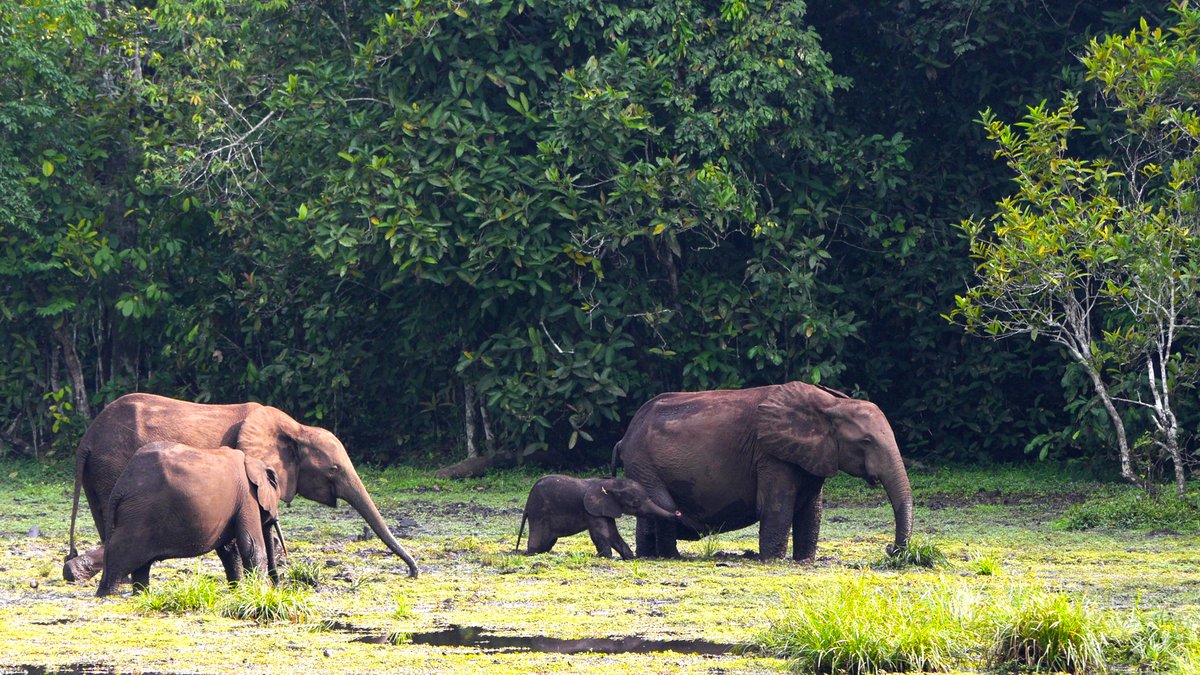
Banner image:The Congo Basin is home to critically endangered African forest elephants (Loxodonta cyclotis). Image by Matt Muir via Wikimedia Commons (CC BY 4.0).
‘Ancient’ carbon venting from lakes in the Congo Basin peatlands: Study
Tropical forest regeneration offsets 26% of carbon emissions from deforestation
Citations:
Sagang, L. B., Dalagnol, R., White, L., George-Chacon, S., Favrichon, S., Li, S., … Saatchi, S. (2026). Managed rainforests support higher carbon density and sequestration in the Congo Basin. Nature Communications. doi:10.1038/s41467-026-72399-4
Laguardia, A., Bourgeois, S., Strindberg, S., Gobush, K. S., Abitsi, G., Bikang Bi Ateme, H. G., … Stokes, E. J. (2021). Nationwide abundance and distribution of African forest elephants across Gabon using non-invasive SNP genotyping. Global Ecology and Conservation, 32, e01894. doi:10.1016/j.gecco.2021.e01894
Yoh, N., Mbamy, W., Gottesman, B. L., Froese, G. Z. L., Satchivi, T., Obiang Ebanega, M., … Buřivalová, Z. (2024). Impacts of logging, hunting, and conservation on vocalizing biodiversity in Gabon. Biological Conservation, 296, 110726. doi:10.1016/j.biocon.2024.110726
Feedback: Use this form to send a message to the editor of this post. If you want to post a public comment, you can do that at the bottom of the page.
Sentinel — Human
The text is a detailed, well-structured analysis built around specific scientific findings and conflicting socio-political viewpoints, exhibiting strong indicators of human journalistic synthesis.