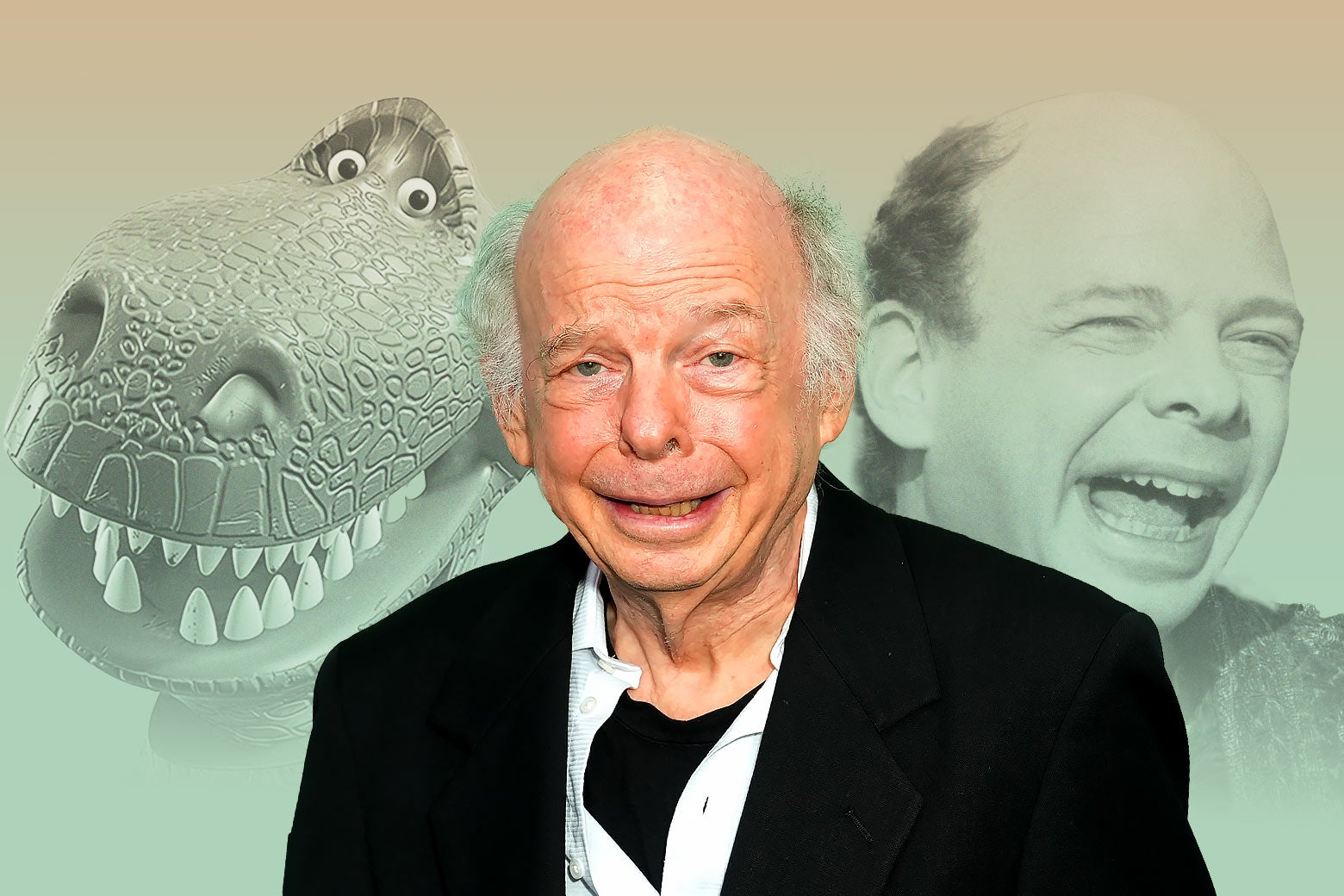
A few weeks ago, I watched a veteran avant-garde playwright deliver a lacerating two-hour monologue on the soul-killing effects of economic privilege, then walked out of the theater, where a line of people were waiting for him with Sharpies and Princess Bride posters. It felt like the perfect encapsulation of Wallace Shawn’s dual existence. On the one hand, he’s a pop-culture icon, immediately recognizable from his roles in film (Clueless) and TV (Young Sheldon), to say nothing of a certain fairy-tale villain. On the other, he’s the author of challenging and often abrasive plays, like the new What We Did Before Our Moth Days, a series of interlocking monologues that opens with John Early’s 25-year-old describing his sexually charged relationship with a 13-year-old girl. He’s also the son of the legendary New Yorker editor William Shawn, whose decadeslong affair with writer Lillian Ross was likely a jumping-off point for the play’s story of a bestselling novelist (Josh Hamilton) who leaves his wife (Maria Dizzia) at home to chase excitement with a melancholy single woman (Hope Davis). When the play begins, Hamilton’s character is already dead, and the staging, with all four actors seated facing the audience and rarely acknowledging the others’ presence, makes it feel as if they might all be.
His two fandoms, Shawn says, rarely overlap, although someone apparently bought out two rows of seats at Moth Days for an unsuspecting 16-year-old’s birthday party. But turn up for The Fever, which is being staged on Sunday and Monday nights when Moth Days’ house would otherwise be dark, and you can catch a glimpse of Shawn’s genial side, greeting friends and fans in the audience before he takes the stage and the mood turns grim. Shawn’s 1990 play began life in the apartments of friends with similar upbringings—those, he reasoned, who most needed to experience the story of a wealthy, well-meaning American bottoming out in an undeveloped country on the brink of revolution, vomiting up his prosperity and confronting just how little his good intentions have done. It’s been revived periodically over the decades, but this is the first time Shawn has done it himself in years—and, given that he’s now 82, might well be the last.
Although its vaguely Central American milieu and references to “the rebels” make The Fever feel like an artifact of an earlier era, its observation of unconscious privilege and vicious view of liberal myopia have only grown sharper with age. It also makes for a fascinating double bill with Moth Days, whose comfortably insulated characters are adrift in a world where nothing much seems to matter; The Fever’s virus is in them, but they haven’t yet started to feel the burn.
Shawn’s own politics have moved steadily left over the decades—last year, he called Israel’s actions in Gaza “demonically evil”—even as he’s grown more compassionate, less inclined to harsh or easy judgments. The two works, debuted 35 years apart, show an evolution of sorts, but more than that, they’re evidence of a mind still working at the same intractable problems, and coming to terms with the questions that will never be answered.
This interview has been edited and condensed for clarity.
Sam Adams: You’ve told a fascinating story of your own political evolution, which involves your play Aunt Dan and Lemon. The play’s characters are obsessed with authoritarian figures like Kissinger and Hitler, and you credit it with your development from a liberal to a more leftist point of view. But it wasn’t writing the play or acting in it; it wasn’t until you left the production and were able to watch it as an audience member that you realized how your views had changed. In effect, you were radicalized by your own play, which had ideas in it that you didn’t realize were there until you got some distance from it. Have you had a similar experience with What We Did Before Our Moth Days? What have you learned from watching it?
Wallace Shawn: That’s an interesting question. I suppose that when the father in Moth Days says that since he’s started, as he says, doing whatever he feels like doing, he’s sort of decided that he’s not a good person and that’s not going to be part of his self-image anymore—in a way, he’s not even going to try any longer to be a good person—I suppose watching it has helped to convince me that whole idea is quite wrong, really, if you’re going to believe in morality at all, or in free will. Obviously there are a million degrees along a continuum between being a wonderfully good person and being an extremely horrible person. And you can’t really let yourself off the hook, assuming you believe that you have some control over your own behavior.
The question of Am I a good person? is central to The Fever, whose protagonist eventually concludes, essentially, that he is not. What went into the decision to bring that play back now, and for you to play the lead again?
You know, The Fever—it’s an argument that has a point. It makes the case that our class—I’m not speaking for you, because I don’t know what your story is—but the class that I would say I belong to. I would say I am someone who unquestionably benefits from being an American. I’m not the “one percent” that was discussed during Occupy Wall Street, but I’m sure I’m in the 10 percent, that class that benefits from the genocide of Indigenous people, slavery, wars in Asia and Latin America that have repressed revolutionary movements in many different countries. … As a person, I have a lot of affection for the other members of my class, or for some of them, including the four characters in What We Did Before Our Moth Days. I have very warm feelings towards those four people. But if you take some steps back, and you’re looking at my class from the perspective of someone in the Sudan, or someone in Gaza, or someone in El Salvador, a poor person in any of those countries, you probably wouldn’t feel the affection for the middle-class people in America that I feel.
I mean, I’m a beneficiary. And those people are, perhaps you could say, less well-off than they would be if I were less well-off. I think it’s very important for us in my class, the beneficiaries, to recognize that basically that’s what we are. The absolute feeling of justification that somebody like Pete Hegseth or Donald Trump feels about the crimes they’re committing in Gaza or in Iran—they shouldn’t really feel that way. They should start from a premise that, basically, we have plundered the world and we’re doing quite nicely because of that. That incredible chest-thumping confidence that they feel is misplaced, and I think if more people understood that, our behavior would be different.
I saw you do The Fever the day after we started bombing Iran, and when you took the stage, you remarked, “This is the first time I’ve done this in the middle of a big war.” How does that change the play for you?
Well, I do feel that the basic points I’m making were true when I first wrote the play and did it, and when I’ve done it between now and then. But amazingly, the people who are running the American government today are even more confident in their right to dominate the world for the benefit of Americans. They even say that they believe in “America First,” which certainly flies in the face of those philosophers in the Western world who have thought that all people were equal and deserved equal happiness. When I did it before, nobody was really explicitly saying the opposite of what I was saying. I was attacking implicit assumptions, unthought-through assumptions that people seemed to have. Now I’m attacking open declarations that people are making very publicly.
You said in an interview during the first Trump administration that, “in a funny way, the stupider the target, the more difficult it is to write valuable criticism of it.” Things are so much stupider now. As an artist, how do you reckon with that?
How do you write something new? It’s difficult even at this time to think of something truly original to say. And if what you’re saying is not original, if you’re merely adding to what other people have already said, it’s not a contribution, and it’s a waste of people’s time to read what you wrote. I don’t think I would want to write an article today unless I had a new thought. Trump began the war by bombing a girls’ school, and I’m incredibly upset about it, but I don’t have anything new to say about it, so I wouldn’t write about it. Ninety percent of what I’m saying in The Fever I wrote many decades ago, when I was really thinking about death squads in Central America. But it has a validity today. Some of what I say about the death squads could have been written about bombing the girls’ school, or bombing Gaza.
Has the text of The Fever changed at all over the decades? The version you’re doing now lasts about two hours, while most of the previous productions seem to have run closer to an hour and a half.
Well, I’ve been rewriting it for many decades. I replaced one phrase with another last Monday. And I’ve taken out references that are ludicrously outdated. There’s no value in mentioning things that no longer exist and making people in the audience suddenly think, Oh, this guy obviously wrote this a long time ago, because you can’t go to a newsstand and buy a newspaper today, and he thinks that you can. But mainly I’ve tried to clarify certain things that were hard to express, and that are still hard to express.
Like what?
There are some very basic truths about how the world works and how the economy works that are actually not that easy to describe, particularly in layman’s language. A good part of the play has to do with Why do I make more money in an hour than somebody in the Sudan? How does that happen? I’m sure that as you hear me say that, you’re either thinking, Wally is unusually unsmart or I could explain that in two seconds. But actually, it’s quite difficult to clarify, say, the Marxist concept of the fetishism of commodities. It’s not that easy. At least not for me.
One of the things that’s fascinating about you is how that disparity plays out in your own life. I don’t know how much you make in two hours of doing The Fever vs. two hours of recording lines for a Toy Story dinosaur, but the disparity has to be huge.
One of the inspirations for The Fever was that I started being well paid when I became an actor. I had worked as a Xerox machine operator and a shipping clerk for low wages. And then a friend had the idea that I should act. Not that anybody thought I should become a professional actor, but act in one thing. And I discovered that one could be paid for that. Whether I was respected as an actor, I don’t know, but I was at least hired sometimes, when other short actors were not available. I think it’s possible that if I had never made any more than I did as a shipping clerk, it wouldn’t have occurred to me to write that piece. I should say that I don’t keep the money that I make from The Fever. I give it away.
You’ve written a lot about authoritarianism, in Aunt Dan and Lemon and The Fever and The Designated Mourner. But here we are, closer than the U.S. has ever been to becoming an authoritarian country, and you’re staging a new play that’s largely about family relationships. Maybe it’s just a function of what you were talking about before, about having nothing new to say about atrocities committed for the same old reasons, but how do you feel about that contrast?
Well, I wrote What We Did Before Our Moth Days in the Biden era, and I didn’t know that it was going to be performed in the Trump era. At first, I was upset at the thought that I was, in a way, failing in my civic duty by presenting a play that focused so much on personal relationships, and not presenting a ringing denunciation of brutality. But first of all, I’ve never written my plays with that purpose in mind. They’ve just come out the way they’ve come out. I’ve never said, “Well, now I have to write a denunciation of the regime of Donald Trump,” and I wouldn’t be capable of doing that. But now the crudeness of the Trump regime and its violent anti-intellectualism makes me very happy to be doing a play that, first of all, is about people who care about books and writing and, second of all, at least attempts to be somewhat subtle rather than brutal and crude. And thirdly, it’s being performed with, I would say, undeniable subtlety by the actors under André Gregory’s direction. All of that is, in a way, a rebuke to the brutal worldview and style of a Pete Hegseth or Stephen Miller or Trump. I feel we’re making a political statement in our own way. If I go to a concert and I hear a quartet playing Beethoven beautifully, I feel they are making the social and political contribution of saying, Well, humanity is capable of something better.
You talked about not wanting The Fever to feel dated or of a particular time. But there is something almost quaint about a character who, as you say, is more of the 10 percent than the one percent struggling with the effect of his own privilege, when you have billionaires like Marc Andreessen saying they consider introspection a waste of time. Could you find a way inside the people with that sort of extreme privilege, either as a dramatist or an actor? Is there anything new to be said?
Well, they’re fascinating. Watching the inauguration of Trump and seeing this gathering of billionaires was an amazing experience. It was flabbergasting. Of course, The Fever doesn’t go near those billionaires, and if they were somehow forced to see The Fever, they would just consider it ludicrous. I take for granted that the people watching the play have some kind of a conscience and a compassion for other human beings that apparently, at least by their own self-descriptions, some of these billionaires don’t have. I wouldn’t know what to say if I met Elon Musk. That conversation would just grind to a halt.
Facts Only
Wallace Shawn is an 82-year-old playwright and actor currently performing in two plays in New York: *What We Did Before Our Moth Days* and *The Fever*.
*What We Did Before Our Moth Days* is a new play featuring four actors delivering interlocking monologues, including a 25-year-old man describing a relationship with a 13-year-old girl.
*The Fever* is a 1990 play Shawn originally performed in private apartments, critiquing American privilege and imperialism, now being revived with Shawn in the lead role.
Shawn is known for both his film and TV roles (*Clueless*, *Young Sheldon*, *Toy Story*) and his avant-garde theater work.
He is the son of former *New Yorker* editor William Shawn, whose affair with writer Lillian Ross may have influenced themes in *Moth Days*.
Shawn’s political views have shifted leftward over decades, including recent criticism of Israel’s actions in Gaza as "demonically evil."
He donates earnings from *The Fever* performances to charity.
The revival of *The Fever* occurs amid U.S. military actions in Iran and Gaza, which Shawn sees as reinforcing the play’s themes.
*Moth Days* was written during the Biden administration but is being performed during the Trump era, leading Shawn to reflect on its apolitical focus.
Shawn has rewritten *The Fever* over the years, updating references and clarifying economic concepts like the "fetishism of commodities."
The play’s runtime has expanded from 90 minutes to two hours in its current iteration.
Shawn’s acting career began when a friend suggested he perform in a production, leading to higher earnings than his previous jobs as a Xerox operator and shipping clerk.
Executive Summary
Wallace Shawn, an 82-year-old playwright and actor, is currently staging two plays in New York: *What We Did Before Our Moth Days*, a new work featuring interlocking monologues about morally ambiguous relationships, and *The Fever*, a 1990 play he is performing himself for the first time in years. Shawn is known for both his pop-culture roles, such as in *Clueless* and *Toy Story*, and his provocative, politically charged theater work. His plays often explore themes of privilege, morality, and the contradictions of liberal consciousness. *The Fever* critiques American economic privilege and imperialism, while *Moth Days* examines personal relationships among affluent, intellectually engaged characters. Shawn’s political views have evolved over decades, shifting from liberalism to a more radical leftist perspective, influenced by his own work and global events. He donates earnings from *The Fever* to charity, emphasizing his critique of wealth disparity. The revival of *The Fever* coincides with heightened U.S. militarism and authoritarian trends, which Shawn sees as validating his longstanding arguments about American privilege and violence.
Shawn acknowledges the tension between his public persona as a beloved character actor and his role as a challenging playwright. He reflects on how his plays, including *Moth Days*, force him to confront his own moral assumptions, even as he resists simplistic judgments about goodness. While *The Fever* directly addresses systemic injustice, *Moth Days* focuses on interpersonal dynamics, a contrast Shawn defends as a subtle political statement in an era of crass authoritarianism. He admits difficulty in engaging with figures like Elon Musk or Trump-era billionaires, whose worldview he finds incomprehensible. Despite the play’s origins in Cold War-era Central American politics, Shawn has updated *The Fever* to remove outdated references while preserving its core critique of class and complicity. His work continues to grapple with questions of responsibility, privilege, and the limits of individual morality within oppressive systems.
Full Take
Wallace Shawn’s dual existence—as both a beloved pop-culture figure and a provocative political playwright—embodies a tension worth examining. His work forces audiences to confront uncomfortable truths about privilege, morality, and complicity, yet his public persona remains tied to lighthearted roles. This disconnect isn’t just biographical; it mirrors a broader cultural contradiction where entertainment and critique coexist uneasily. Shawn’s revival of *The Fever* during a moment of escalating U.S. militarism and authoritarianism underscores the play’s enduring relevance, even as its critique of liberal hypocrisy feels more urgent than ever. The play’s protagonist, a wealthy American confronting his own complicity, serves as a stand-in for Shawn’s own class—a group he describes with affection but also unflinching moral scrutiny.
The pattern here is one of *cognitive dissonance as resistance*: Shawn’s work refuses to let audiences (or himself) off the hook, even when the subject matter is deeply personal, as in *Moth Days*. His admission that he wouldn’t know how to engage with billionaires like Elon Musk reveals a limit to his critique—it assumes a baseline of conscience that may not exist in the targets of his anger. This raises questions about the efficacy of moral appeals in an era where power is increasingly concentrated in the hands of those who dismiss introspection as irrelevant. Shawn’s insistence on subtlety and nuance in *Moth Days* feels like a quiet rebellion against the brutality of contemporary discourse, but does it risk being drowned out?
Root cause: The paradigm driving Shawn’s work is a Marxist-inflected moral reckoning with liberalism’s failures. His plays assume that privilege is systemic, not individual, and that guilt is an insufficient response without structural change. Yet his focus on personal relationships in *Moth Days* suggests a belief that individual morality still matters—a tension he hasn’t fully resolved.
Implications: Shawn’s work challenges audiences to hold two ideas at once: that systemic injustice is real, and that personal ethics still have meaning. The danger is that this duality could be weaponized—either to absolve individuals of responsibility ("the system is rigged, so why try?") or to dismiss systemic critique as mere guilt-tripping. His plays avoid this trap by refusing easy answers, but the question remains: Can art like this shift behavior, or does it merely preach to the converted?
Bridge questions:
If Shawn’s critique of privilege assumes a shared moral framework, how does it engage those who reject that framework entirely?
Does the revival of *The Fever* in 2024 risk being seen as nostalgic, or does its updated language make it newly potent?
What would it look like for Shawn to write a play that directly confronts the mindset of figures like Trump or Musk—could it be anything other than satire?
Counterstrike scan: A bad actor seeking to discredit Shawn’s work might frame his plays as elitist guilt-tripping, dismissing his critique of privilege as performative or hypocritical (given his own success). They might also exploit the provocative content of *Moth Days* to paint him as morally bankrupt, ignoring the play’s broader themes. However, Shawn’s self-awareness and willingness to interrogate his own complicity make this attack difficult to sustain. The content does not align with a coordinated influence campaign; it is too idiosyncratic and self-critical.
Patterns detected: none
Sentinel — Human
Sentinel analysis incomplete — partial response from fallback model.