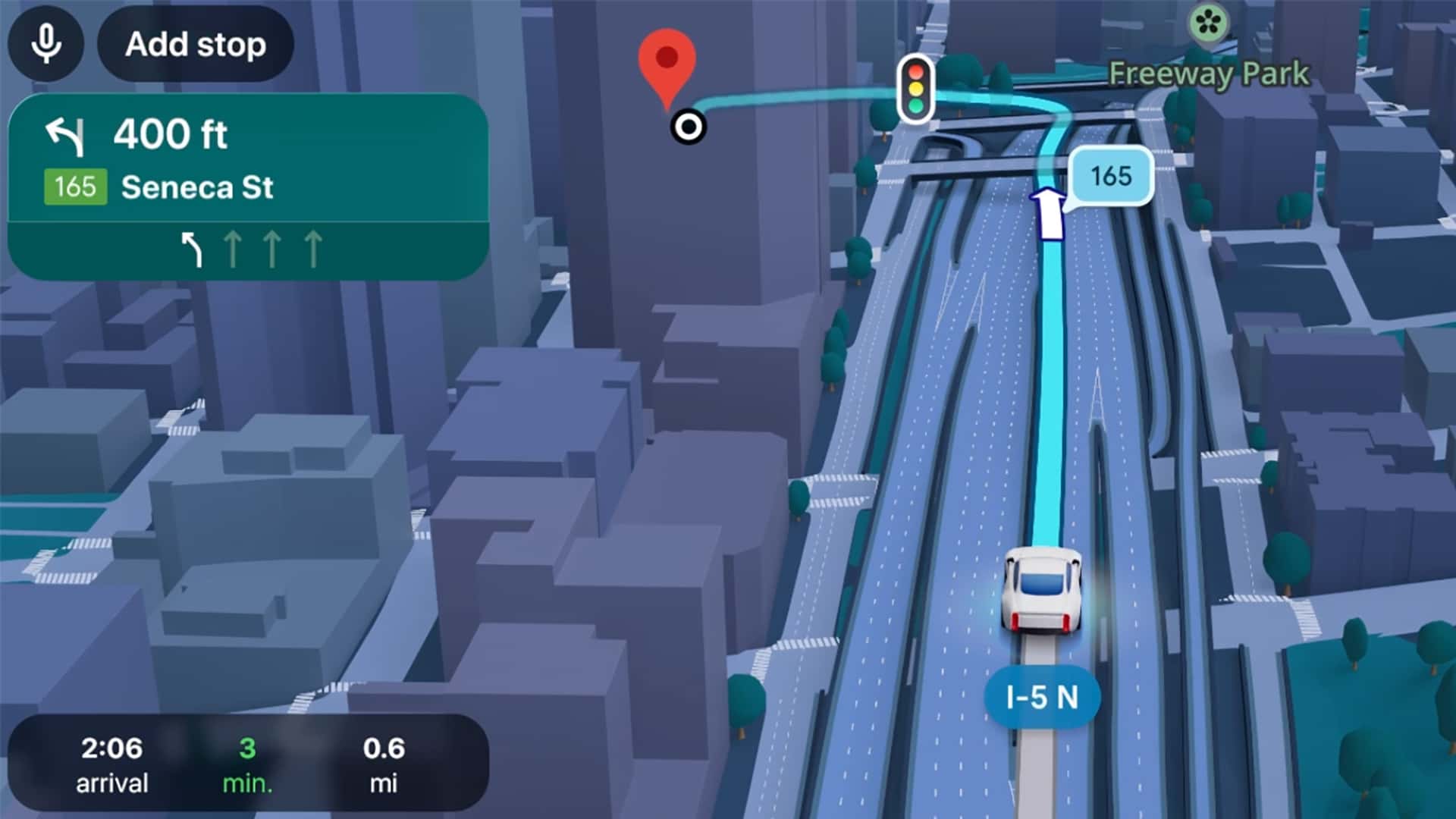
The new “Immersive Navigation” mode is billed as the most significant update to driving directions in Maps in over a decade.
- Google Maps is getting a huge update.
- The new “Immersive Navigation” mode brings a real 3D map with buildings, crosswalks, and stop lights.
- Google’s Gemini AI is also being integrated into Maps, enabling drivers to ask questions about their trip.
Popular GPS navigation app Google Maps is getting a big overhaul, with two features headlining the update. First, the new “Immersive Navigation” mode introduces a detailed 3D map that includes buildings, overpasses, crosswalks, traffic lanes, traffic lights, and stop signs.
Google bills this new mode as being “the most significant update in over a decade” to the app’s driving experience. According to the American IT giant, the changes should help drivers stay focused and informed on the road, with Maps giving fresh, real-world information and natural directions.
The visual overhaul is made possible with help from Google’s Gemini artificial intelligence models, which analyze real-world imagery from Street View and aerial photos to give an accurate view of objects along a route, like medians and landmarks.
In addition to the way Maps will now look when navigating to a destination, Google is giving its popular app a few new features. Using smart zooms and transparent buildings, the app will show drivers more of their route to help them prepare for their next move. The voice guidance is also improved to sound more natural, providing audible directions “like a friend,” according to Google.
Maps will now alert drivers in real-time about disruptions along their route, while also informing them about trade-offs for alternative routes, like a longer trip with less traffic or a faster one with a toll. Moreover, drivers will be able to visualize their destination before heading out, with Street View imagery and recommendations for parking. When the destination is near, Maps will highlight the building’s entrance and which side of the street to be on.
Google Maps’ new Immersive Navigation mode is rolling out now across the United States. In the coming months, it will become available to eligible iOS and Android devices, Apple CarPlay, Android Auto, and cars with Google built-in.
But that’s not all. Google is also integrating its Gemini AI assistant into Maps, so drivers can start a conversation with the GPS navigation app. The company said users can ask questions like, “My phone is dying–where can I charge it without having to wait in a long line for coffee?” or “Is there a public tennis court with lights on that I can play at tonight?”
The app will then come up with a personalized map to help visualize the search results without having to manually research places. The same thing should work for trip planning, with questions like, "I’m headed to the Grand Canyon, Horseshoe Bend, and Coral Dunes–any recommended stops along the way?"
The company said that results are personalized based on what a person has previously searched for or saved in Maps.
The new conversational feature, called Ask Maps, is rolling out now in the U.S. and India on Android and iOS devices, with the desktop browser version coming soon.
RECOMMENDED FOR YOU
Rivian Adds A Sport Mode To All R1 EVs On The Road
All The EVs That Got Canceled Or Delayed In 2025 And 2026
Volvo’s Big Software Update For Older Cars Is Finally Rolling Out
Xiaomi Will Fix Its $5,800 Hood's Fake Ducts After Lawsuits
Lucid CEO: 'I Replaced The Software Team' After The Gravity's Buggy Launch
I've Watched Honda Fail At EVs For Five Years. After Today, I'm Out Of Patience
ZF’s AI-Powered Software Could Make The ‘ESP Off’ Button Irrelevant
Facts Only
Google Maps is introducing a new "Immersive Navigation" mode with 3D maps featuring buildings, crosswalks, traffic lights, and stop signs.
The update is described as the most significant driving directions update in over a decade.
Gemini AI models analyze Street View and aerial imagery to create accurate route visualizations.
The app will use smart zooms, transparent buildings, and improved voice guidance for navigation.
Real-time alerts will notify drivers of route disruptions and provide alternative route comparisons.
Drivers can visualize destinations with Street View imagery and parking recommendations.
The update is rolling out in the United States first, with plans for iOS, Android, Apple CarPlay, Android Auto, and Google-built-in cars.
Google is integrating Gemini AI into Maps, allowing users to ask conversational questions about their trip.
The "Ask Maps" feature provides personalized responses based on past searches and saved locations.
"Ask Maps" is available in the U.S. and India on Android and iOS, with desktop support coming soon.
The AI can generate personalized maps for queries like charging stations or trip planning.
Executive Summary
Google Maps is undergoing a major update with two key features: Immersive Navigation and AI integration via Gemini. Immersive Navigation introduces a detailed 3D map with real-world elements like buildings, traffic lights, and crosswalks, described as the most significant driving update in over a decade. The feature aims to enhance driver focus by providing natural directions and real-time disruptions, with visual aids like smart zooms and transparent buildings. Additionally, Gemini AI will allow users to ask conversational questions, such as finding charging stations or trip recommendations, with personalized responses based on past searches. The update is rolling out in the U.S. first, with global expansion planned. While the changes promise improved usability, their long-term impact on driver attention and data privacy remains to be seen.
The update also includes real-time alerts for route disruptions, alternative route comparisons, and destination visualization with Street View. Voice guidance has been refined to sound more natural, and the app will highlight building entrances upon arrival. The conversational AI feature, "Ask Maps," is currently available in the U.S. and India, with desktop support coming soon. Google emphasizes personalization and real-world accuracy, leveraging Street View and aerial imagery. However, the reliance on AI and data-driven personalization may raise questions about user autonomy and the potential for over-reliance on automated systems.
Full Take
The strongest version of this narrative highlights Google’s commitment to innovation in navigation, leveraging AI to create a more intuitive and visually rich driving experience. The integration of Gemini AI and 3D mapping could genuinely improve driver awareness and reduce cognitive load, especially in complex urban environments. The conversational AI feature also democratizes access to real-time, personalized information, which could be particularly useful for travelers or those navigating unfamiliar areas. Google deserves credit for addressing long-standing pain points in navigation, such as unclear directions and lack of contextual awareness.
However, the pattern of tech companies framing AI-driven features as unambiguously beneficial warrants scrutiny. The emphasis on personalization and real-time data raises questions about user privacy and the potential for over-reliance on automated systems. While the update promises to keep drivers "focused and informed," there’s an implicit assumption that more information and AI assistance will always lead to better outcomes—a claim that ignores the risks of distraction or algorithmic bias. The narrative also leans on authority games, using phrases like "most significant update in over a decade" to borrow credibility from Google’s reputation rather than empirical evidence of improved safety or efficiency.
Rooted in the paradigm of "smart" technology as inherently progressive, this update reflects a broader trend of embedding AI into everyday tools, often without sufficient public debate about trade-offs. The unstated assumption is that users want—or need—this level of integration, which may not hold true for all demographics. Historically, such updates have led to increased data collection and centralized control over navigation, potentially eroding user autonomy. The second-order consequences could include reduced spatial awareness as drivers delegate more cognitive tasks to AI, or even the commodification of attention as Google monetizes personalized recommendations.
Bridge questions: How might this update affect drivers who prefer minimalist navigation tools? What safeguards exist to prevent AI recommendations from being influenced by commercial interests? Would you trust an AI to make real-time route decisions in an emergency?
Counterstrike scan: If this were part of a coordinated influence campaign, the playbook would involve framing AI as an indispensable upgrade while downplaying privacy concerns and dependency risks. The actual content aligns with this pattern to some extent, as it emphasizes benefits without addressing potential drawbacks in depth. However, it stops short of outright manipulation, focusing instead on feature highlights. The lack of critical perspective is notable but not necessarily malicious—it’s a common trait in tech journalism that often amplifies corporate narratives without sufficient skepticism.
Sentinel — Human
The article shows minimal signs of synthetic generation, with natural phrasing and specific details consistent with human-written tech reporting.