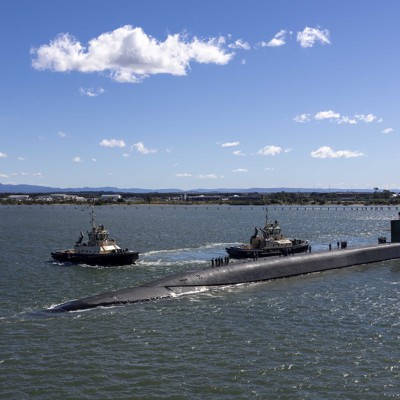
More Columbia-class submarines?
Sen. Tommy Tuberville floated the idea of fielding 16 instead of the planned dozen.
The United States may need more Columbia-class submarines to match the capabilities of the current fleet of ballistic missile subs, Adm. Richard Correll, the head of U.S. Strategic Command, said Thursday.
“The existing capability we have includes 14 Ohio-class boats with 20 tubes. So that's 280 launch tubes. The program of record is a minimum of 12 Columbia with 16 tubes each, and that's 192. So that's 280 versus 192,” Correll told the Senate Armed Services Committee.
“Additional capacity and capability is very beneficial from my perspective. There's ongoing work within the department in terms of force sufficiency, and that work will inform any future budget decisions associated with Columbia. But if you just do the math for what we have and the program of record, I will continue to advocate for additional capability at sea in terms of the Columbia class.”
The first Columbia-class submarine is about a year behind schedule, with expected delivery in 2028. The Navy has a maintenance plan to extend the life of Ohio class submarines so they can last until the Columbia submarines are built.
But at least one senator seems open to adding to the Columbia program.
Correll’s response came after Sen. Tommy Tuberville, R-Ala., asked what STRATCOM would do if Congress could fund more Columbia-class submarines—16 instead of the planned 12.
“Submarines are the tip of the spear for our nuclear capabilities. The problem is we can’t seem to build them fast enough,” Tuberville said. “What flexibility and capability does STRATCOM gain if we were able to field 16 Columbia class submarines versus 12?”
Senate Armed Services Committee Chairman Roger Wicker chimed in. "The answer is that we very much need to do that. Is that correct?”
Correll responded that adding four more new SSBNs would maximize "flexibility and options to present to the president should the need arise."
“The importance to our deterring capability, I can't overstate that—all three legs are vitally important. They complement each other, and the sum of the parts are much greater than the whole. For the SSBN, that assured second strike capability that's always at sea, always ready to respond, deters effectively. And I see that in the intel reporting record.”
Facts Only
Adm. Richard Correll, head of U.S. Strategic Command, testified before the Senate Armed Services Committee on Thursday.
The current U.S. fleet includes 14 Ohio-class ballistic missile submarines, each with 20 launch tubes, totaling 280 tubes.
The planned Columbia-class program calls for 12 submarines, each with 16 tubes, totaling 192 tubes.
The first Columbia-class submarine is approximately one year behind schedule, with expected delivery in 2028.
The Navy has a maintenance plan to extend the service life of Ohio-class submarines until Columbia-class submarines are operational.
Sen. Tommy Tuberville asked about the strategic benefits of increasing the Columbia-class fleet to 16 submarines.
Correll stated that additional submarines would provide greater flexibility and options for the president.
Senate Armed Services Committee Chairman Roger Wicker supported the idea of expanding the fleet.
Correll emphasized the importance of submarines in nuclear deterrence, citing their role in providing a second-strike capability.
The Navy is conducting internal assessments to determine force sufficiency for future budget decisions.
Executive Summary
The U.S. Navy is considering expanding its Columbia-class submarine fleet beyond the planned 12 vessels to match the capabilities of the current Ohio-class fleet. Adm. Richard Correll, head of U.S. Strategic Command, highlighted the disparity in launch tubes—280 in the Ohio class versus 192 in the planned Columbia class—suggesting additional submarines would enhance deterrence. The first Columbia-class submarine is delayed, with delivery expected in 2028, while the Navy plans to extend the Ohio class's service life to bridge the gap. Sen. Tommy Tuberville proposed increasing the fleet to 16 submarines, arguing it would improve flexibility and deterrence. Senate Armed Services Committee Chairman Roger Wicker supported the idea, emphasizing the strategic importance of submarine-based nuclear capabilities. Correll underscored the role of submarines in providing a reliable second-strike capability, citing intelligence reports that confirm their deterrent effect.
The discussion reflects broader concerns about maintaining nuclear deterrence amid delays and evolving threats. While the Navy has not yet committed to expanding the fleet, Correll’s remarks suggest ongoing internal assessments of force sufficiency. The debate centers on balancing cost, strategic needs, and industrial capacity to build submarines faster. The Ohio class’s extended service life provides temporary relief, but long-term solutions remain under review.
Full Take
The strongest version of this narrative is that the U.S. faces a strategic gap in its submarine-based nuclear deterrence, with the Columbia-class program falling short of the Ohio class’s capacity. Adm. Correll’s testimony frames the issue as a mathematical shortfall—280 tubes versus 192—while Sen. Tuberville and Chairman Wicker amplify the urgency, portraying submarine production as a race against time. The argument gains credibility by tying deterrence to tangible metrics (launch tubes) and invoking intelligence reports to validate the submarines’ strategic value.
However, the discussion risks oversimplifying complex trade-offs. The focus on tube counts ignores other factors like stealth, missile range, and warhead yield, which also shape deterrence. The delay in the Columbia program is acknowledged but not scrutinized—why is production lagging, and could expanding the fleet exacerbate delays? The narrative also leans on authority figures (admirals, senators) to lend weight to the argument, a classic appeal to credibility (ARC-0012 Authority Bias). The framing of "flexibility and options" is vague—what specific scenarios would 16 submarines address that 12 cannot?
Root cause: This debate reflects a broader paradigm in U.S. defense policy—quantitative metrics (e.g., tube counts) often drive procurement decisions, even when qualitative advantages (e.g., technology) might offset numerical gaps. The assumption that more submarines equal better deterrence goes unchallenged, despite historical examples where smaller, more advanced forces achieved strategic parity.
Implications: Expanding the fleet would strain an already stretched industrial base, potentially delaying other naval priorities. The cost would likely divert funds from conventional forces or other legs of the nuclear triad. Second-order effects could include accelerated arms races with adversaries, who may interpret expansion as escalatory.
Bridge questions:
If stealth and survivability are the core strengths of submarines, does raw tube count truly measure deterrence, or is this a proxy for deeper strategic anxieties?
What trade-offs would the Navy accept to accelerate Columbia production—fewer ships elsewhere, delayed modernization, or higher budgets?
How might adversaries respond to a larger U.S. SSBN fleet, and could this trigger unintended escalation?
Counterstrike scan: A coordinated influence campaign would exploit fears of falling behind in nuclear capabilities, using selective metrics (tube counts) to create urgency while downplaying costs or alternatives. The actual content aligns partially—it highlights a gap but stops short of fearmongering or suppressing counterarguments. No overt manipulation patterns are detected, though the reliance on authority figures and simplified metrics warrants scrutiny.
Patterns detected: ARC-0012 Authority Bias