Many people, including myself, have been thinking about the state of media a lot lately and people are increasingly asking me for my take on things. We all have had our “bunnies on the trampoline” moment, in which we were completely tricked by an artificial intelligence video on social media for the first time; mine was with that very video just a few months ago. What once felt like a novelty seemingly overnight has turned into a daily threat. Over the past few years, we have sadly become accustomed to seeing false content on social media, but now this content is often accompanied with a realistic-looking (but fake) video. This makes it even harder to distinguish what is real and what is fake.
The pace at which this is accelerating should alarm all of us. Just a few weeks ago, in the aftermath of the “El Mencho” killing in Jalisco, MND reported on the amount of fake news that was being produced, shared, and most troublingly, believed by people around the world. No, cartels were not running through the Puerto Vallarta airport shooting people. No, there wasn’t a passenger airplane lit on fire at the Puerto Vallarta airport. No, the Puerto Vallarta Costco wasn’t burned down. And no, President Sheinbaum didn’t have to spend the night on a Mexican Navy ship at sea to secure her safety.
Fake fires, real fear: Debunking the lies that went viral after ‘El Mencho’ fell
Yet these clickbait stories and videos “worked” well — devastatingly well. In a world of scrolling images that we often look at for just a second, they worked to create misinformation and misunderstanding, frighten people, and ultimately resulted in massive cancellations by visitors to Mexico. I have talked to people in the tourism and real estate sectors from across the country — Oaxaca, the Riviera Maya, Mexico City, San Miguel de Allende, Los Cabos and Puerto Vallarta — who have all lamented the significant shock to their businesses that were suffered as a result of the “post-Mencho” fake news media circus. Real livelihoods, real financial losses — all caused by fake content created and spread in minutes.
If that wasn’t enough to make you stop and think, just weeks later, we are seeing it happen again on an even larger scale on the war with Iran. On March 14, the New York Times ran a comprehensive article titled, “Cascade of AI fakes about war with Iran causes chaos online.” The paper shared 37 fake images and videos falsely depicting active war, 5 fake images and videos falsely depicting war preparation, 8 fake images and videos falsely depicting war destruction, 43 memes made with AI, and on and on and on.
Which brings me to why I have been thinking so much about the media lately. Can you imagine if we did not have sources like the New York Times, the Wall Street Journal, and Mexico News Daily? (Yes, I am a bit biased on that last one.) This has nothing to do with being on the right or left side of the political aisle and this isn’t about opinion pieces that we agree or disagree with. This is about having trustworthy sources that help us make sense of the cesspool of misleading and fake AI-generated content flooding our feeds every single day. The misuse of AI is no longer a future concern — it is the defining information challenge of right now. In a world where actors are increasingly and deliberately trying to sow chaos and confusion (often for nefarious purposes), how will we know what to believe? This was a question just beginning to be asked not too long ago that is now an urgent, daily reality with real-world consequences.
Fortunately, us adults can turn to trusted sources that can help make sense of it all. Many of us know what “reliable” looks like and we search these sources out to help us understand what is going on. That’s why people are subscribing to media outlets like the NYT, WSJ, and MND faster than ever. But what about kids? How will they learn to differentiate what is real news from what is fake? How will they learn the importance of understanding the difference? How will they understand the gravity and implications of getting it wrong? How will they learn what media sources to turn to for clarity, for objectivity, for honesty?
It is with that backdrop that we created MND Kids last year and why we are further doubling down on this initiative today. Since the launch of this platform over 6 months ago, thousands of kids of all ages in both Mexico and the United States have used MND Kids to improve their media literacy. Both educators and parents are now using it to help their kids learn how to read the news, have conversations about fake versus real news, and to reinforce the importance of reading real, unbiased, apolitical news to help them learn how to think critically about things. Equally as important, our content has allowed kids to learn about the good things going on in Mexico that are so often missing from many media sources. MND Kids isn’t about clickbait; it’s about building media literacy, instilling a comprehensive understanding of Mexico, and being proud of Mexico’s historical and current accomplishments.
Today, we are taking our efforts even further. We just started a new pilot program called “MND Young Journalists.” This program encourages kids inspired by MND Kids content to write their own news articles. The program helps make reading and writing non-fiction content more accessible and relevant. It encourages active learning. It teaches kids the power of the pen.
Each week, the editors at MND will review the submissions from MND Kids readers and publish one of them on our MND Kids site under the “Young Journalists” tab. We believe — with conviction — that it has never been more urgent for the next generation to learn critical thinking, media analysis, and the ability to form and express an educated, thoughtful opinion about the world around them. The importance of learning to read to review the facts, form an educated opinion, and share that opinion in a thoughtful, logical way is one of the most important things we can teach our kids. It may also be one of the most important defenses we have against the AI misinformation epidemic bearing down on all of us.
The team at MND is very proud to help motivate and inspire the next generation of thinkers and leaders. We won’t pretend that it has been easy. Navigating the politics and bureaucracy of school systems is not something we have experience in. In truth, it has been painfully slow. But the urgency of what is happening in the world right now does not allow us to wait for the system to catch up. With that said, we continue to aggressively invest and grow this initiative as we feel that it is as important as anything else that we do.
You have a role to play in this too:
If you think your kids, grandkids, nieces, nephews or friend’s kids would benefit by reading MND Kids, you can check out the site here: mndkids.com.
You can also add MND Kids to your MND subscription by upgrading to a family plan that includes MND Kids here: Upgrade – Mexico News Daily.
And if you know of a school district or after school program that would benefit from MND Kids, please email us at: kids@mexiconewsdaily.com.
You can learn more about MND Kids here: About MND Kids.
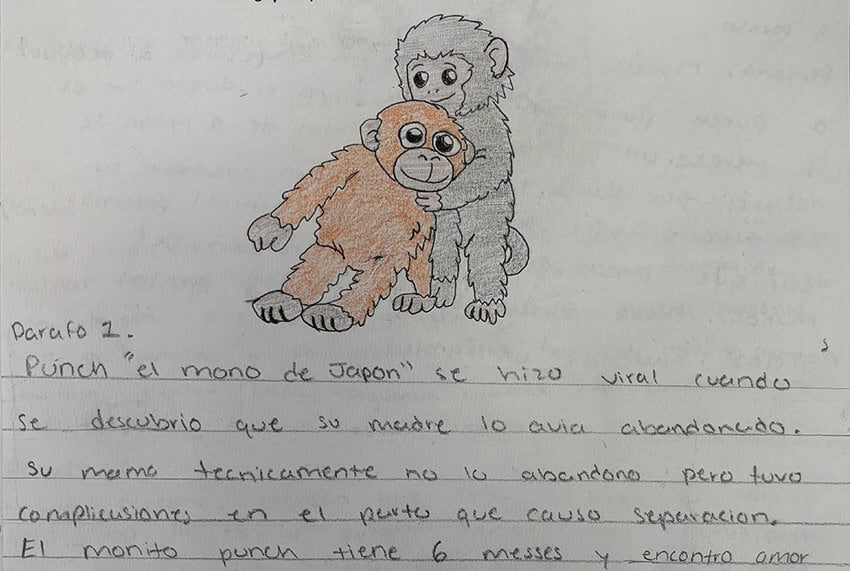
And by the way: The lead photo of this article shows a story written by MND Kids reader Nathalie of Aurora, Illinois, who wrote a recent news article about “Punch the Japanese monkey” as part of a homework assignment in class to write an article in style of MND Kids. Damn, that’s inspiring!
Travis Bembenek is the CEO of Mexico News Daily and has been living, working or playing in Mexico for nearly 30 years.
Facts Only
Travis Bembenek, CEO of Mexico News Daily, has lived in Mexico for nearly 30 years.
AI-generated fake videos, such as the "bunnies on the trampoline" clip, have tricked many people on social media.
False content about the aftermath of "El Mencho's" killing in Jalisco included fabricated claims of cartel violence at Puerto Vallarta airport, a burning passenger plane, and a Costco fire.
These false claims led to tourism cancellations in Mexico, affecting businesses in Oaxaca, Riviera Maya, Mexico City, San Miguel de Allende, Los Cabos, and Puerto Vallarta.
The New York Times documented 37 fake AI-generated images/videos depicting active war with Iran, along with additional fabricated content about war preparations and destruction.
Mexico News Daily (MND) launched MND Kids over six months ago to improve media literacy among children in Mexico and the U.S.
MND Kids is used by educators and parents to teach children how to distinguish real from fake news.
MND recently introduced the "MND Young Journalists" pilot program, where children submit news articles for potential publication on the MND Kids site.
The first published article by a young journalist was written by Nathalie from Aurora, Illinois, about "Punch the Japanese monkey."
MND offers family subscription plans that include access to MND Kids.
Schools and after-school programs can request access to MND Kids by emailing kids@mexiconewsdaily.com.
Executive Summary
Full Take
The strongest version of this narrative is that AI-generated misinformation is not just a future threat but a present crisis with tangible economic and social consequences. The article effectively highlights how fabricated content—whether about cartel violence in Mexico or geopolitical tensions with Iran—can spread rapidly, sowing fear and disrupting livelihoods. It also makes a compelling case for media literacy as a defense, particularly for children, and praises initiatives like MND Kids for teaching critical thinking. The piece avoids partisan framing, focusing instead on the universal need for reliable information sources.
However, the narrative leans heavily on emotional appeals—fear of chaos, concern for children's futures—to underscore urgency. While these are valid concerns, they risk amplifying the very anxiety the article seeks to address. The focus on Mexico and the U.S. also raises questions about global media literacy gaps in regions with less access to trusted journalism. The article assumes that traditional media outlets like the New York Times and Wall Street Journal are universally trusted, which may not hold true for all audiences, especially in an era of declining institutional trust.
Root cause: The paradigm here is one of information asymmetry, where bad actors exploit the speed and scale of AI to overwhelm truth-seeking mechanisms. The unstated assumption is that media literacy alone can counter this, but structural solutions—like platform accountability or regulatory frameworks—are barely mentioned. Historically, this echoes past moral panics about new technologies (e.g., radio, television) disrupting social order, though the stakes today are arguably higher due to AI's hyper-realistic capabilities.
Implications: The cost of misinformation falls disproportionately on vulnerable groups—tourism workers in Mexico, children navigating digital spaces—while the benefits of chaos accrue to those who weaponize it for political or financial gain. Second-order consequences include eroded trust in all media, not just fringe sources, and a potential chilling effect on free expression as platforms over-correct with censorship.
Bridge questions: How might media literacy initiatives like MND Kids scale to reach marginalized communities with limited digital access? Could overemphasizing the threat of AI misinformation inadvertently normalize censorship under the guise of protection? What role should tech platforms play in mitigating harm without stifling innovation?
Counterstrike scan: A bad actor pushing this narrative might exaggerate the helplessness of individuals against AI misinformation to justify top-down control of information flows. However, the article's focus on education and critical thinking as solutions aligns more with empowerment than manipulation. No structural alignment with a coordinated influence campaign is detected.
Patterns detected: ARC-0024 Ambiguity (assumption that traditional media is universally trusted), ARC-0043 Motte-and-Bailey (media literacy as both a shield and a panacea without addressing systemic issues).