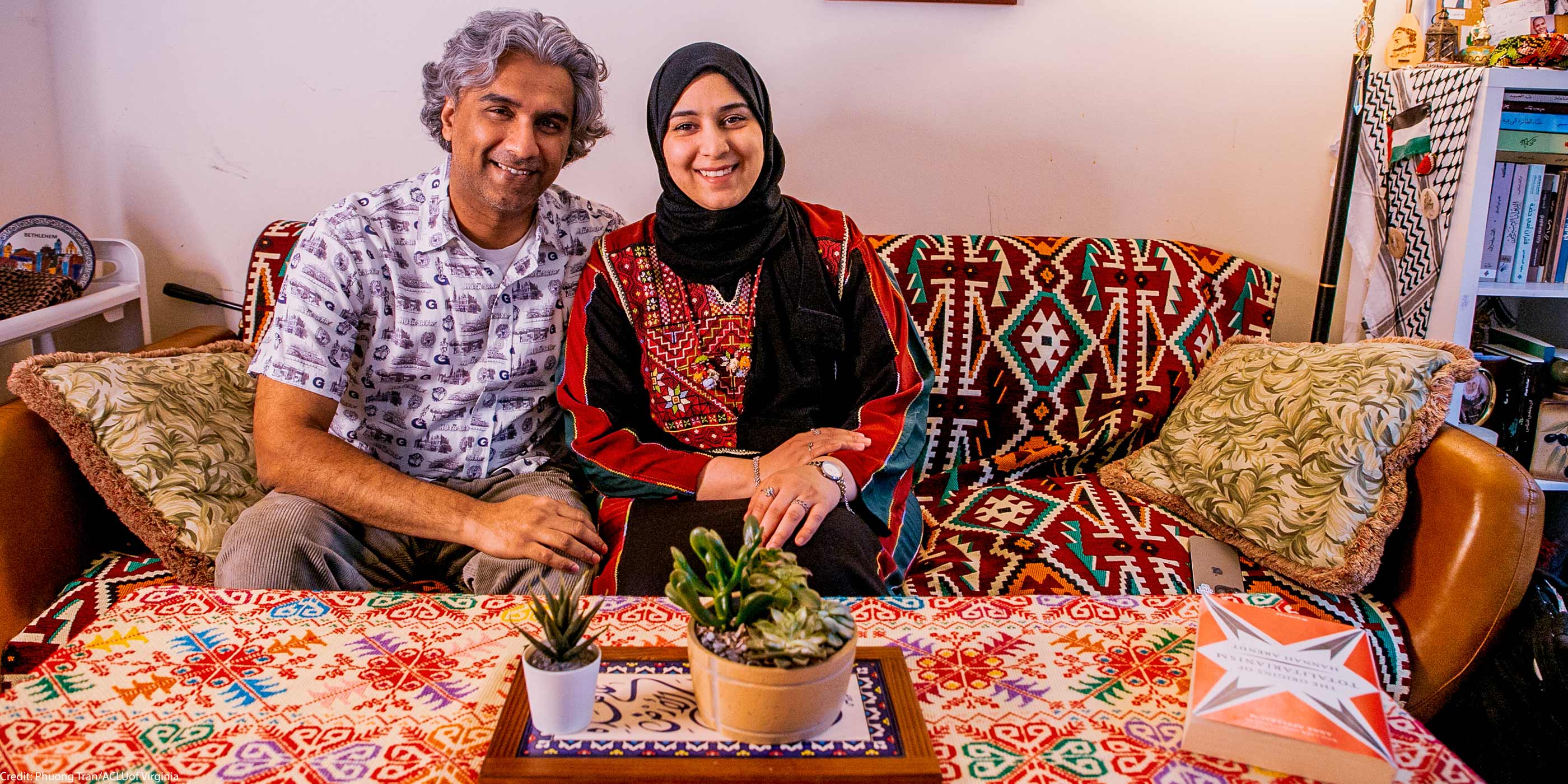
Dr. Badar Khan Suri is a peace scholar at Georgetown University known for his dedication to his students, family, and community. He describes himself as “a small but consistent voice for the inalienable rights of oppressed people facing occupation and inhumane practices.” Now the Trump administration is trying to re-detain him for his constitutionally protected speech and associations.
This week marks one year since the Trump administration unlawfully arrested and attempted to deport Dr. Suri. Months after the district court in Virginia ordered his release, the administration appealed, arguing that the court had no jurisdiction to consider his case in the first place. A year later, the only justification for Dr. Suri’s arrest remains his advocacy in support of Palestinian rights and his family ties to Gaza. The administration is trying to use immigration laws to silence speech it disagrees with, while also claiming that no federal district court has authority to judge the constitutionality of its actions. If upheld, this dangerous precedent would chill the speech of all noncitizens seeking to speak up about issues that matter to them.
Dr. Suri moved from India to Northern Virginia with his wife and their three young children three years ago on a valid visa so that he could pursue his postdoctoral research at Georgetown University’s Alwaleed Bin Talal Center for Muslim-Christian Understanding. ICE targeted and detained Dr. Suri just days after arresting Mahmoud Khalil and Leqaa Kordia, and weeks before Rümeysa Öztürk and Mohsen Mahdawi were also taken. His arrest was part of the administration’s broader campaign to target immigrant scholars for criticizing U.S. support of Israel’s assault on Gaza.
Exactly one year later, our client Dr. Suri will be at the Fourth Circuit Court of Appeals in Virginia to challenge the government’s attempt to redetain him and to make clear that he deserves to remain free with his family.
Ahead of arguments, here’s what to know:
What Happened to Dr. Suri?
After breaking his fast at a Georgetown campus iftar in March last year, Dr. Suri was headed home to northern Virginia, where he lives with his family. As he turned into his apartment complex, three masked, plainclothes ICE agents appeared outside. Without ever presenting a warrant, they arrested Dr. Suri and forced him into an unmarked SUV. His wife begged for answers to no avail. He was then taken to the Washington, D.C. ICE office, where an arresting officer told Dr. Suri that someone at a high level in the Secretary of State’s office “does not want you here.”
Over the next four days, ICE transported Dr. Suri between five different detention facilities in Virginia, Louisiana, and, ultimately, Texas. While he was shuttled between detention facilities, he was shackled at the hands, waist, and ankles. His wife and lawyers frantically tried to locate him, while the agents refused to tell him where he was going.
For three days, he was confined in a windowless cell at the Alexandria Processing Center in Louisiana, a deportation hub often referred to as a “black hole” where immigrants disappear. He was unable to use a phone for longer than 20 seconds and would ring his family at regular intervals only to hear their panicked voices on the other end of the line.
Throughout his time in detention, Dr. Suri faced appalling conditions. When he arrived, officers gave him dirty underwear. They did not give him a bed or a pillow, and instead told him to sleep in the communal recreation room where the lights were kept on, and the TV blared almost non-stop. He also asked for religious accommodations, including halal food, a Quran, and a prayer mat; officers instead gave him a Christian Bible. Dr. Suri was subject to these abusive conditions for nearly six weeks before a court ordered his release on bail on May 17.
The experience also traumatized Dr. Suri’s family. His wife slept by the door, terrified their children would be taken by ICE. His children saved him pizza slices and cupcakes, hoping he would walk through the door at any time. Their youngest son started to withdraw from the world, becoming almost completely non-verbal in his absence
Why is the Trump administration Going After Him?
Like other immigrant academics and students, Dr. Suri was arrested in retaliation for his speech in support of Palestinian rights. But he was also targeted because of his U.S. citizen wife’s similar speech, Palestinian origins, and father’s former employment in Gaza. Whereas some of the other scholars and students were involved in campus activism, Dr. Suri wasn’t. Instead, he used social media to criticize U.S. support of Israel’s assault on Gaza in October 2023, motivated by the time he spent in Gaza for his master’s degree and fear for his wife’s family members who still lived in Gaza with no way to flee during the war. Weeks before his detention, the couple was doxxed by Canary Mission, a blacklisting website known to target people critical of Israel.
The administration falsely argued that Dr. Suri’s presence in the United States “compromise[d] a compelling foreign policy interest” and therefore, under a rarely used section of the Immigration and Nationality Act of 1954, it had the right to deport him.
The administration also smeared Dr. Suri in the press. It falsely claimed that he had ties to Hamas, something it has never substantiated with any evidence. It has become crystal clear that the government was trying to punish Dr. Suri based on a wildly exaggerated chain of familial associations: his marital ties to his wife, her familial ties to her father, and her father’s short term as a political advisor to the prime minister of Gaza in the early 2010s.
All together, the government’s case against Dr. Suri amounts to a collection of lies and misrepresentations manufactured to allow them to punish him for his protected political speech. This is dangerous, unprecedented, and unconstitutional.
The Government’s Latest Fight to Detain Dr. Suri
The Trump administration continues to try to strip Dr. Suri’s freedom despite losing in district court and already being denied a stay by the appeals court.
In its appeal, the administration takes a narrow view of the courts’ habeas jurisdiction, arguing that because it quickly swept Dr. Suri out of Virginia without notice to his family or lawyers, the Virginia court does not have jurisdiction to hear his petition. Instead, it argues that his case should be handled by a court in Texas. It also argues that that no federal court has authority to review the constitutionality of Dr. Suri’s detention until the executive branch finishes its own administrative immigration process, which can take months or years.
The government’s argument essentially boils down to the sweeping assertion that it can use immigration laws to silence speech it dislikes and detain noncitizens indefinitely because of their family’s supposed associations.
At the Fourth Circuit Court of Appeals this week, the ACLU, ACLU of Virginia, and Center for Constitutional Rights will be arguing that the district court’s rulings were correct: the federal court in Virginia has jurisdiction over Dr. Suri’s habeas petition, and he must remain free while his case is considered. Without judicial review, people like Dr. Suri lose an essential tool in challenging unlawful government attempts to retaliate against and silence their speech.
The First Amendment protects all of us, regardless of our political opinions or associations – and we all deserve speedy protection from the courts when that right is infringed upon. When the government ignores those rights to go after one person, we’re all in danger. Nobody should ever fear being ripped away from their family and thrown in prison for their protected speech.
Facts Only
* Dr. Badar Khan Suri is a peace scholar at Georgetown University.
* The Trump administration attempted to detain him one year after an unlawful arrest.
* The arrest is linked to his advocacy for Palestinian rights and family ties to Gaza.
* The administration appealed the Virginia court’s ruling.
* ICE targeted Dr. Suri alongside other immigrant scholars criticizing U.S. support of Israel's actions in Gaza.
* The arrest occurred in March 2023.
* Dr. Suri was detained in five different detention facilities across Virginia, Louisiana, and Texas.
* He experienced shackling, inadequate food and sanitation, and religious discrimination.
* The administration argues that Dr. Suri’s presence “compromised a compelling foreign policy interest.”
* The ACLU and Center for Constitutional Rights are seeking to challenge the detention.
* The case raises concerns about the use of immigration law to silence speech.
Executive Summary
Full Take
Sentinel — Uncertain
This article presents a narrative about Dr. Suri’s detention, utilizing a largely neutral tone and presenting both the administration’s arguments and the legal challenges. The writing exhibits patterns common in synthesized reporting, marked by hedging language and reliance on generalized assertions, suggesting a high probability of AI assistance.