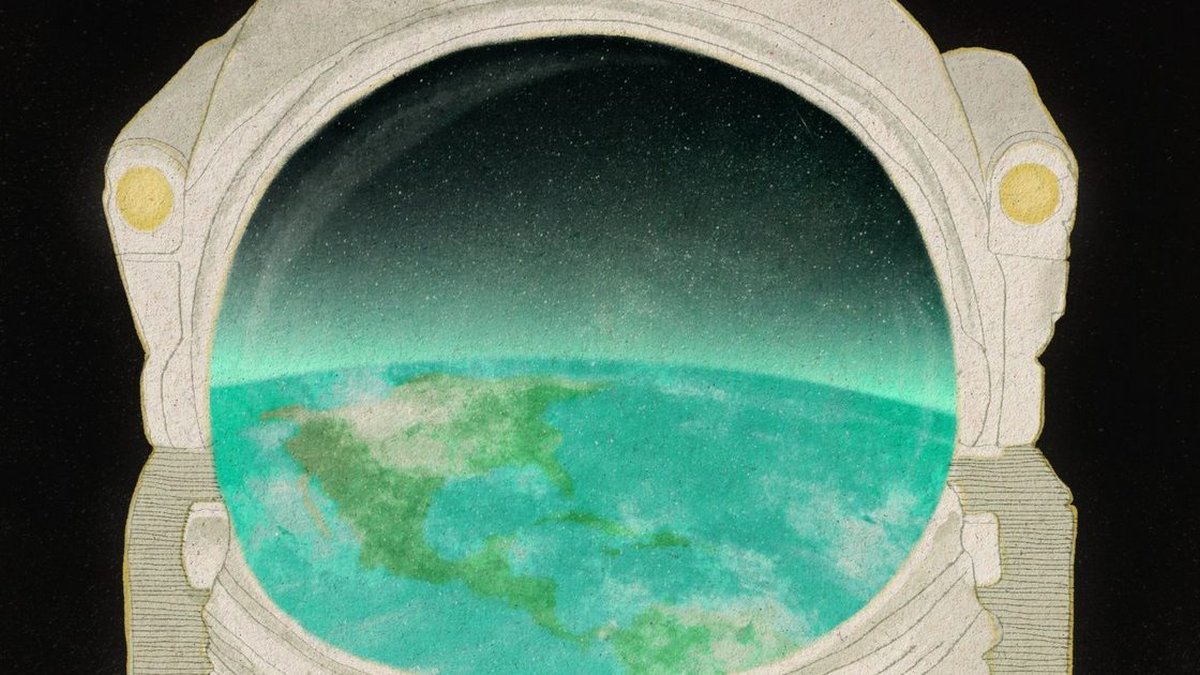
The success of Artemis II signalled a renewal of the space race, with nations vying to
reach and perhaps colonise celestial bodies. Ian Crawford talks to Danny Bird about the history of space exploration and what it can tell us about potential future developments
Danny Bird: Human beings imagined travelling beyond the Earth centuries before such a journey became possible. How should we understand our perennial fascination with exploring the cosmos?
Ian Crawford: Ultimately, I think it comes down to our desire to understand where we are. Over time, that curiosity became intertwined with the history of scientific discovery.
It’s been an extraordinary intellectual achievement. Human societies evolved, became more sophisticated and devoted a small part of their collective resources to understanding our place in the universe. Over centuries, we realised that we live on a small planet orbiting a small star. And, as our knowledge of science progressed, it gradually became clear that we might actually be able to leave that planet. For most of human history, that idea would have been inconceivable – yet by the middle of the 20th century, we had developed the technology to physically leave Earth.
You’re a proponent of the ‘Big History’ concept. Could you elaborate on this, and how it relates to this discussion?
This is a term introduced by the historian David Christian in the 1990s, integrating human history with the far deeper history of the universe.
Recorded history stretches back only around 5,000 years, whereas modern humans emerged several hundred thousand years ago. But all of that sits within a much larger story beginning with the origin of the universe roughly 13.8 billion years ago.
Modern cosmology describes an evolving universe in which stars and planets formed, life emerged on Earth and evolved biologically over billions of years, eventually producing human beings and, later, human civilisation. Big History attempts to connect these layers into a single narrative: human history understood within cosmic history.
HG Wells explored a similar idea in his 1920 book The Outline of History. Writing after the First World War, he argued that a broader understanding of history might encourage people to think less nationalistically and more cooperatively.
That remains one of Big History’s great strengths. Conventional history often focuses on nations and borders, but in the wider sweep of cosmic and evolutionary history those divisions occupy only a tiny fraction of the story. The origins of stars, planets, chemical elements and life belong equally to all of humanity.
In that sense, Big History parallels the cosmic perspective offered by space exploration. It places humanity within the vastness of space, and emphasises its shared evolutionary history across time. It points toward the same conclusion: we all inhabit one small planet shaped by a common past, and it is irrational for us to remain trapped in endless conflict. That was Wells’s argument a century ago, and I think it still carries real force today.
The launch of Sputnik by the Soviet Union in 1957 is often viewed as the moment when space exploration stopped being science fiction and became reality. How historically significant was that breakthrough?
Enormously significant. It marked the first time a human-made object had left the planet on which humanity evolved and gone into orbit. Until then, most human history had unfolded within Earth’s atmosphere. Suddenly, we had the capability not only to leave Earth but also to see it from outside. The possibility had long been understood in principle: sufficiently powerful rockets could place objects into orbit. But Sputnik was the first successful demonstration that it could actually be done.
I remember my father, who was doing his National Service in Cyprus in 1957, telling me about his astonishment when he heard about Sputnik. To many people, it seemed almost unbelievable. Those working in aerospace engineering had, of course, understood for decades that this feat was achievable, and had been striving towards it.
The space race was a nationalistic contest between the USA and the Soviet Union, but the exploration of space has also fostered extraordinary international cooperation. Over the past 70 years, which has been the stronger force: rivalry or collaboration?
Historically, rivalry has probably been the stronger force. In the early years, exploration of the cosmos was closely tied to Cold War competition and the desire of both superpowers to demonstrate technological superiority.
Conversely, the clearest example of cooperation is the International Space Station [ISS], which brought together 15 nations in a shared scientific and engineering projects in the 1990s.
Until Sputnik 1 blasted into orbit, all of human history had unfolded within Earth’s atmosphere
Ideas for space stations date from the beginning of the space age. In the 1970s, the Soviet Union developed the Salyut programme, while the USA launched Skylab. After the Cold War, however, policymakers argued that Russia should be incorporated into a joint international programme.
Part of the reasoning was strategic. After the collapse of the Soviet Union in 1991, there were concerns that unemployed aerospace specialists might redirect their expertise into missile development or proliferation. Integrating Russia into an international project was, therefore, seen as politically and practically beneficial. That argument helped shape what became the International Space Station, with additional participation from the European Space Agency [ESA], Japan and others. Unlike the Apollo programme, which emerged from rivalry, the ISS was conceived as a cooperative enterprise from the outset.
Humans haven’t returned to the moon’s surface since Apollo 17 in 1972. Now, with programmes such as Nasa’s Artemis, that looks set to change. Why did it take so long – and why does the moon matter again now?
President John F Kennedy’s challenge had been to land humans on the moon before the end of the 1960s, and Apollo 11 did that in 1969. Afterwards, the programme continued partly because the infrastructure already existed and because the later missions produced major scientific returns. But Apollo was enormously expensive and inherently dangerous. Once the primary geopolitical objective had been achieved, the political rationale weakened.
In fact, hardware for Apollos 18, 19 and 20 had already been built before the Nixon administration cancelled them. After Apollo there was a long hiatus, partly because many people felt that humanity had already ‘done’ the moon. But by the 1990s two developments changed attitudes.
First, scientists realised that the Apollo missions had sparked many new questions. Decades of analysis of lunar samples and data made it clear that the moon still had much to reveal. Second, other nations increasingly saw lunar exploration as a demonstration of technological capability. From the late 1990s, countries such as Japan, India and South Korea, alongside the European Space Agency and China, launched lunar missions.
Hardware for Apollos 18, 19 and 20 was built, but the Nixon administration cancelled them
China is perhaps the clearest example of this renewed momentum. Its programme began modestly but has developed into an extraordinarily sophisticated programme of robotic lunar exploration.
The television drama For All Mankind imagines the Soviets reached the moon before the USA. How plausible is that idea, and how differently could history have unfolded had it happened?
The Soviet Union certainly had ambitions to reach the moon. It was developing heavy-lift rockets comparable to Nasa’s Saturn V, which took Apollo craft to the moon, but repeated failures severely delayed the programme. In principle, the Soviets could have reached the moon first. In reality, however, they eventually shifted their focus towards space stations in Earth orbit.
- Read more | What if the Soviets had beaten the Americans to the moon? An alternate space race history
What interests me more is that the television programme’s alternative history mirrors certain aspects of today’s emerging competition between the USA and China. At present, both countries are developing lunar programmes in parallel and largely in competition. But at some point, the logic of efficiency and shared benefit could favour cooperation over duplication. We might move towards a more collaborative model of lunar exploration. That outcome is not guaranteed, but it is something towards which they could – and, arguably, should – be actively working. The future is not fixed, it is something we shape collectively.
Many readers will know the famous ‘Blue Danube’ sequence in 2001: A Space Odyssey (1968), during which a scientist travels to the moon via an orbiting Hilton hotel. How has commercialisation been part of the story of space exploration?
There’s always been some degree of commercial involvement. In the USA, rockets and spacecraft were largely built by private companies working for the government. What’s different today is that companies such as [Elon Musk’s] SpaceX and [Jeff Bezos’s] Blue Origin can independently develop and operate their own systems. That is a major shift.
We have not yet reached the stage where hotels have opened in orbit, but space tourism is clearly becoming plausible. It’s already in the news, with wealthy celebrities using spaceflight to promote themselves and the companies involved. The question is what effect this will have on science and space exploration more broadly. Initially, it will remain extremely expensive, but costs may fall over time.
There are both advantages and risks. Tourism on the moon or Mars could damage scientifically valuable environments before they have been properly studied. That would require careful regulation.
Tourism on the moon or Mars could damage scientifically valuable environments before they have been properly studied
On the other hand, infrastructure built for tourism could also be used to support scientific research. I often compare it to my own fieldwork in Iceland, where research benefits from transport infrastructure largely sustained by tourism. My research budget could never fund an aircraft, but it can pay for a plane ticket. A similar dynamic could eventually emerge in space, where commercial infrastructure enables scientific work to be undertaken on a much larger scale.
The language of space exploration often echoes the Age of Discovery, with talk of ‘frontiers’, ‘new worlds’ and even the ‘colonisation’ of space. Given the consequences of colonial expansion over past centuries, how should we think about such parallels today?
There are certainly lessons to learn from history, even if history never repeats itself exactly. That said, comparisons between European imperial expansion and space exploration are sometimes overstated.
The worst consequences of imperialism were inflicted on indigenous peoples and ecosystems. So far, however, all exploration beyond the Earth-moon system has been via robotic probes, and one of the major discoveries of the space age has been how unusual Earth appears to be. Before the space age, many scientists thought that Mars might support life. Exploration has gradually revealed that most worlds in our Solar System are far more hostile than earlier generations imagined.
Viewed from space, Earth appears extraordinary in possessing such rich biodiversity and evolutionary history, though missions have shown that some icy moons in the outer solar system may host subsurface oceans, making them intriguing targets in the search for life.
As I mentioned earlier, there’s a risk that permanent settlements or large-scale tourism on the moon could damage scientifically important sites if pursued irresponsibly. But there are no indigenous populations or complex ecosystems on the moon equivalent to those harmed by historical colonialism on Earth.
Most worlds in our solar system are far more hostile than earlier generations imagined
Space exploration has arguably revealed as much about Earth as it has about the cosmos. How might that kind of understanding of our own planet develop in the decades ahead?
One of the greatest benefits of space exploration is the perspective it gives us on Earth itself. That perspective crystallised during the Apollo programme, particularly with the famous ‘Earthrise’ photograph taken during Apollo 8.
Intellectually, humanity had understood since Copernicus that we live on a small planet orbiting what has turned out to be an ‘ordinary’ star. But seeing Earth from space made that understanding emotionally real. It suddenly became all too clear that this tiny world is our entire home. Apart from a handful of astronauts, none of us can leave it. We are all confined to the same planet together.
That creates a powerful argument for managing human affairs more responsibly. If things go wrong here, nobody is coming to rescue us. We were reminded of it again by recent images of Earth taken during the Artemis II mission portraying this strikingly beautiful world, unique in the solar system and, for all we know, perhaps unique in the universe.
Sometimes, I imagine how Earth might appear to members of an alien civilisation arriving in the solar system. They would see a remarkable living planet whose dominant intelligent species has divided itself into nearly 200 competing states, many frequently in conflict. They are unable to cooperate fully even when faced with threats to their species’ survival – unable to prevent environmental damage, control pollution effectively or eliminate nuclear weapons. The visiting aliens might conclude that Homo sapiens is technologically advanced but politically immature.
To me, that is one of the most important gifts of space exploration. Seeing Earth from outside changes how we think about ourselves, our divisions and our shared responsibility for the planet.
Are there indications from history that ongoing space exploration could encourage a more united future?
Many people tell me that this view is naive – that humanity will never organise itself cooperatively on that scale. But I think the existence of the European Space Agency proves otherwise.
When the ESA emerged from earlier European institutions in the 1960s and 1970s, Europe was only a few decades removed from the Second World War. Nations that had recently been engaged in catastrophic conflict created a multinational organisation devoted to peaceful scientific exploration.
If you had asked someone in 1940 whether Europe would one day operate a continent-wide space agency, they would probably have considered it absurd. Space exploration itself barely existed even as a concept. Technologically, it seemed impossible. Politically, the idea that nations engaged in a devastating conflict could one day collaborate peacefully in an as then unimagined scientific field would have sounded fantastical. And yet it happened.
That is why I think that broader international cooperation is possible. History shows us that forms of collaboration once considered unrealistic can eventually become reality. I think we should work towards this.
Ian Crawford is professor of planetary science and astrobiology at Birkbeck, University of London
This article was first published in the July 2026 issue of HistoryExtra Magazine
Facts Only
* Human beings imagined traveling beyond Earth centuries before the journey became possible.
* The Big History concept integrates human history with the history of the universe beginning 13.8 billion years ago.
* Recorded history stretches back about 5,000 years, while modern humans emerged several hundred thousand years ago.
* Sputnik launched by the Soviet Union in 1957 was the first human-made object to orbit Earth.
* The Space Race was a nationalistic contest between the USA and the Soviet Union.
* The International Space Station involved 15 nations in shared projects in the 1990s.
* Hardware for Apollos missions 18, 19, and 20 was built before the Nixon administration cancelled them.
* China developed a sophisticated program of robotic lunar exploration.
* Commercial entities like SpaceX and Blue Origin can independently develop systems.
* Space tourism is emerging as a plausible activity.
Executive Summary
Full Take
Sentinel — Human
The text reads like a thoughtful, nuanced interview transcript focusing on the philosophical implications of space exploration and history, exhibiting strong human voice and analytical depth.