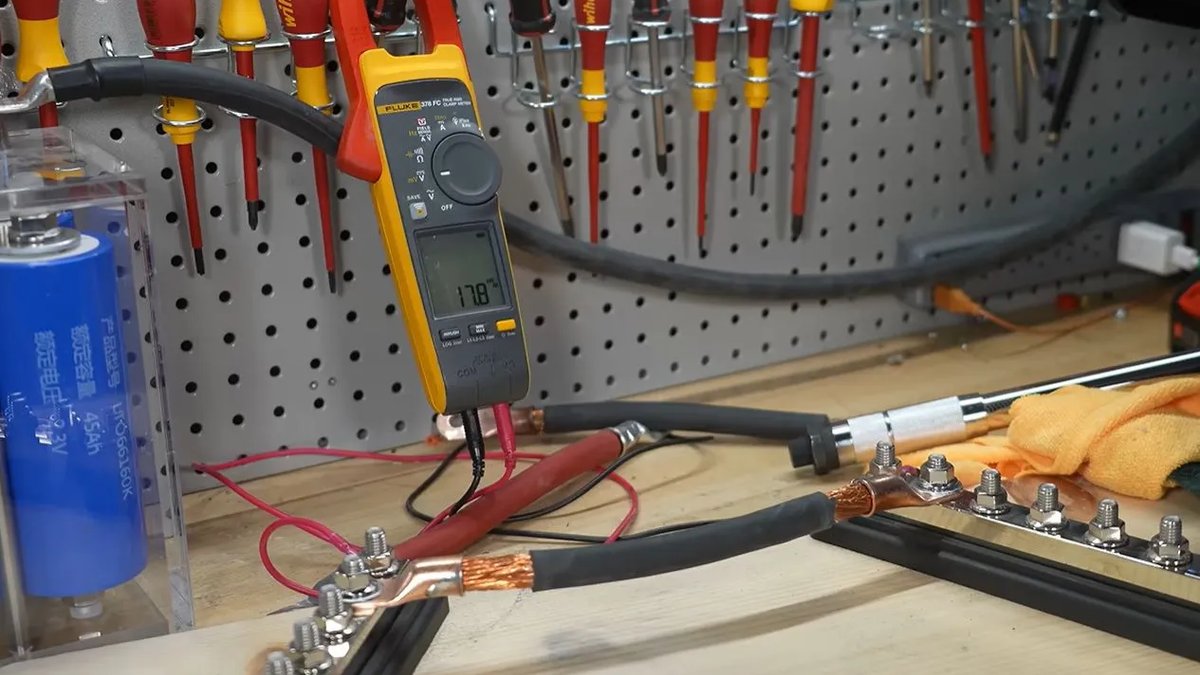
For some reason there’s heated debate around the topic of whether high current carrying wiring ought to use crimped or soldered connections, even though the industry standard is to crimp everything. As a practical demonstration of why this is the case, [Will Prowse] set up a test involving a rig capable of dispensing a few hundred amps through both a crimped and a soldered copper cable.
Prior to making things go spicy, [Will] made sure to check the resistance of the two cables, noting that the soldered version had significantly lower resistance than the crimped connectors. This could be one metric that proponents of soldered connectors can point to as a benefit.
Of course, the main benefit of crimping is that you create a cold weld if crimped properly, which is a sold-state welding process that effectively blends two metal surfaces together. This is also why wire wrap is generally considered to be so very reliable, as it creates a gas-free, solid connection that does not rely on a softer, dissimilar material like solder to hold things together. Of note here is also that the cold weld process tends to continue for a while, so this kind of connection is likely to get better over time.
In the subsequent testing this difference is demonstrated quite well, especially when both cables are subjected to the sort of mechanical abuse that would be expected in an installation, such as vibrations and direct impacts. Here the soldered connections quickly begin to fail, resulting in one soldered connector even unsoldering itself due to heat development. Ultimately cold welding is simply superior over relying on a flimsy and capricious interface of intermetallic compounds.
Wills been doing great work showing the “safety features” of battle born batteries too, well worth a watch
I’d love to see analysis of “not so properly” crimped terminals.
If I’d ever crimp a lug using a cold chisel and hammer (not that I ever did), I’d be tempted to say “I bet that cold welded a fair percentage of those rascally strands of copper”
I’ve seen a few deeply sketchy crimp jobs over the years, as well as done a few in a pinch. On welded seam barrels, even sketchy holds up fairly well. If it passes a pull test, and neither the barrel nor the cable strands are compromised, it’ll likely do ok.
I say this having done 1000A lugs using a hammer setter and sledge (NEVER the right tool, but often the tool to hand when in the middle of the Atlantic), as well as 300A to 600A with a drift punch and hammer (round the end of the drift, and support the barrel in a vee, and punch at least two points, starting from the bolt end working toward the cable, several hits to make a dimple, so as to not overdo it with one heavy one. Watch for the insulation to push away from the lug barrel as Poisson comes into after the first dimple. If the lug is spec’d for dimple crimping, you can use the go/no-go dimensions to check). I do not recommend it, but sometimes one must do what they must until the proper crimp tool is available. If possible, leave enough extra for two more lug installs. One if the first fails, a second when the proper tool is to hand.
You, sorry, someone who theoretically did that, probably made the crucial mistake of not slapping the crimp and saying “this is not going anywhere!”
The arcane incantations of the old magic cannot be neglected.
Hmm, this would seem to have violated the first rule I learned about soldering, probably from a Boy Scout merit badge pamphlet, that you do not rely on the solder for the mechanical connection.
First create a mechanical connection, then solder.
Strain relief is no good once the connection heats up and melts the solder
True, but in the case of this class of connection, there are still issues. Among them, a) as shown in the vid, once solder wicks in, the cable becomes solid, and strain relief is easily lost, and b) IF the lug heats up, you now may have molten solder running out.
For most connectors that are INTENDED to be soldered, the solder is it at the terminal, and mechanical support is further up the cable. THink solder-cup D-type connectors for old-school serial cables. Same style solder cup is still is wide use (Switchcraft 6282-6PG-528 used with Miller lunchbox TIG welders, for example, is one I use a lot of). It will always have strain relief for the cable (this is the mechanical connection, and also controls breakage due to the solder effect on stranded wire in a vibration situation)
If you need that ultra low resistance, Do both… Crimp then heat and solder.
I do it like this, flux the wire and lug hole,place a small cut of solder into the wedge crimp void of the lug hole, place the wire and crimp… Then heat and add a small amount of silver solder to flush out all the flux from the joint.
Shrink wrap tubing.
Done.
For a lug, the entire series of strands is involved in the contact area if you use properly applied solder.
Then the maximum line to lug contact is achieved.
Or to say it another way, the coolest running conductor you can get.
Yep. I used to work at a company that made (up to) 2400A mains filters. Crimp then solder was their process.
If i build a ground lug from a solder less crimp terminal, I shove on a shrink tube and cut off the insulating plastic, Then do the same thing Flux,Crimp,solder and then cover shrink.
For grounds, it’s real important.
Same goes for braid lines… Crimped is part one… Then Flux/Solder, it’s required on them.
ive more than once dipped a stripped wire in flux and wrapped it with solder solder before crimping and blasting it with hot air. probibly substandard but i only did it because the crimp was too big for the cable. im a shut-in so id never use it on a vehicle.
your crimp’s are only as good as your crimping tools. everyone knows that crappy stamped sheet metal crimper with the red handles, its in every toolbox, and not useful for a single thing. i also got a dupont crimper that seems to be substandard, though im not sure if its a fault of the crimp pins, the tool or the operator. i usually opt for soldered on the grounds that am poor and only can afford crappy tools and crimps.
Yep. Done lots of crimps for small EVs (200 – 500 A) and my hand hydraulic crimper works miracles. Without it I can’t imagine connections surviving mile after mile of heat and vibration.
“This is also why wire wrap is generally considered to be so very reliable”…
Wire wrap is far less reliable than PCB/soldering for many reasons. If done be hand, the wire tensions will often cause short circuits or bad connections, usually after the system has been working just fine for a while. Even if done by machine, wire wrap cannot withstand the same environmental conditions that PCBs can.
Wire wrap was good for prototyping, but pretty much nobody uses it anymore.
Sentinel — Human
This text is characterized by the voice of an experienced practitioner sharing detailed, hard-won practical knowledge about electrical connections. It blends technical theory with specific anecdotal evidence, indicating human authorship focused on experiential validation rather than pure academic reporting.