Skip to content
Chimera readability score 0.6671 out of 100, reading level.

Tenzin Nyidon
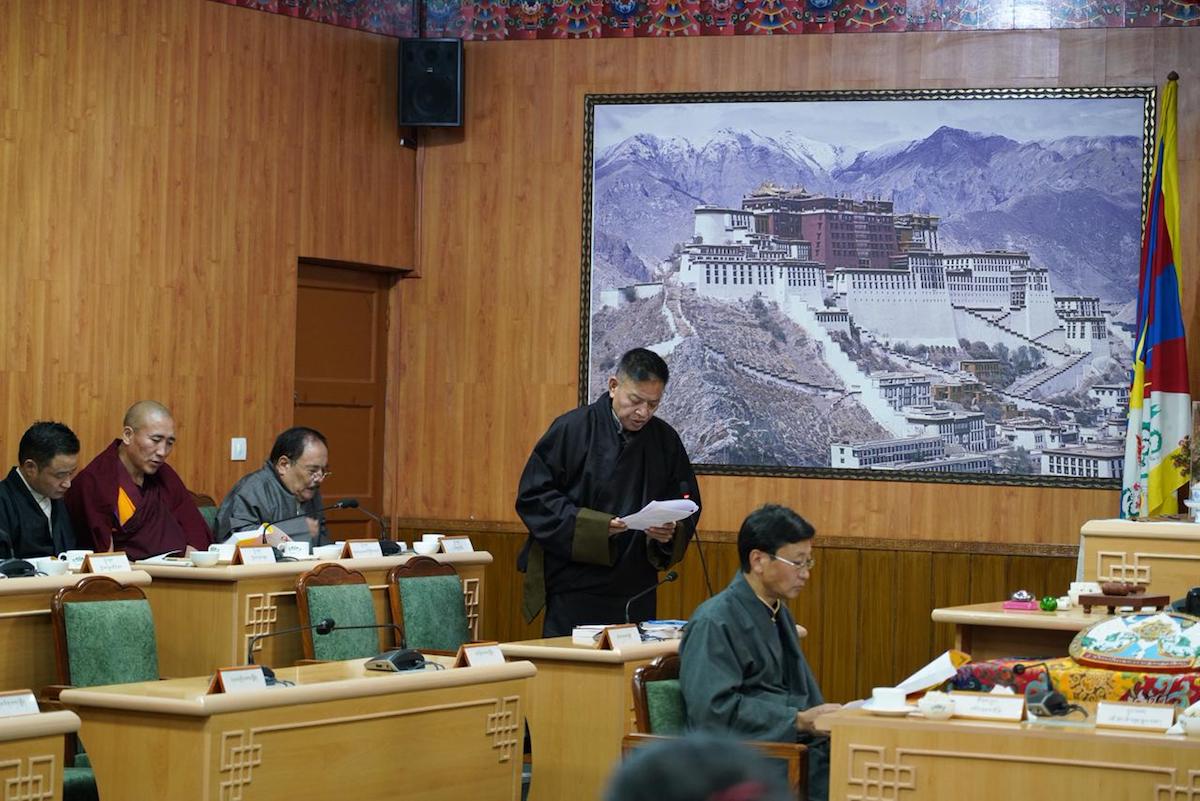
DHARAMSHALA, March 16: The executive branch of the exile Tibetan government, officially known as the Central Tibetan Administration (CTA), led by President Penpa Tsering proposed a budget of ₹3,407.42 million (₹340.74 crore INR) for the upcoming fiscal year during the opening day of the 11th session of the 17th Tibetan Parliament-in-Exile on Monday. The 13-day parliamentary session scheduled to run from March 16 to March 30, 2026, will be the last session of the 17th Tibetan Parliament in Exile.
The budget proposal by CTA President Penpa Tsering, who currently holds the portfolio of Finance Minister, seeks an increase of ₹103.4 million compared to last year’s approved budget of ₹3,304.02 million, representing an overall increase of 3.13 percent.
According to the budget proposal, ₹2,255.23 million, or 66.19 percent of the total allocation, has been earmarked for social sector expenditures. Political-related expenses account for ₹796.69 million, or 23.38 percent of the budget, while ₹355.50 million, representing 10.43 percent, has been allocated for administrative costs.
In the previous fiscal year, the administration initially proposed a budget of ₹3,675.30 million. However, the Tibetan Parliament ultimately approved a reduced allocation of ₹3,304.02 million for 2025–26. The reduction followed the termination of financial assistance from the United States government, which the CTA had anticipated when drafting its earlier proposal of approximately ₹368 crore. With nearly 90 percent of its funding dependent on external assistance, the administration was compelled to revise its fiscal planning in response to the funding shortfall.
During the opening session, Speaker Khenpo Sonam Tenphel acknowledged the continued support of the Government and people of India, as well as numerous countries and international supporters. He noted that such assistance has enabled Tibetans in exile to preserve and promote their distinct language, culture, and religious traditions for over six decades, while also strengthening international awareness of the Tibetan cause.
The Speaker also referred to recent legislative developments in the National People’s Congress of the People’s Republic of China, highlighting the passage of policies aimed at promoting “ethnic unity” and advancing the broader policy of Sinicization. He warned that such measures seek to tighten state control over minority nationalities and religious practices. Expressing concern over the implications for the Tibetan language and identity, he urged Tibetans living in the free world to remain vigilant and to continue safeguarding and strengthening Tibetan linguistic and cultural traditions.
The ongoing parliamentary session will primarily deliberate on the approval of the administration’s proposed budget. Lawmakers will also review the final report of a special committee tasked with standardizing the design, colors, and specifications of the Tibetan national flag and national emblem.

Facts Only

* The Central Tibetan Administration (CTA) is proposing a budget of ₹3,407.42 million for the upcoming fiscal year.
* The budget represents a 3.13% increase compared to the previous year’s ₹3,304.02 million.
* ₹2,255.23 million (66.19%) is allocated to social sector expenditures.
* ₹796.69 million (23.38%) is allocated to political-related expenses.
* ₹355.50 million (10.43%) is allocated to administrative costs.
* The session will run from March 16 to March 30, 2026.
* The CTA President, Penpa Tsering, currently holds the portfolio of Finance Minister.
* The previous year’s approved budget was ₹3,304.02 million.
* The termination of US government assistance is cited as a factor influencing the budget.
* India and numerous countries are listed as supporters of the CTA.
* The standardization of the Tibetan national flag and emblem is a key legislative item.

Executive Summary

The Central Tibetan Administration (CTA) is proposing a budget of ₹3,407.42 million for the upcoming fiscal year, representing a 3.13% increase over the previous year's approved budget. The budget prioritizes social sector expenditures at 66.19% of the total allocation, followed by political-related expenses at 23.38% and administrative costs at 10.43%. This increase is driven by a need to address funding shortfalls stemming from the termination of US government assistance, a move anticipated by the CTA. The 11th session of the 17th Tibetan Parliament-in-Exile will run from March 16 to March 30, 2026, marking the session’s conclusion. The session will focus on budget approval and the standardization of the Tibetan national flag and emblem designs. The CTA acknowledges continued support from India and international supporters, while Speaker Khenpo Sonam Tenphel expresses concern regarding China's policies toward minority nationalities and religious practices. Uncertainty surrounds the future of funding due to the dependence on external assistance.

Full Take

The CTA’s budget proposal, reflecting a 3.13% increase, isn’t simply a financial maneuver; it’s a stark demonstration of systemic vulnerability. The reliance on 90% external funding – predominantly from the US – creates a precarious position, exposed by the abrupt termination of that assistance. This is a classic example of ARC-0043 Motte-and-Bailey: they’re acknowledging the dependence, but framing it as a proactive adjustment (“revising its fiscal planning”) rather than a critical admission of strategic over-reliance. The phrasing is carefully calibrated to avoid direct criticism of past assumptions. The session’s impending closure – the last of the 17th Parliament – suggests a reckoning, a moment to confront the underlying issue of dependence. The Speaker’s alarm about Chinese “ethnic unity” policies isn’t merely a statement of concern; it’s a strategic framing designed to garner international support and subtly highlight the potential for increased state control over Tibetan cultural preservation – a narrative powerfully resonant with Western anxieties about authoritarianism. This leverages ARC-0024 Ambiguity – presenting the Chinese policies as broadly threatening without detailing specific actions, allowing for wider interpretation. Rooted in a history of fragile exile, the CTA’s financial position reveals a fundamental paradox: their survival depends on maintaining an image of independence while simultaneously operating within a system of external support. The implication isn't just financial; it’s about agency. The CTA is attempting to manage perceptions of weakness, a maneuver consistently deployed throughout its history. Furthermore, the session’s focus on the flag and emblem standardization points to an effort to solidify identity – a defensive measure against potential cultural homogenization. This resonates with ARC-0018 Systemic - the CTA's entire existence is predicated on a system of external influence, a perpetual balancing act between self-determination and dependence. What’s conspicuously absent is a concrete plan for diversifying funding sources, exposing a fundamental failure in strategic foresight.

Sentinel — Likely Human

Confidence

This report details the CTA's proposed budget for the upcoming fiscal year, reflecting a shift in funding due to the termination of US assistance and highlighting concerns about Chinese policies impacting Tibetan culture and identity.

Signals Detected
medium severity: Sentence length variance is relatively consistent, trending toward a slightly higher average than typical journalistic writing.
low severity: The 'both sides' framing regarding Chinese policies is present, though presented with a cautious tone, but lacks a pronounced argumentative edge.
low severity: The use of ‘however,’ ‘furthermore,’ and ‘moreover’ while frequent, doesn’t exhibit a deeply structured argumentative skeleton.
low severity: The connection between the US funding reduction and the budget revision is explicitly stated, providing a clear causal link, but lacks detailed supporting information.
Human Indicators
The article presents factual information about the CTA's budget proposal and related developments in a clear and organized manner.
The inclusion of perspectives on Chinese policies adds context to the narrative.