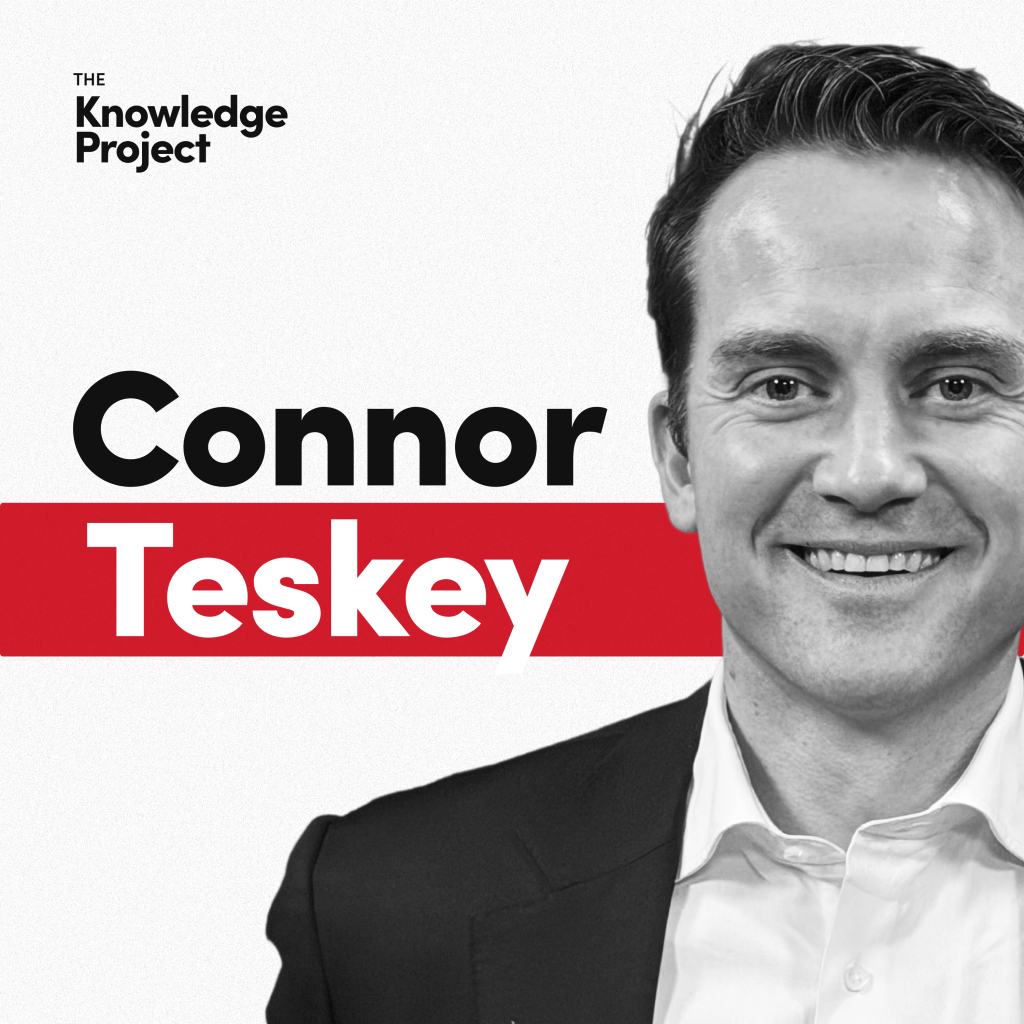
Connor Teskey is CEO of Brookfield Asset Management, one of the world’s largest investors, managing about a trillion dollars across infrastructure, power, real estate, private equity, and credit.
In this exclusive interview, his first as CEO, we explore his approach to capital allocation, isolating variables, and building a business designed for long-term growth.
Featured clips
Your Work Ethic is in Your Control
What Happens Post Business Acquisition?
Identifying Talent
Work and Life Harmony
Listen and Learn: YouTube | Spotify | Apple Podcasts | X | Transcript
Discover why effective investing begins with minimizing losses, how waiting for perfect information can result in missed opportunities, the strategies Brookfield uses to manage market risk while maintaining upside potential, and the key insights he gained working alongside Bruce Flatt.
This discussion goes beyond investment strategies, offering a glimpse into Connor’s perspective on decision-making in an uncertain environment, mentorship, culture, positioning, and talent.
It’s a rare inside look at the operations of one of the world’s most tight-lipped firms.
Enjoy!
Tiny Lessons
- “When something feels 90% right, do the deal. The most important thing is that you do 10 of them.”
- If you can do the work but can’t explain the work, it doesn’t matter that you can do the work.
- When you stop asking for permission, you start to trust yourself.
- Working hard isn’t just about grinding more; it’s about being available for others.
- “There is no limit to how much you can care about things.”
- In a crisis, don’t mourn the damage. Instead, focus on capitalizing on the opportunity that just opened up.
- Overbuild happens in every asset class, every cycle, everywhere. The question is, how do you protect yourself?
- Isolate every bet.
- You can’t eliminate risk, but you can contain it.
- Cash is like oxygen, you don’t realize you need it until you can’t live without it.
- When you know the answer, do it now.
- Keep your eyes on the horizon. “We learn a lot from the past, but we don’t spend a lot of time dwelling on it.”
- “There’s a false degree of precision in today’s world of Excel. The reality is that so many times you just have to overlay good judgment, and you have to recognize that there are certain things outside of your control that your Excel model will make seem like a certainty, but aren’t.”
- Working hard is 100% in your control.
- Protect your downside. “If you underrate the worst-case scenario, the base case or the expected case will end up being very attractive.”
- Liquidity is consistently undervalued.
+Want more? Check out our episode with Bruce Flatt
* Note: Shane and guests may hold positions in assets discussed in this episode. This podcast is not investment advice, and is intended for informational and entertainment purposes only. Nothing in this conversation should be considered investment advice, financial guidance, or a recommendation to buy or sell any security. Always do your own due diligence or consult with a qualified financial advisor before making investment decisions.
Facts Only
Connor Teskey is the CEO of Brookfield Asset Management.
Brookfield Asset Management manages approximately $1 trillion in assets.
The firm invests across infrastructure, power, real estate, private equity, and credit.
This is Teskey’s first interview as CEO.
The interview covers capital allocation, risk management, and long-term growth strategies.
Teskey worked alongside Bruce Flatt, Brookfield’s former CEO.
The discussion includes topics like decision-making, mentorship, culture, and talent.
Brookfield is described as one of the world’s most tight-lipped firms.
The interview is available on platforms like YouTube, Spotify, Apple Podcasts, and X.
Teskey advises acting when a deal feels "90% right" rather than waiting for perfect information.
He emphasizes the importance of isolating risks and protecting downside in investments.
Liquidity and cash flow are highlighted as critical to navigating crises.
Executive Summary
Connor Teskey, CEO of Brookfield Asset Management, shares insights from his leadership approach in an exclusive interview. Brookfield manages approximately $1 trillion across infrastructure, power, real estate, private equity, and credit. Teskey emphasizes the importance of decisive action, even with imperfect information, advocating for a "90% right" threshold to avoid missed opportunities. He highlights the value of isolating risks, protecting downside, and maintaining liquidity as core principles in investment strategy. The discussion also covers mentorship, talent identification, and the balance between work and life, reflecting Brookfield’s culture of long-term growth and resilience. Teskey’s perspective underscores the role of judgment over precision, particularly in uncertain environments, and the need to adapt rather than dwell on past mistakes.
The interview offers a rare glimpse into Brookfield’s operations, known for their discretion. Key takeaways include the prioritization of cash flow as critical to survival, the undervaluation of liquidity in markets, and the importance of self-trust in decision-making. Teskey’s mentorship under Bruce Flatt, Brookfield’s longtime leader, is noted as influential in shaping his approach. The conversation blends practical investment strategies with broader themes of leadership, adaptability, and maintaining focus amid volatility.
Full Take
**STEELMAN:** Teskey’s interview presents a compelling case for disciplined, long-term investment strategies rooted in risk containment and adaptability. His emphasis on acting decisively with imperfect information—rather than paralyzing analysis—resonates with the realities of dynamic markets. The focus on isolating risks and prioritizing liquidity reflects a pragmatic approach to uncertainty, one that acknowledges the limits of predictive models. His insights on mentorship and culture also humanize the often opaque world of high finance, suggesting that Brookfield’s success stems not just from financial acumen but from a deliberate organizational ethos.
**PATTERN SCAN:** The narrative leans heavily on authority—both Teskey’s role as CEO and Brookfield’s reputation—to lend weight to its claims. While not inherently manipulative, the framing of "tight-lipped" exclusivity could subtly appeal to curiosity or FOMO (fear of missing out), a mild form of emotional exploitation. The aphoristic "Tiny Lessons" risk oversimplifying complex financial principles, potentially bordering on semantic manipulation if taken out of context. That said, the content largely avoids overt distortion or bad faith tactics.
**ROOT CAUSE:** The underlying paradigm here is the tension between control and uncertainty in high-stakes decision-making. Teskey’s principles assume that markets are inherently unpredictable but that disciplined frameworks can mitigate chaos. This echoes the broader shift in finance from pure quantitative modeling to hybrid approaches that integrate judgment and adaptability. The unstated assumption is that Brookfield’s scale and patience give it an advantage—a privilege not all investors share.
**IMPLICATIONS:** For human agency, Teskey’s advice democratizes certain principles (e.g., "working hard is 100% in your control") while acknowledging structural realities (e.g., the need for liquidity as "oxygen"). The cost of this approach may be the pressure to act swiftly, which could disadvantage those without Brookfield’s resources. Second-order consequences include the potential commodification of "judgment" as a skill, raising questions about how accessible these strategies are outside elite institutions.
**BRIDGE QUESTIONS:**
How might Teskey’s "90% right" rule apply—or fail—in industries with higher stakes than finance (e.g., healthcare or public policy)?
What blind spots might arise from a culture that prioritizes "capitalizing on crises" over mourning losses?
If liquidity is undervalued, what systemic factors (e.g., regulatory, technological) might be driving this mispricing?
**COUNTERSTRIKE SCAN:** A coordinated influence campaign pushing this narrative might amplify the "exclusive insights" angle to create artificial scarcity, pairing it with selective data to portray Brookfield’s strategies as universally applicable. The actual content, however, avoids this trap by grounding claims in Teskey’s specific context and acknowledging uncertainty. No structural alignment with manipulative playbooks is detected.
Patterns detected: none