Subscribe to the Free Future Newsletter
Free Future home
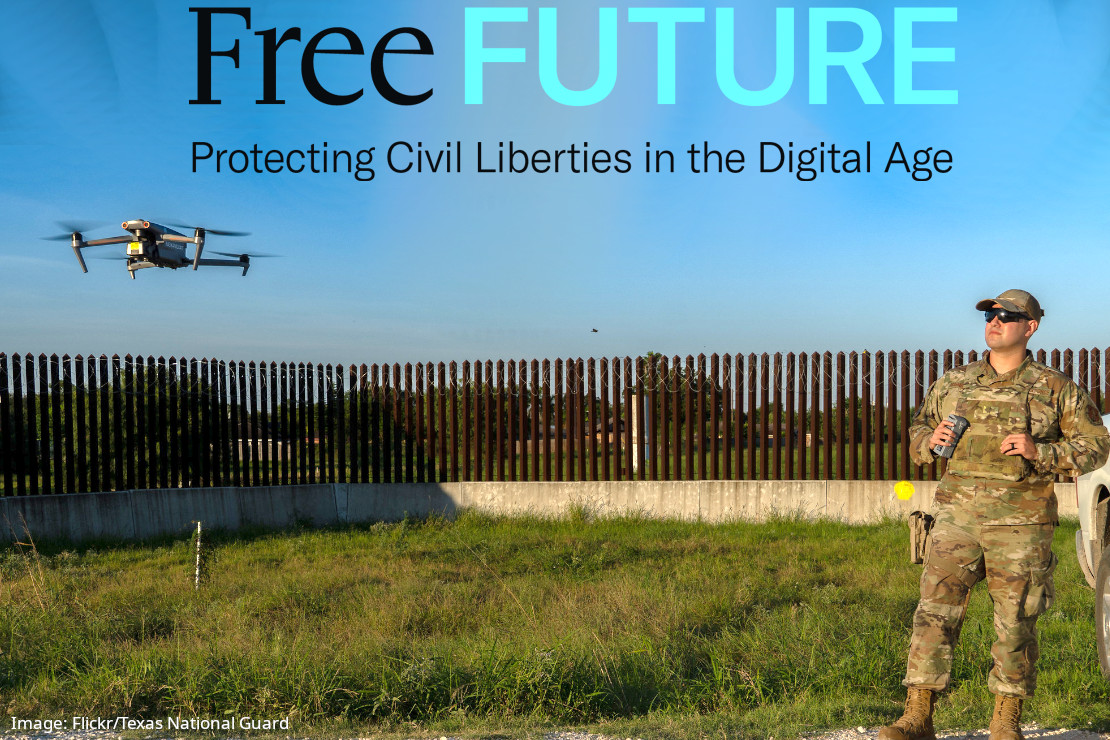
Minnesota Public Radio Friday published an investigation into drone sightings in Minneapolis during President Trump’s recent surge of undisciplined paramilitary immigration agents into that city — including reports that suggest the use of drones for intimidation.
One activist told MPR she was woken up by a drone hovering in her backyard outside her second-story bedroom window. She subsequently recorded at least 16 possible drone sightings; before the surge, she had never seen one. She and others shared video and still photographs of many drone sightings with MPR.
A south Minneapolis woman interviewed by MPR said neighborhood residents were seeing drones all over. “People keep track in the neighborhood chats, ‘Ope, the drones are back tonight,’” she said. Another city resident said they saw a drone hovering 20 feet over a house being used to distribute groceries to people hiding from ICE, while another reported seeing multiple drones flying complex patterns over her neighborhood in January.
A lack of transparency
Unfortunately, the FAA has not built a system that allows ordinary people to identify the operator of drones they see flying over their homes and communities. And it's not clear that the feds are complying with the limited system the FAA has built, called Remote ID. That means that it can be hard to know for sure who is operating a particular drone. But while secrecy makes it hard to confirm, it sure looks like ICE or other federal agencies are using drone technology the same way they’re using other surveillance technologies: to intimidate protesters and observers.
Minneapolis police and Minnesota state police said the drone sightings did not comport with how they use drones and were not theirs, MPR reported. And DHS refused to comment on the drone sightings. The Washington Post reported in January, however, that “ICE has been using small drones to monitor some protests over the past year.”
And of course these flights come in a larger context of other abuses of technology by agencies like ICE and the Border Patrol. As my ACLU-Minnesota colleague Alicia Granse (who is part of the ACLU team suing DHS over its treatment of observers) has summarized it, that includes examples of observers and protesters:
- Being led to their own homes by federal agents.
- Having themselves, their vehicles, or their homes conspicuously photographed.
- Seeing vehicles identified as belonging to a federal agency parked outside their home.
- Being told they would be entered into a domestic terrorist watchlist.
- Having their Global Entry status revoked.
- Having their phones confiscated and being told that they’ve been cloned.
Intimidation by drone, it seems, needs to be added to the list. We have ourselves received reports from observers in another city of a drone flying low in front of people’s faces after an ICE protest, in what seemed to be a clear effort to intimidate. Veteran protesters also report drones swooping low over other protests in similar apparent intimidation attempts.
Surveillance, dominance, and control
In a 2024 white paper, we called for strict limits on the use of drones over protests to ensure that not only are they not used for intimidation, but that they not record protesters except where there is criminal behavior. As we pointed out then:
Sometimes police attend protests not to keep the peace but to intimidate and surveil. These kinds of abuses are especially likely to happen around protests among historically marginalized groups, or groups protesting the police themselves, or expressing other viewpoints that the police don’t like.
In addition, drones are often perceived as alien and hostile and frequently elicit a visceral response…. And by virtue of their position in the sky, they signify surveillance, dominance, and control. Human rights activists have pointed to the way drones have functioned as an intimidating and oppressive “technology of domination” in countries such as Afghanistan, Pakistan, China, and the Palestinian occupied territories.
Perhaps the most striking example of aircraft used to intimidate protesters was at the racial justice protests outside the White House in June 2020, when the Trump Administration deployed a military Blackhawk helicopter to disperse peaceful protesters by hovering low over a street, creating wind gusts strong enough to snap tree limbs. As we noted at the time, experts call this tactic a “show of force” and say it’s a common military tactic to “intimidate and remind potential enemies of your armed presence.” A Blackhawk helicopter is a whole other level compared to a small drone, but it dramatizes the intentions some in law enforcement can bring to a protest.
I hear a lot about "drones for good" from boosters, and drones do have a lot of good uses, but they should never be used for surveillance, let alone intimidation, of peaceful protesters in our country. Yet just such intimidation is emerging as a distinct “use case” for some in law enforcement, and policymakers need to respond accordingly.
Facts Only
* Minneapolis experienced a surge in drone sightings during President Trump’s increased activity of paramilitary immigration agents.
* At least 16 possible drone sightings were reported by one activist.
* Residents in a south Minneapolis neighborhood reported consistent drone sightings, tracked through neighborhood online chats.
* A drone was observed hovering 20 feet over a house distributing groceries to people hiding from ICE.
* Multiple drones were seen flying complex patterns over a neighborhood in January.
* The FAA lacks a system to identify drone operators.
* Remote ID, the limited FAA system, appears not to be fully implemented.
* ICE has been reported using small drones to monitor some protests.
* DHS refused to comment on the drone sightings.
* ACLU-Minnesota reports include: being led to homes, photos taken, vehicle identification, watchlist suggestions, phone confiscation, and Global Entry revocation.
* Another city reported a drone flying in front of faces during an ICE protest.
* Veteran protesters reported drones swooping low over other protests.
* The 2024 white paper called for strict limits on drone use over protests.
* Drones are perceived as alien and hostile.
Executive Summary
Full Take
Patterns detected: ARC-0043 Motte-and-Bailey, ARC-0024 Ambiguity, ARC-0018 Framing.
The article’s core narrative – that ICE is deploying drones for intimidation – relies heavily on a Motte-and-Bailey strategy. It initially presents the compelling observation of increased drone sightings, establishing a ‘motte’ (a factual claim). However, it then argues for the *implication* that this is deliberate intimidation by ICE, framing it as a ‘bailey’—a logical extension of the observed behavior. The article also employs a degree of ambiguity by not definitively stating that ICE *is* intentionally using drones for intimidation, instead highlighting the *potential* for such use based on the observed patterns. This is a classic technique to avoid outright claims while maintaining the plausibility of the core argument.
The report taps into a deeply ingrained cultural anxiety surrounding surveillance and government overreach, mirroring patterns of fear-based rhetoric seen in narratives surrounding border security and immigration enforcement. The framing of drones as “alien and hostile” leverages this psychological response—an inherent distrust of new technologies, particularly when wielded by authority figures. This echoes the broader A.R.C. pattern of leveraging perceptual distortions to manufacture outrage, a technique often utilized in coordinated influence campaigns (ARC-0018 Framing). The invocation of historical examples of drone usage in oppressive regimes—Afghanistan, Pakistan, China— further amplifies this effect, deploying a seemingly objective “historical context” to lend credence to the present concerns.
The narrative’s appeal to human rights activists and civil liberties groups adds another layer of credibility, subtly framing the situation as a violation of fundamental freedoms. The use of “observer” language, frequently associated with social justice movements, further positions the concerns as aligned with a broader struggle for social equity. While the article does not explicitly identify who might benefit from this narrative—beyond the activists themselves—the underlying assumption is that heightened scrutiny of government surveillance practices benefits those concerned about civil liberties. However, a key assumption underpinning this analysis—that the observed drone activity is not simply random or due to other factors—remains unstated, creating a potential vulnerability for counter-narratives. It’s reasonable to question whether the reporting is adequately accounting for the possibility of private citizens operating drones for legitimate purposes, without any connection to government agencies. A deeper root cause analysis would likely reveal an underlying anxiety about the expansion of governmental power and control in the digital age. The article raises questions regarding the balance between security concerns and the protection of fundamental rights—a complex issue with no easy answers.
Questions detected: Is the reported increase in drone sightings genuinely attributable to ICE activity, or are other factors—such as hobbyist drone operators—at play? What systemic changes are needed to ensure transparency and accountability in the use of drone technology by government agencies?
Sentinel — Likely Human
This article details reported drone sightings in Minneapolis during protests, alleging ICE and federal agencies' use of drones for intimidation. The piece relies heavily on external sources and a balanced, descriptive approach, exhibiting stylistic traits common in human-written investigative reporting rather than appearing to be generated by an AI.