Skip to content
Chimera readability score 0.5219 out of 100, reading level.
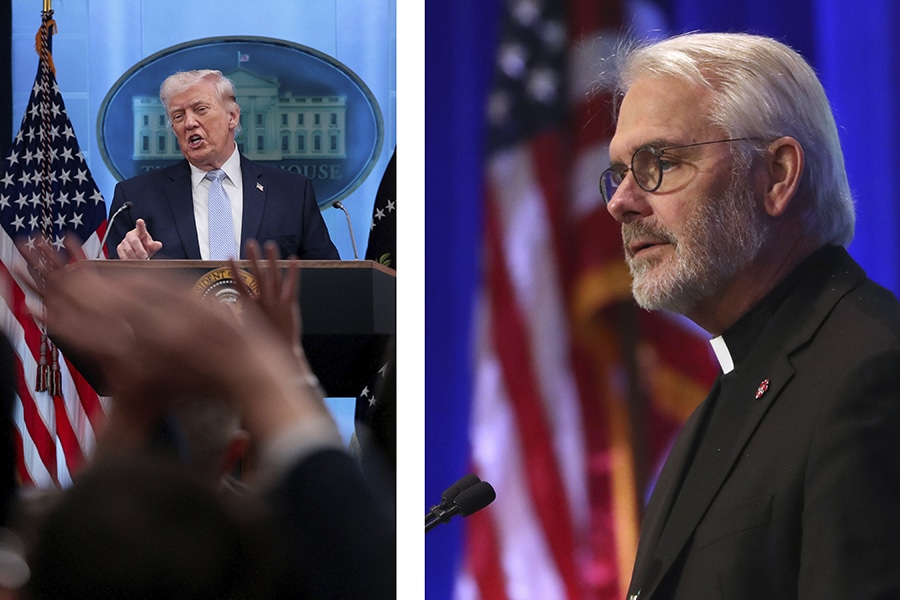
US bishops’ leader rebukes Trump after he threatens Iran’s ‘whole civilization will die tonight’ April 7, 2026By Kate Scanlon OSV News Filed Under: Conflict in the Middle East, Feature, News, World News President Donald Trump threatened a “whole civilization will die tonight” if Iran does not make a deal by 8 p.m. EDT on April 7 — a statement that drew a stark rebuke within hours from the leader of the U.S. Catholic bishops, who invoked Pope Leo XIV’s recent appeals for peace as he called on the president “to step back from the precipice.” In a post that same day on his social media website, Truth Social, Trump said, “A whole civilization will die tonight, never to be brought back again. I don’t want that to happen, but it probably will.” “However, now that we have Complete and Total Regime Change, where different, smarter, and less radicalized minds prevail, maybe something revolutionarily wonderful can happen, WHO KNOWS?” Trump said. “We will find out tonight, one of the most important moments in the long and complex history of the World. 47 years of extortion, corruption, and death, will finally end. God Bless the Great People of Iran!” Trump made similar comments at an April 6 press briefing at the White House, telling journalists, “The entire country can be taken out in one night, and that night might be tomorrow night.” A destroyed vehicle is seen amid rubble at the site of a strike on a residential building in Tehran, Iran, March 16, 2026, amid the U.S.-Israeli war with Iran. U.S. President Donald Trump on April 7 sharply ramped up his threats against Iran, warning “a whole civilization will die tonight” unless the country’s leadership strikes a deal that involves reopening the Strait of Hormuz. (OSV News photo/Majid Asgaripour, WANA via Reuters) In his statement, Archbishop Paul S. Coakley of Oklahoma City, president of the U.S. Conference of Catholic Bishops, said, “The threat of destroying a whole civilization and the intentional targeting of civilian infrastructure cannot be morally justified. There are other ways to resolve conflict between peoples.” He cited Pope Leo XIV’s calls for peace during Holy Week and Easter, and said, “I call on President Trump to step back from the precipice of war and negotiate a just settlement for the sake of peace and before more lives are lost.” The U.S. and Israel initiated combat operations against Iran Feb. 28 that killed Ayatollah Ali Khamenei and other key Iranian political and military officials in the war’s beginning. Trump has argued the regime presented grave nuclear threats, and pointed to “the specter of nuclear blackmail” in an April 1 address about the conflict from the White House. In response to the attacks, Iran effectively shut down the Strait of Hormuz, a key oil trade route, by striking ships there. The closure of the strait has led to a significant spike in energy costs. Polls conducted throughout the first month of the conflict — dubbed Operation Epic Fury — show most U.S. adults are opposed to it, with energy costs one of the factors driving that opposition. Speaking in Hungary April 7, Vice President JD Vance, who is Catholic, suggested the Iranians are engaged in “economic terrorism” and said, “We’ve got tools in our toolkit that we so far haven’t decided to use.” In reference to the president’s post, Senate Minority Leader Chuck Schumer, D-N.Y., wrote on X that “This is an extremely sick person.” “Each Republican who refuses to join us in voting against this wanton war of choice owns every consequence of whatever the hell this is,” he said. Democrats in Congress have tried and failed in both chambers to advance a war powers resolution that would have curtailed Trump’s military actions in Iran. A resolution that would have expressed the disapproval of Congress failed in the Senate on March 4 and the House on March 5 along mostly party lines. In an interview with “Face the Nation” taped April 2 and that aired on Easter, Archbishop Timothy P. Broglio of the U.S. Archdiocese for the Military Services questioned the legitimacy of America’s war in Iran, arguing that the war is likely not justified under Catholic teaching on legitimate defense by military means, sometimes called just war theory. Archbishop Broglio said that under the just war theory, he was concerned the U.S. military action in Iran was “compensating for a threat” before the threat “is actually realized.” In his Easter comments, Pope Leo issued a sharp rebuke of war. He said, “In the light of Easter, let us allow ourselves to be amazed by Christ!” “Let us allow our hearts to be transformed by his immense love for us! Let those who have weapons lay them down! Let those who have the power to unleash wars choose peace! Not a peace imposed by force, but through dialogue! Not with the desire to dominate others, but to encounter them!” he said April 5. Pope Leo also said he will host a prayer vigil for peace in St. Peter’s Basilica on Saturday, April 11. “On this day of celebration, let us abandon every desire for conflict, domination, and power, and implore the Lord to grant his peace to a world ravaged by wars and marked by a hatred and indifference that make us feel powerless in the face of evil,” he said. “To the Lord we entrust all hearts that suffer and await the true peace that only he can give.” Noting the pontiff’s planned vigil for peace, Archbishop Coakley in his own statement said, “I make a special plea to my brother bishops, the priests, the laity, and all people yearning for true peace to join the Holy Father’s Vigil for Peace, whether virtually, or in parishes, chapels, or before the Lord present in the quiet of their hearts to join with our Holy Father as we pray for peace in our world.” Quoting Pope Leo’s own words, the USCCB president added, “Let us entrust to the Lord ‘all hearts that suffer and await the true peace that only he can give. Let us entrust ourselves to him and open our hearts to him! He is the only one who makes all things new (cf. Rev 21:5).'” read more conflict in the middle east Trump threatens Iran’s ‘whole civilization will die’ amid Pope Leo’s call for peace vigil Pope sends Easter greetings to Catholic parish in Gaza amid fear, uncertainty of war Trump threatens strikes on Iranian infrastructure same day Pope Leo appeals for peace ‘The power with which Christ rose is entirely nonviolent,’ pope says in Easter peace message Archbishop Broglio: War in Iran likely not justified under Catholic teaching on legitimate defense Pope: Don’t be paralyzed by mistrust, fear; be catalyzed by Christ to build peace Copyright © 2026 OSV News Print

Facts Only

President Donald Trump threatened on April 7, 2026, that "a whole civilization will die tonight" if Iran did not agree to a deal by 8 p.m. EDT.
The threat was posted on Truth Social and repeated at a White House press briefing.
The U.S. and Israel initiated combat operations against Iran on February 28, 2026, killing Ayatollah Ali Khamenei and other key officials.
Iran responded by closing the Strait of Hormuz, disrupting oil trade and increasing energy costs.
Archbishop Paul S. Coakley, president of the U.S. Conference of Catholic Bishops, rebuked Trump’s threat, citing Pope Leo XIV’s calls for peace.
Pope Leo XIV announced a prayer vigil for peace on April 11, 2026, in St. Peter’s Basilica.
Vice President JD Vance described Iran’s actions as "economic terrorism" during remarks in Hungary.
Senate Minority Leader Chuck Schumer criticized Trump’s statement as "extremely sick" and blamed Republicans for supporting the conflict.
Democrats in Congress failed to pass war powers resolutions to limit Trump’s military actions in Iran.
Archbishop Timothy P. Broglio questioned the war’s justification under Catholic just war theory in an April 2 interview.
Polls show most U.S. adults oppose the conflict, with energy costs as a contributing factor.
The conflict is referred to as Operation Epic Fury.

Executive Summary

On April 7, 2026, President Donald Trump issued a stark threat against Iran, warning that "a whole civilization will die tonight" if the country did not agree to a deal by 8 p.m. EDT. The threat, made via Truth Social and reiterated at a White House press briefing, escalated tensions amid an ongoing U.S.-Israeli conflict with Iran that began on February 28, 2026, with strikes killing key Iranian officials, including Ayatollah Ali Khamenei. Iran responded by closing the Strait of Hormuz, disrupting global oil trade and spiking energy costs. Archbishop Paul S. Coakley, president of the U.S. Conference of Catholic Bishops, condemned the threat, invoking Pope Leo XIV’s Easter appeals for peace and urging Trump to pursue negotiation over war. Polls indicate most U.S. adults oppose the conflict, citing economic and moral concerns. Vice President JD Vance framed Iran’s actions as "economic terrorism," while Democrats in Congress failed to pass resolutions curtailing Trump’s military authority. Archbishop Timothy P. Broglio questioned the war’s justification under Catholic just war theory, arguing it may preemptively address a threat not yet realized. Pope Leo XIV, in his Easter message, called for disarmament and dialogue, announcing a April 11 prayer vigil for peace.
The situation reflects deep divisions over the legitimacy of the conflict, with religious leaders emphasizing moral and humanitarian concerns, while political figures frame it as a necessary response to Iranian aggression. The economic and geopolitical stakes remain high, with no clear path to de-escalation.

Full Take

The strongest version of this narrative presents a high-stakes geopolitical crisis where Trump’s rhetoric escalates tensions, framed by religious leaders as morally indefensible and by political opponents as reckless. The inclusion of Pope Leo XIV’s Easter message and the bishops’ rebuke adds a moral dimension, contrasting with the administration’s framing of Iran as an existential threat. The article effectively highlights the divide between those advocating for peace and those justifying military action, while grounding the conflict in tangible economic and humanitarian consequences.
Pattern scan: The piece avoids overt manipulation but leans into emotional framing by juxtaposing Trump’s apocalyptic language with the bishops’ appeals to morality and peace. The use of terms like "economic terrorism" by Vance and Schumer’s "extremely sick" characterization of Trump could be seen as attempts to provoke outrage or solidarity, depending on the reader’s perspective. The article also employs a form of false framing by presenting the conflict as a binary choice between war and peace, without exploring intermediate diplomatic options in depth.
Root cause: The narrative assumes that military force is the primary lever of statecraft, with little room for alternative conflict resolution mechanisms. The unstated assumption is that Iran’s actions are inherently aggressive, while U.S. actions are defensive—a framing that aligns with historical patterns of Western interventionism in the Middle East. The religious critique, while principled, risks being dismissed as idealistic in the face of realpolitik.
Implications: The escalation risks normalizing threats of mass destruction as diplomatic tools, eroding norms against civilian targeting. The economic fallout from the Strait of Hormuz closure disproportionately harms global consumers, while the moral costs of war—highlighted by the bishops—fall on civilians and soldiers alike. Second-order consequences include further polarization in U.S. politics, with Democrats and Republicans entrenching around opposing views of the conflict’s legitimacy.
Bridge questions: How might the conflict’s framing change if the media focused on Iranian civilian perspectives or the long-term regional instability caused by regime change? What evidence would be needed to justify the war under just war theory, and is that evidence publicly available? If energy costs are a primary driver of opposition, how might economic incentives be leveraged to de-escalate the crisis?
Counterstrike scan: A coordinated influence campaign would amplify Trump’s threats to rally nationalist support while using the bishops’ statements to galvanize anti-war sentiment, creating a controlled opposition dynamic. The actual content does not fully match this pattern, as it presents both perspectives without clear coordination. However, the lack of Iranian voices or independent verification of the "nuclear threat" claim leaves room for manipulation by bad actors seeking to exploit the divide.

Sentinel — Human

Confidence

This text shows signs of being human-written. It exhibits variation in sentence length and hedging density below AI average, has a personal voice, idiosyncratic emphasis, and stylistic fingerprint, indicative of human writing.

Signals Detected
low severity: Variance in sentence length and hedging density below AI average
high severity: Presence of personal voice, idiosyncratic emphasis, and stylistic fingerprint
low severity: No significant matching argumentative skeleton or template patterns
Human Indicators
Individual style, coherent narrative flow, and personal perspective