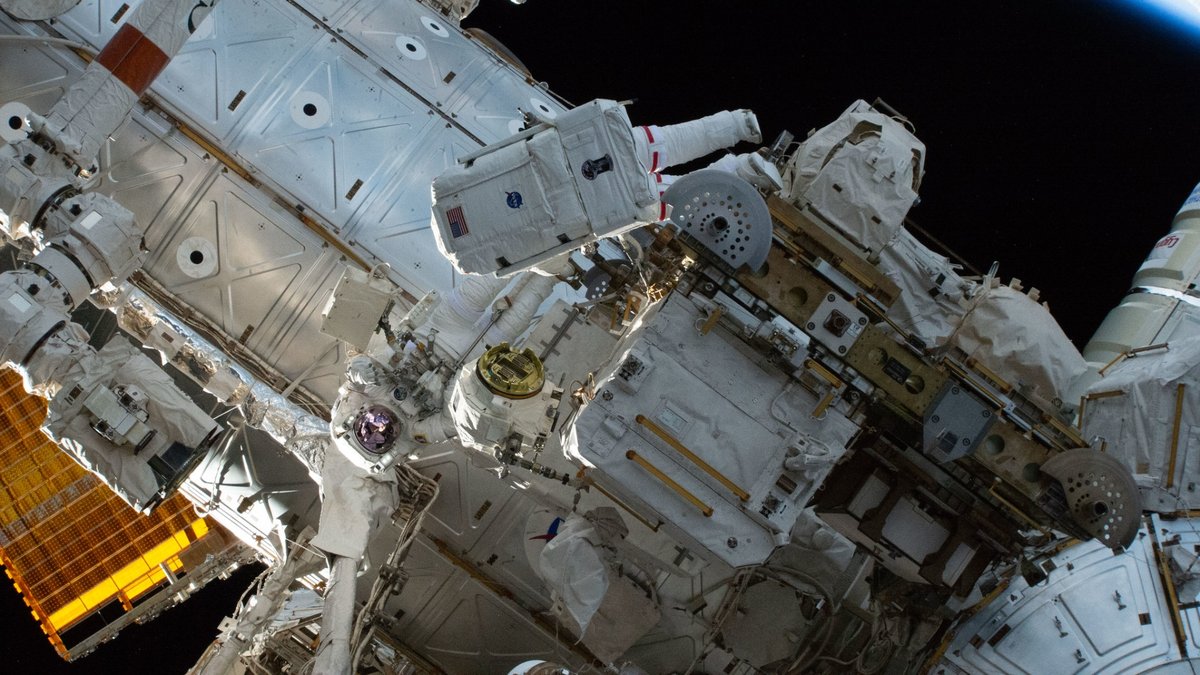
NASA astronauts Chris Williams and Jessica Meir completed a seven-hour and 20-minute spacewalk on June 30 to replace a malfunctioning wrist joint on the International Space Station’s Canadarm2.
Guided by Canadian Space Agency (CSA) astronaut Jenni Gibbons from Mission Control in Houston, the duo removed the degraded component, known as joint number five, and installed a spare that was stored on the exterior of the orbital complex.
The robotic arm experienced an elevated motor current and failed to move as expected on May 27. Mission managers determined the 25-year-old system required an extravehicular activity to swap the joint and restore full operational capacity.
During the operation, the spacewalkers detached the latching end effector to access the failed joint. The astronauts utilized pistol grip tools to unthread multiple expandable diameter fasteners. Meir encountered a free-spinning fastener during the installation of the spare joint but resolved the issue by applying direct axial force to properly thread the bolt.
Shortly after the astronauts secured the new hardware and reconnected the electrical interfaces, ground controllers powered up Canadarm2. The robotics flight control team in Houston verified the arm was successfully receiving two functional strings of power and data. This initial electrical test confirmed the joint replacement was successful, clearing the way for NASA and Canadian Space Agency operators to conduct full movement checks on the robotic system throughout the week.
The physical toll of the lengthy operation became apparent during the closing procedures. Williams experienced hand fatigue and struggled with a stiff actuator on his extravehicular mobility unit. While already inside the airlock, Meir navigated around their workstation to assist Williams in configuring his suit for repressurization.
While waiting for the airlock pressure to equalize, Williams reflected on the legacy of the robotic system.
“For over 25 years, the Canadarm2 has been a crucial part of the International Space Station,” Williams said during the broadcast. “The arm was key to the construction of our orbiting laboratory and continues to be a workhorse that we rely on.”
Williams also noted the collaborative effort required to maintain the hardware.
“It’s also a testament to international cooperation,” Williams added. “Teams from across Canada, the U.S. and the world have come together to make this programme a success.”
The replaced joint returned inside the space station with the astronauts. NASA and the CSA will return the hardware for ground-based engineering analysis and possible refurbishment. The fully operational Canadarm2 will resume its duties, which include capturing cargo vessels and supporting external maintenance.
Sentinel — Human
This text exhibits strong indicators of human authorship, characterized by natural flow, specific detail, and the inclusion of contextual quotes typical of factual news reporting.