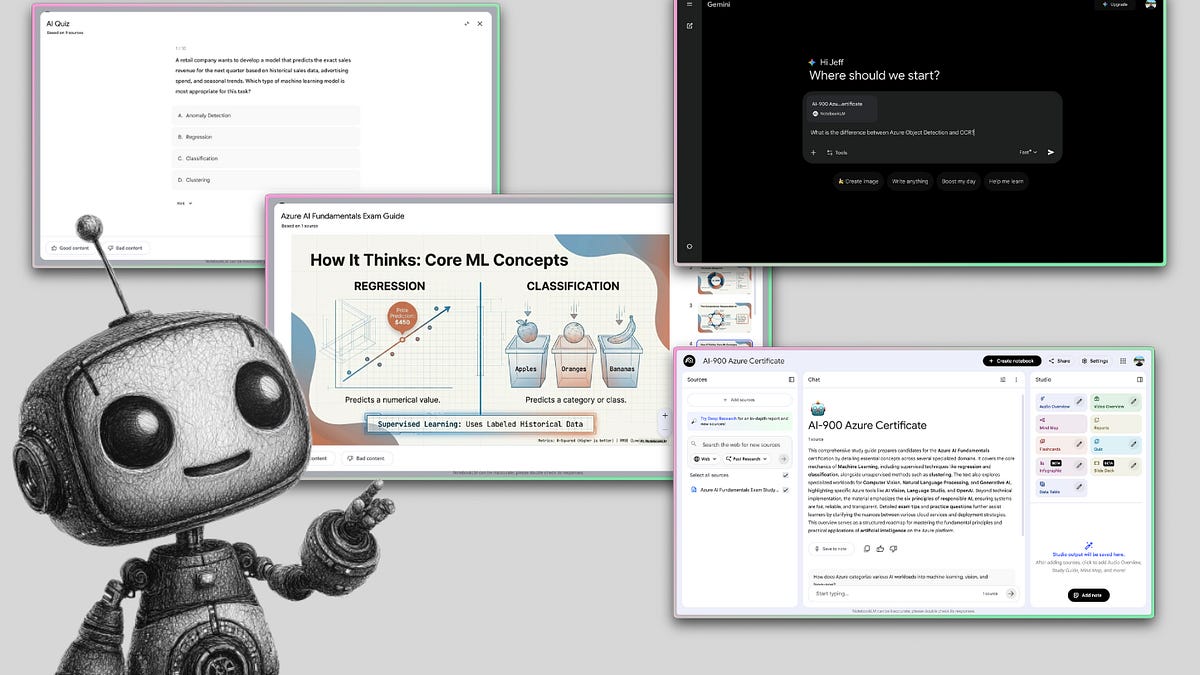
Google Maps update, NotebookLM Video Overviews. Tricks to using NotebookLM with Gemini. Compilation of NotebookLM guides and how-tos. Chatbot traffic upload.
This Newsletter usually goes out at 05:30 AM EST. On rare occasions it’s a bit late (like today).
Good Morning,
I wanted to update you on some of Google’s AI improvements that caught my attention. You can follow the NotebookLM Twitter. At the beginning of March we learned that NotebookLM is introducing Cinematic Video Overviews, a major update to its AI-powered video creation capabilities.
NotebookLM leverages Gemini 3, Nano Banana Pro, and Veo 3 to offer “fluid animations and rich, detailed visuals to help you learn and engage with the topics you care about. Users with a Google AI Ultra subscription can turn their notes into personalized, fully animated videos. Users can also only generate a max of 20 cinematic video overviews per day.
Google is saying that NotebookLM has moved beyond a simple “research assistant”, evolving into a full "Research-to-Content" pipeline. Read how to do it.
Google Maps Getting a Huge AI Update
Ask Maps is a new way to get answers to your complex, real-world questions with a simple conversation. These updates to Google Maps look fairly useful. They are calling this “its biggest upgrade in over a decade.” By combining Gemini models with a deep understanding of the world, Maps now unlocks entirely new possibilities for how you navigate and explore. Learn more.
Ask Maps
The first big change is a conversational feature called "Ask Maps", which is designed to let you ask Google Maps more complicated questions that it never could have handled before.
I asked Jeff Morhous for ideas for beginners on using Gemini with NotebookLM.
The AI-Augmented Engineer
The vibe-worker’s guide to software engineering, AI workflows and coding interfaces.
NotebookLM And Google AI ecosystem related Articles
Using NotebookLM to learn new things
3 Hidden NotebookLM Features Most People Don’t Use
The ultimate NotebookLM tutorial
58 Nano Banana 2 Prompts for Infographics (With Examples)
9 NotebookLM Prompts That Supercharge Productivity
We Blind-Tested ChatGPT vs Claude vs Gemini — Here’s the Winner (2026)
Every Google AI Tool in 2026: What Each One Does and When to Use It
How Google Workspace CLI Made My Claude Code Setup 10x More Powerful
How I Connected NotebookLM to Claude and Changed How I Do Research Forever
Gemini Embedding 2:
Google’s first multimodal embedding model. It can map text, images, video, audio, and PDFs into a single unified space, which is a massive leap for developers building advanced search and RAG (Retrieval-Augmented Generation) systems.
The model is based on Gemini and leverages its best-in-class multimodal understanding capabilities to create high-quality embeddings across:
Text: supports an expansive context of up to 8192 input tokens
Images: capable of processing up to 6 images per request, supporting PNG and JPEG formats
Videos: supports up to 120 seconds of video input in MP4 and MOV formats
Audio: natively ingests and embeds audio data without needing intermediate text transcriptions
Documents: directly embed PDFs up to 6 pages long
As you might know, Embeddings are the technology that power experiences in many Google products. While many people have been switching from ChatGPT to Claude, I think Gemini’s offering is worth it now in 2026 if you use Google’s ecosystem.
Let me just say I love the idea of a smarter Google Maps.
In a Nutshell what does it mean for just the average person though?
If you know someone who uses Google Maps and would want to know, feel free to share it with them.
So convenience wise what’s actually changed or changing?
New Experiences in Google Maps
I’ve tried my best to break down the key new experiences you can expect over the coming months if you are an Android and Google Maps user.
Ask Maps: A new conversational assistant powered by Gemini. Instead of just searching for keywords, you can ask complex, natural-language questions like, “Where can I charge my phone without a long wait for coffee?” or “Find a restaurant with vegan options and easy parking along my route.”
Immersive Navigation: This replaces the traditional flat 2D map with a vivid 3D view of your entire route. It uses AI to stitch together Street View and aerial imagery, showing realistic buildings, overpasses, and terrain to help you orient yourself better in unfamiliar areas.
Enhanced Road Details: During navigation, the map now highlights specific details like lane markings, crosswalks, traffic lights, and stop signs. This is designed to help drivers prepare for tricky turns and lane changes well in advance.
Transparent Buildings: As you approach complex turns, nearby buildings can become translucent on the screen. This “X-ray” style view allows you to see the road ahead even if it curves behind a large structure.
Contextual Route Comparisons: When Maps suggests an alternate route, it now explains the trade-offs in plain language—for example, telling you a route is “3 minutes longer but avoids heavy highway construction.”
Arrival Guidance: To simplify the “last mile” of a trip, the app now highlights the specific entrance of a building and provides recommendations for nearby parking as you get close to your destination.
Natural Voice Guidance: Voice directions have been updated to sound more human and use landmarks. Instead of “In 500 feet, turn right,” you might hear, “Go past this exit and take the next one for Illinois 43 South.”
Google Gemini is Taking Marketshare
According to Similarweb, Gemini (in pink) continues to make strides in terms of worldwide traffic and active users.
Gemini has been taking ChatGPT Marketshare in some domains
We like to talk about the Claude vs. ChatGPT rivalry lately, but Google is the one that’s made the most progress in terms of building a full-stack AI ecosystem.
More ChatGPT Users are also using Gemini
As Gemini, Claude, Grok and others reach near parity with ChatGPT, it becomes more about preference, tone and the “personality” of the chatbot (or brand of the company) for many everyday users.
Simliarweb has a lot of recent data they have shared on this here (in mid March, 2026).
Facts Only
NotebookLM introduced Cinematic Video Overviews
Users with Google AI Ultra subscription can generate videos
Maximum of 20 cinematic video overviews per day
NotebookLM leverages Gemini 3, Nano Banana Pro, and Veo 3
Google Maps is getting a major update
Ask Maps is a new conversational feature
Updates to Google Maps are called its biggest upgrade in over a decade
Combines Gemini models with deep understanding of the world
New features include: Ask Maps, Immersive Navigation, Enhanced Road Details, Transparent Buildings, Contextual Route Comparisons, Arrival Guidance, and Natural Voice Guidance
Executive Summary
Full Take
The article presents a pattern of corporate competition in the AI industry, with Google's NotebookLM and Google Maps updates aiming to challenge or improve upon existing platforms like ChatGPT. The focus on video creation with NotebookLM suggests a strategy to cater to content creators and educators, while the improvements in Google Maps aim to enhance navigation and exploration for users.
In terms of deeper implications, these advancements further blur the line between human and artificial intelligence, as AI becomes increasingly capable of understanding and responding to complex natural-language questions, creating personalized content, and providing more immersive experiences. However, they also raise concerns about privacy, data security, and potential misuse in influencing user behavior or decision-making.
Questions for further inquiry might include: What ethical considerations should be addressed as AI continues to advance? How can we ensure that the benefits of these technologies are distributed equitably among all users? And how will these developments impact the future of work, particularly within industries such as software engineering and education?