Featured
SpaceX IPO Closes Higher Than $160 Per Share
Written by: Lesley Conn
First-Day Trading Makes Elon Musk World’s First Trillionaire
Like so many of its products, SpaceX launched its IPO on Friday to worldwide fanfare, and by closing bell, its debut stock price settled into orbit well above any other publicly traded space company.
Trading on the Nasdaq under the ticker symbol SPCX, SpaceX opened at $150 per share, 11% higher than its initial price offering of $135 per share. Within the hour, SPCX hit a high of $176.52 before closing at $160.95 and edging past $163 in after-hours trading.[1]
The public offering of the stock makes founder Elon Musk the world’s first trillionaire and SpaceX the seventh-largest firm in the world with a valuation higher than $2 trillion.[2]
SpaceX’s record-setting debut follows a years-long strong performance in the space industry:
- So far in 2026, about half of all global orbital launches (65 of 144) have gone up on a Space X reuseable booster.[3]
- SpaceX also dominated the launch market in 2025, with 165 of a record 329 launches, again tallying half of all global orbital launches.[4]
- The company is also the dominant player in the satellite market, with more than 66% of the nearly 16,000 active satellites part of SpaceX’s 10,000-plus Starlink constellation.[5]
- While not the first company to offer broadband from space, SpaceX’s Starlink has rapidly grown into market dominance, with more than 10 million of the 12 million customers who pay for satellite internet connectivity.[6]
In its stock prospectus, SpaceX lays out its corporate agenda.[7]
“Our mission is to build the systems and technologies necessary to make life multiplanetary, to understand the true nature of the universe, and to extend the light of consciousness to the stars,” the company stated. “To do this, we have formed the most ambitious, vertically integrated innovation engine on (and off) Earth with unmatched capabilities to rapidly manufacture and launch space-based communications that connect the world, to harness the Sun to power a truth-seeking artificial intelligence that advances scientific discovery, and ultimately to build a base on the Moon and cities on other planets.”
Going Even Bigger for Launch
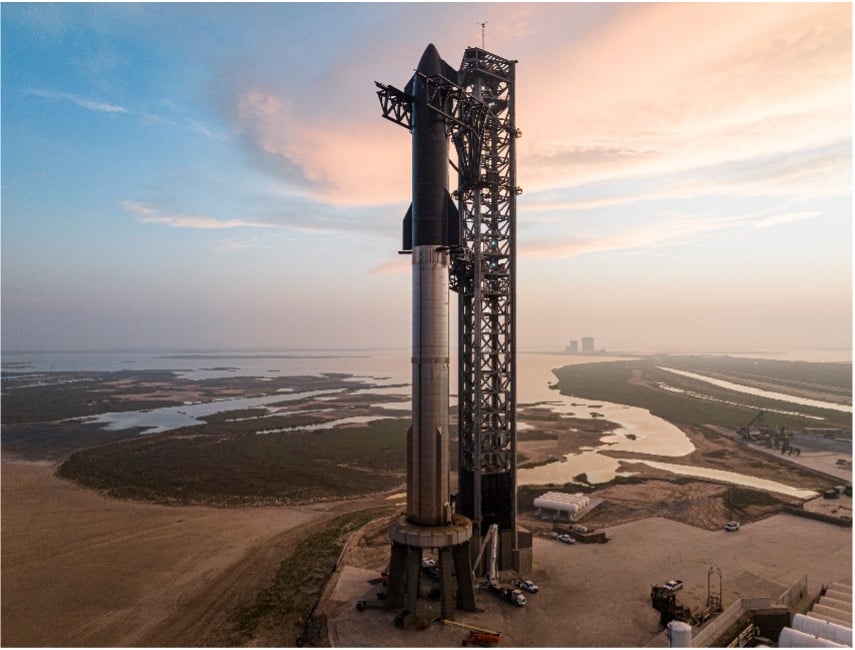
Ahead of its IPO, SpaceX launched the third version of its Starship booster and spacecraft in a suborbital test for a launch system the company expects to be in regular use later this year.[8] The test showed how the big rocket could bend the low Earth orbit market by hauling satellites up by the dozen.
With the ability to lift as much as 100 tons to Earth orbit, Starship is also a key component of NASA’s Artemis program, competing with Blue Origin for lunar lander contracts, and a role lifting cargo for an eventual Moon base. It is powered by 33 redesigned Raptor engines on its main stage. It is also emblematic for the firm and its stock, which has paired massive capital outlays with ideas like orbiting data centers and interplanetary settlement, which would turn science fiction into reality.[9]
The latest evolution of Starship, named V3, launched May 22, overcoming the loss of a single main stage engine and a pair of engines on its upper stage. The massive first stage suffered flight anomalies that led to a hard splashdown into water off the Texas coast. The upper stage demonstrated its ability to deploy satellites in orbit and maneuvering capabilities before its descent and landing in the Indian Ocean.[10] The upper stage, burdened with additional fuel due to engine failures, caught fire after the landing. The company called the test flight a success.
The flight tested a new configuration for Starship, with 33 upgraded Raptor engines firing from a new pad at Starbase, the firm’s corporate launch facility in Texas.[11] Considered to be one of the most complex machines ever made, the V3 Starship replaces earlier versions, which struggled through flight tests including events described by the company as a “rapid unscheduled disassembly.”
In space, Starship deployed simulated Starlink satellites and two active payloads to test Starlink hardware and used cameras to examine the heatshield of the mothership.
When fully operational, Starship will augment SpaceX’s best-known launch vehicle, the Falcon 9, which entered May averaging one launch every two days. The launch pace is expected to accelerate in the summer months.[12]
Delays for new launch vehicles from competitors left SpaceX’s Falcon 9 with a nearly clear field in recent years. It also has a jump on other satellite broadband competitors, as the first low Earth orbit constellation to reach consumers.
Competing Against SpaceX
Blue Origin, the only firm with a launch vehicle that could rival Starship, was on pace for regular flights of its massive New Glenn this this year, lifting as much as 50 tons to low Earth orbit on each launch. The company, a venture by Amazon founder Jeff Bezos, was forced to retrench after one of its New Glenn boosters detonated during a hot-fire test May 28, destroying a launch complex at Cape Canaveral, Fla. Blue Origin leaders were working on a return to flight even as they combed through wreckage looking for what may have caused the mishap.[13]
New Glenn was key for another effort pushed by Bezos, as the primary launch vehicle for Amazon’s Leo. The 3,200-satellite broadband constellation, a Starlink competitor, faces a regulatory deadline of July 30 to have at least half of its proposed satellites launched. Amazon, which has 330 satellites in orbit, has asked the Federal Communications Commission for a two-year extension on the deadline.[14]
Another launch vehicle competitor, United Launch Alliance, has faced teething problems with its Vulcan, which can lift 30 tons to low Earth orbit. After several delays, Vulcan returned to flight May 30, delivering 29 Amazon Leo satellites to orbit.[15]
China’s Qianfan broadband constellation is also in its infancy. Projected to eventually top 10,000 satellites in orbit, the constellation reached 164 satellites in early June.[16]
Military bets big on SpaceX
With hundreds of satellites in its Starshield secure communications constellation, SpaceX was already a top Pentagon contractor.[17] The company’s role in national defense grew significantly larger in May with two major contract awards that could change how the military spots targets and how it communicates on the battlefield.
SpaceX was selected to build the $2.3 billion Space Data Network Backbone (SDN) constellation, which is planned to integrate sensors, streamline communications and data flow.[18] The backbone augments existing military communication satellites with a proliferated network of small satellites in low Earth orbit, making it more difficult for an enemy to disable communications with an attack in space. SpaceX is expected to have prototype satellites for the constellation next year.
SpaceX in May was also awarded $4.2 billion for a key military program that would use satellites to track missiles, drones and aircraft, delivering an unprecedented form of intelligence to troops in combat worldwide. Space Force Col. Ryan Frazier, who is heading the Space-Based Airborne Moving Target Indicator effort, said the constellation would allow troops to monitor hostile movements without putting flight crews or ground forces at risk.[19]
“By focusing these capabilities to the space domain, we are providing the joint force with sustained battlespace awareness of contested airspace,” Frazier said in an email.
The target tracking satellite would be key for the Golden Dome missile defense effort, giving a clear view of systems designed to evade U.S. defenses including stealthy cruise missiles and hypersonic weapons.
SpaceX had been a key launch contractor for the Pentagon for more than a decade, but its entry into the military satellite market has come in recent years.
SpaceX’s Starlink constellation, designed to deliver commercial broadband, was first adopted for battlefield use in 2022 by Ukraine, which has relied on the constellation for secure military communications in its war with Russia.
SpaceX Ambitions Go Beyond Dominance in Orbit
Investors keen to buy into U.S. Space economy over the past 12 months have launched stock prices higher, with the VettaFi Space Index to 3,400 points from 1,200 points over the past 12 months.[20]
The Starship flight and SpaceX’s stock debut could also point the way for SpaceX’s competitors and peers in what has been called the “new space” sector, where ideas and venture capital led to a decade of unprecedented growth in the launch and satellite sector.
SpaceX is far from first of its kind to look to Wall Street for capital, with companies including Voyager, Firefly, Intuitive Machines, and Planet Labs among the publicly traded new space firms. But SpaceX is by far the largest stock deal in the sector and could prove to be a bellwether for the satellite, communications, and artificial intelligence industries.
The public offering bundles SpaceX holdings with Starlink’s subscriber-paid internet services, the social media site X.com, and xAI, an artificial intelligence company. Before the IPO, the combined firm had been valued at more than $1.2 trillion. While the goals of SpaceX’s missions beyond Earth remain lofty, they shrink when compared to the firm’s artificial intelligence goals, which include moving data centers to solar-powered satellites in Earth orbit. SpaceX now has data centers on Earth including what it describes as the world’s most powerful computer, Colossus.[21]
SpaceX in its SEC filings estimates the broadband and direct-to-device markets could generate $1.8 trillion, while the AI market would be more than 10 times larger at $22.7 trillion.[22]
SpaceX Financials Released
A day before the Starship launch, the Securities and Exchange Commission released financial statements from SpaceX required for its stock offering. It is the first detailed look inside the 24-year-old firm’s cashflows, which has been privately held by investors including Musk.[23]
SpaceX lost $4.9 billion overall in 2025 as a combined company including its space, connectivity, and artificial intelligence divisions. The firm’s space division recorded a loss of $657 million in 2025, driven by more than $3 billion in research and development costs. Led by Starlink, connectivity proved to be a moneymaker for SpaceX, with operating income of $4.4 billion up from $2 billion. Artificial intelligence, with $5 billion spent on research and development in 2025, recorded a loss of $6.3 billion.
SpaceX’s losses in 2025 came as the company invested heavily in new technology and more infrastructure. But revenue rose last year to record levels across the company. Space sector revenue inched up to $4.1 billion from $3.8 billion. AI saw a modest gain to $3.2 billion from $2.6 billion. Connectivity brought in $11.3 billion up from $7.6 billion.
SpaceX’s biggest customer is the U.S. government, which drove more than $3.6 billion in 2025 revenue, with contracts for the Pentagon, NASA, and intelligence agencies. Having the federal contracts in hand could make SpaceX more lucrative as Congress mulls a budget that could nearly double Space Force spending to $71.1 billion.[24]
Beyond the bottom line, SpaceX touts structural advantages that could bring profits to investors in the future. It is betting that its massive, reuseable launch vehicle, growing communications demands, and an ability to build orbiting data centers drawing electricity from solar arrays will drive costs down and revenue up.
In its prospectus, SpaceX portrays itself as the sole company that could make that vision into reality.
“Our ability to launch mass at scale and low cost is our foundational competitive advantage. Deployment of 100 gigawatts per year via satellites carrying over 100 kilowatts of compute power per metric ton will require thousands of launches per year and the transport of approximately one million metric tons to orbit annually. The fully reusable nature of Starship positions us to be capable of launching this level of mass.”
Space Stocks on Winning Streak
The global space economy has shown annual growth at nearly 8% in recent years, surging to an estimated $613 billion in 2024. Led by rising demand for commercial space services, growing government spending, and an international race to the Moon, some space companies have shown outsized growth in the past year.
A $1,000 investment in Planet Labs a year ago would be worth more than $10,400 today, with shares rising from less than $4 to more than $42.[25] Rocket Lab investors saw their shares go as high as $125 per share from to $25 in the past year.[26] Intuitive Machines rose to $34 per share from $11 a year ago.[27]
One yardstick that may be a measure of SpaceX’s worth is stock in EchoStar, a conglomerate of satellite television, telecommunications, and networking firms that acquired $8.5 billion of SpaceX stock as part of a $17 billion sale of bandwidth licenses.[28] The deal grew in November, with more bandwidth licenses traded for SpaceX stock, giving EchoStar an $11.1 billion stake in the firm, or 54 million shares valued at $212 per share.[29]
One year ago, EchoStar was trading at about $23 per share. It surged in September to about $80 per share. The rise continued after the November deal, with EchoStar stock hitting $143 per share May 21. The price dropped slightly after the May 22 starship test flight but had recovered by May 26.
Space Foundation Insights article by Tom Roeder and Lesley Conn. Reach them at [email protected].
1 Nasdaq. “Space Exploration Technologies Corp. Class A Common Stock. June 12, 2026. https://www.nasdaq.com/market-activity/stocks/spcx
2 Forbes. “SpaceX Opens at $150—Surging 20% After Largst IPO Ever (Live Updates). June 12, 2006. https://www.forbes.com/sites/tylerroush/2026/06/12/spacex-opens-at-150-surging-17-after-largest-ipo-ever-live-updates
3 Space Foundation database. “Launch 2026.”
4 Space Foundation database. “Launch 2025”
5 North American Aerospace Defense Command. “Box Score.” May 22, 2026. https://www.space-track.org/#boxscore
6 Securities and Exchange Commission. “Form S-1” May 20, 2026. https://www.sec.gov/Archives/edgar/data/1181412/000162828026036936/spaceexplorationtechnologi.htm
7 Securities and Exchange Commission. “Form S-1” May 20, 2026. https://www.sec.gov/Archives/edgar/data/1181412/000162828026040364/spaceexplorationtechnologib.htm
8 SpaceX. “Starship 12th flight test.” May 21, 2026. https://www.spacex.com/launches/starship-flight-12
9 CNBC “SpaceX targets fixed $135 IPO roadshow price at $1.75 trillion valuation, source says” June 3, 2026. https://www.cnbc.com/2026/06/03/spacex-ipo-stock-price-roadshow-musk.html
10 SpaceX. “Starship 12th flight test.” May 27, 2026. https://www.spacex.com/launches/starship-flight-12
11 SpaceX. “Starship 12th flight test.” May 21, 2026. https://www.spacex.com/launches/starship-flight-12
12 SpaceX. “Falcon-9” May 22, 2026. https://www.spacex.com/vehicles/falcon-9
13 Blue Origin. “NG-4 Hotfire Updates” May 30, 2026. https://www.blueorigin.com/news/ng-4-hotfire-updates
14 FCC. “Report No. SAT-01972” Feb. 6, 2026. https://docs.fcc.gov/public/attachments/DOC-418526A2.pdf
15 ULA. “United Launch Alliance precisely delivers seventh Amazon Leo Mission” May 30, 2026. https://newsroom.ulalaunch.com/releases/united-launch-alliance-precisely-delivers-seventh-amazon-leo-mission-advancing-constellation-toward-commercial-service
16 People’s Daily. “China’s Long March-12B rocket completes successful maiden flight” June 2, 2026. https://en.people.cn/n3/2026/0602/c90000-20462782.html
17 Space Foundation database. “Launch 2025.”
18 Space Systems Command. Email to author. May 26, 2026.
19 Space Systems Command. Email to author. May 29, 2026.
20 VettaFi. “VettaFI Space Index” June 1, 2027. https://www.vettafi.com/indexing/index/space
21 xAI. “Colossus” Undated. https://x.ai/colossus
22 Securities and Exchange Commission. “Form S-1” May 20, 2026. https://www.sec.gov/Archives/edgar/data/1181412/000162828026036936/spaceexplorationtechnologi.htm
23 Securities and Exchange Commission. “Form S-1” May 20, 2026. https://www.sec.gov/Archives/edgar/data/1181412/000162828026036936/spaceexplorationtechnologi.htm
24 Space Foundation database. “Space Force Budget.”
25 New York Stock Exchange. “Planet Labs.” May 21, 2026. https://www.nyse.com/site-search?q=planet+labs&pageNumber=1
26 Nasdaq. “Rocket Lab.” May 21, 2023. https://www.nasdaq.com/market-activity/stocks/rklb-0
27 New York Stock Exchange. “Intuitive Machines” May 21, 2026. https://www.nyse.com/quote/XNMS:LUNR
28 EchoStar. “EchoStar Announces Spectrum Sale and Commercial Agreement with SpaceX” Sept. 8, 2025. https://ir.echostar.com/news-releases/news-release-details/echostar-announces-spectrum-sale-and-commercial-agreement-spacex
29 Securities and Exchange Commission. “Form 8K.” Nov. 6, 2025. https://ir.echostar.com/static-files/57bf0a65-59a3-4f0e-8b6d-f2d7cbb9d454
Facts Only
SpaceX IPO launched on June 12, 2026, under ticker SPCX on Nasdaq.
Shares opened at $150, 11% above the $135 initial offering price, closing at $160.95.
SpaceX valuation exceeded $2 trillion, making Elon Musk the world’s first trillionaire.
SpaceX conducted 65 of 144 global orbital launches in 2026 and 165 of 329 in 2025.
Starlink constellation includes over 10,000 satellites, serving 10 million of 12 million satellite internet customers.
Starship V3 test flight occurred on May 22, 2026, deploying simulated Starlink satellites despite engine failures.
SpaceX secured Pentagon contracts worth $2.3 billion (Space Data Network Backbone) and $4.2 billion (missile-tracking satellites).
2025 financials showed $4.9 billion in losses, with $3 billion in space R&D and $6.3 billion in AI losses.
Starlink generated $11.3 billion in revenue in 2025, up from $7.6 billion.
Blue Origin’s New Glenn booster failed during a May 28 hot-fire test, delaying its launch schedule.
United Launch Alliance’s Vulcan rocket delivered 29 Amazon Leo satellites on May 30, 2026.
China’s Qianfan constellation reached 164 satellites by June 2026.
VettaFi Space Index rose from 1,200 to 3,400 points over the past year.
EchoStar acquired $11.1 billion in SpaceX stock, valuing shares at $212 each.
Executive Summary
Full Take
The SpaceX IPO narrative presents a compelling vision of technological dominance, but it also invites scrutiny of its underlying assumptions and potential risks. At its strongest, the story highlights SpaceX’s unparalleled execution in launch cadence, satellite deployment, and military contracts, positioning it as the undisputed leader in the new space economy. The financial disclosures, however, reveal a company still in heavy investment mode, with losses driven by ambitious R&D in AI and space infrastructure. The pattern here aligns with ARC-0012 "Overpromise-Underdeliver," where grand visions (e.g., interplanetary cities, orbiting data centers) may outpace near-term profitability. The article also employs ARC-0024 "Ambiguity" by framing losses as strategic investments without addressing sustainability concerns.
Rooted in the paradigm of techno-optimism, this narrative assumes that scale and vertical integration will inevitably lead to profitability—a bet that has paid off for Musk in the past but carries systemic risks. The Pentagon contracts, while lucrative, tie SpaceX’s fortunes to geopolitical stability and defense budgets, creating dependencies that could backfire. Meanwhile, competitors’ struggles (e.g., Blue Origin’s setbacks) are framed as validation of SpaceX’s superiority, ignoring broader industry challenges like regulatory hurdles and market saturation.
For human agency, the implications are mixed: SpaceX’s innovations could democratize space access, but its dominance may stifle competition, reducing consumer choice. The military applications raise ethical questions about privatized warfare and surveillance. Bridge questions emerge: How sustainable is SpaceX’s debt-fueled growth? Could regulatory or geopolitical shifts disrupt its trajectory? What if Starship’s promised cost reductions fail to materialize?
Counterstrike scan: A coordinated influence campaign would amplify SpaceX’s successes while downplaying risks (e.g., financial losses, competitor viability). The article does this to some extent but stops short of outright manipulation, instead relying on selective framing. No overt attack pattern is detected, but the narrative’s uncritical tone warrants skepticism.
Patterns detected: ARC-0012 Overpromise-Underdeliver, ARC-0024 Ambiguity