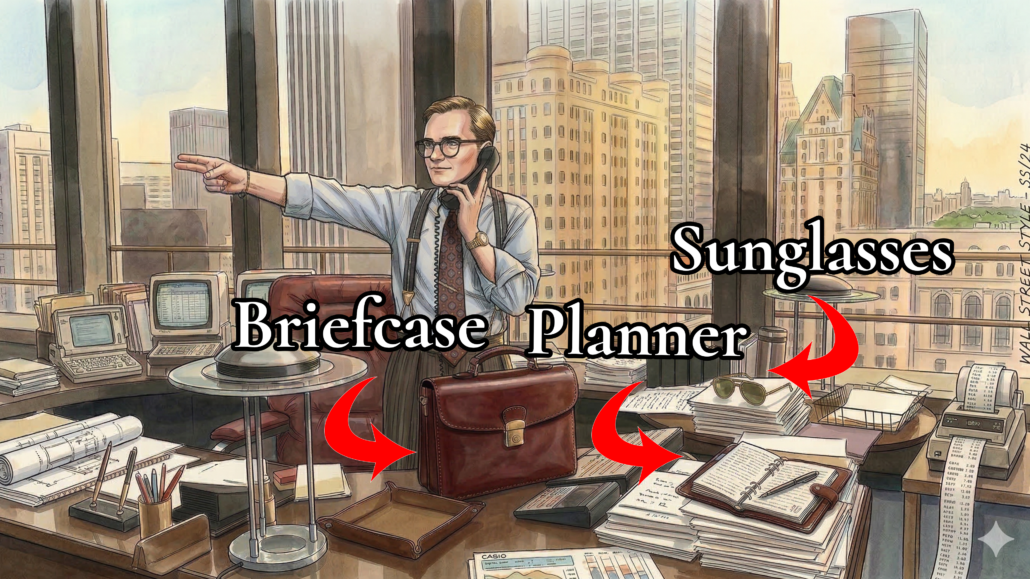
While the 1980s are often remembered for neon colors and synth-pop, the Every Day Carry (EDC) of a gentleman during this era was a refined, and increasingly high-tech, affair. Here is the typical EDC for a man of the 1980s.
- 1. Sunglasses: The New Essential
- 2. The Wristwatch: Analog vs. Digital
- 3. Loose Change & Payphones
- 4. The Bifold Wallet & The “Card Boom”
- 5. Refined Business Cards & Cases
- 6. The Checkbook
- 7. Personalized Small Leather Goods
- 8. The Daily Planner (The Filofax)
- 9. The Ballpoint Pen
- 10. The Pocket Protector
- 11. The Briefcase & Attaché Case
- 12. The Sony Walkman
- Bonus: The “Brick” Mobile Phone
- Summary Table: 1980s EDC Essentials
- Conclusion
- Frequently Asked Questions
- What to Watch Next
1. Sunglasses: The New Essential
By the 1980s, classic dress hats had largely become a thing of the past. To fill the void left by the brim, sunglasses exploded in popularity. Propelled by the silver screen – think Top Gun, Ferris Bueller’s Day Off, and Miami Vice – shades became the ultimate status symbol.
- Key Brands: Ray-Ban and Oakley dominated the scene.
- Top Styles: Aviators and Wayfarers were seen on everyone from Wall Street brokers to weekend warriors.
- The Trend: They were so iconic that some men even wore them at night (we see you, Corey Hart).
2. The Wristwatch: Analog vs. Digital
Wristwatches remained the default tool for punctuality, but the 80s introduced a stylistic fork in the road.
The Traditional Choice
Two-tone metal colorways (gold and steel) and square or non-circular dials were the height of fashion. Brands like Seiko, Omega, and IWC (technically ee-veh-tseh) were the middle-market and luxury staples.
Choosing a Watch That Fits Your Life
The Digital Revolution
The “gadget watch” arrived in earnest. While digital watches debuted in the 70s as luxury items (like Roger Moore’s Hamilton Pulsar in Live and Let Die), the 80s made them affordable. Casio became the king of the wrist, incorporating lights, alarms, and even calculators.
3. Loose Change & Payphones
In a pre-smartphone world, a pocket full of quarters was a literal lifeline. If you were on the go and needed to make a call, you were hunting for a phone booth. This spare change was typically kept in a dedicated coin purse or simply rattled around in a trouser pocket.
4. The Bifold Wallet & The “Card Boom”
Traditional leather bifold wallets reigned supreme because men were carrying more than just cash.
RECOMMENDED
Le Grand 10 Card Saddle Brown Leather Wallet
The 1980s was the decade of the “Power Carry,” and our Le Grand 10 Card Bifold in Saddle Brown is the ultimate evolution of that aesthetic. Crafted from five layers of superlative, full-grain European leather, this wallet is designed to handle the heavy card requirements of a modern (or 80s) lifestyle without the unsightly bulk. With ten dedicated card slots, a divided cash pocket for organizing multiple currencies, and discreet RFID protection for 21st-century security, it offers the perfect marriage of retro capacity and contemporary craftsmanship.
Upgrade Your Carry: Get the 10 Card Saddle Brown Wallet Here
The 1980s saw an explosion in the variety of cards a man needed to carry:
- Credit Cards: Magnetic strip technology replaced the old “knuckle-buster” manual machines.
- Gas Cards: Essential for loyalty discounts at specific stations.
- Rental Cards: You couldn’t get your weekend VHS fix at Blockbuster without one.
- Emergency Cards: Vital info like blood type and allergies, kept on a physical card.
5. Refined Business Cards & Cases
Exchanging business cards was more than a professional necessity; it was a ritual. In the upper echelons of the white-collar world, the case was just as important as the card.
“That’s bone. And the lettering is something called Silian Rail.” — American Psycho
To avoid the “Patrick Bateman” level of anxiety, men invested in leather or metal cases from brands like Louis Vuitton, Cartier, or Armani.
6. The Checkbook
Though starting to decline to the credit card by the end of the decade, the checkbook was still a primary payment method for most of the 80s. Usually kept in a leather cover, it sat alongside cash and credit cards as a pillar of 80s finance for larger transactions.
7. Personalized Small Leather Goods
The 1980s celebrated the “personal touch.” Thanks to improved manufacturing, it became affordable to have key fobs, wallets, and card cases monogrammed or embossed. This allowed the average man to feel a sense of bespoke luxury without the price tag of historic custom-made products.
Choosing the Best Leather for Your Accessories
8. The Daily Planner (The Filofax)
Before we had calendars in our pockets, we had the Filofax. For the “yuppie” subculture, a leather-bound daily organizer was the ultimate tool for managing meetings, addresses, and reminders. It was the analog precursor to the smartphone.
9. The Ballpoint Pen
While the fountain pen remained the choice of the traditionalist, the ballpoint pen became the 80s workhorse. They were convenient, cheap enough to hand out as “swag,” and often personalized with business logos.
10. The Pocket Protector
As pens became cheaper and more disposable, the risk of a leak increased.
A Practical Shield for the Professional
Saving Expensive Dress Shirts from 1980s Ink Stains
Engineers and office workers often sported the pocket protector. While it began as a practical tool to save expensive dress shirts from ink stains, it eventually became a “nerdy” pop-culture cliché that faded as the decade closed.
11. The Briefcase & Attaché Case
If you were a professional in the 80s, you carried a briefcase.
- Hard Cases: Rigid, boxy attaché cases (think Samsonite or Hartmann) were the gold standard for security and status.
- Soft Bags: Toward the late 80s, messenger-style bags began to appear, though they were often unfairly derided as “man purses.”
12. The Sony Walkman
The Sony Walkman was the “poster child” for 80s tech innovation. It allowed for a private soundscape in public spaces, revolutionizing how men commuted and exercised. It was hip, trendy, and, for the fitness-obsessed 80s man, an essential companion for a jog.
Bonus: The “Brick” Mobile Phone
For the 1% on the bleeding edge of technology, there was the Motorola DynaTAC 8000X.
Motorola DynaTAC 8000X
- Weight: 1.1 kg (2.5 lbs)
- Battery: 30 minutes of talk time / 10 hours of charging.
- Price: $3,995 ($13,000 in today’s money). It wasn’t practical, but it was the ultimate 1980s power move.
Also popular in the ’80s, and a staple for the previous 20 years, was the car phone. These were devices hardwired directly into a vehicle. By this decade, car phones were a common tool for business professionals. Specialized mounting devices were also entering the scene, allowing men to integrate their mobile phones with their cars for easier access on the go.
Summary Table: 1980s EDC Essentials
| Item | Popular Brands | Key Feature |
| Sunglasses | Ray-Ban, Oakley | Wayfarers & Aviators |
| Watch | Casio, Seiko, Omega | Digital complications or Two-tone metal |
| Organization | Filofax | Leather-bound paper planners |
| Audio | Sony | The Walkman (Portable Cassette) |
| Professional | Parker, Cross | Ballpoint pens & Attaché cases |
Conclusion
Which items surprised you the most, and did we miss any essentials? We’d love to hear from those who lived through the 1980s: how accurate was our roundup? Let us know what your EDC looked like back then!
We’ve already covered the 1920s and the 1960s. Leave a comment below to let us know which decade you’d like us to cover next!
Frequently Asked Questions
What did a classic gentleman typically carry every day in the 1980s?
A gentleman’s EDC in the 1980s included essentials like a leather wallet, key case, elegant wristwatch, quality fountain or ballpoint pen, business card holder, compact notepad, coin purse, classic cigarette case or lighter (if he smoked), and a discreet handkerchief.
How is 1980s EDC different from today’s modern carry?
In the 1980s, ubiquitous personal technology was absent from daily carry, as most gentlemen weren’t weighed down by mobile phones or excessive electronics. Instead, he favored analog tools such as mechanical watches, traditional writing instruments, and, occasionally, a pocket knife. The focus was on items that combined refinement, durability, and utility.
Which leather accessories were popular EDC items for gentlemen in the 1980s?
Fine leather goods dominated: classic billfold wallets, credit card sleeves, coin purses, and key fobs, often crafted from aniline-dyed or bridle leather for longevity and patina. Accessories were meant to coordinate with luxury shoes and belts, underscoring the importance of unified style.
Was a wristwatch essential for a gentleman’s EDC in the 1980s?
Yes, a wristwatch, often mechanical or quartz but sometimes digital, was indispensable for punctuality and style. Brands like Rolex, Omega, and Seiko were common for those seeking a blend of performance and timeless sophistication. The digital watch, particularly models from Casio and Seiko with functions like alarms and backlights, became a signature accessory and status symbol unique to the decade.
Did men carry business cards and special holders in the 1980s?
Absolutely. Exchanging business cards was both a professional necessity and a mark of good manners. A slim, metal or leather business card case ensured presentation was always polished.
Did gentlemen carry knives or multitools in their daily kit?
A small pocket knife or discreet folding knife was a popular, practical accessory for opening letters and packages or handling small tasks. These were typically understated in appearance.
Were handkerchiefs still part of daily EDC for gentlemen in the 1980s?
Handkerchiefs remained an essential for dealing with minor spills, sneezes, or offering to a companion, reflecting attention to both personal appearance and etiquette. Disposable tissue was also used.
What kind of pens did distinguished gentlemen prefer to carry?
Quality writing instruments, such as Parker Jotters, Montblanc or Waterman fountain pens, were valued for note-taking, signatures, and correspondence. A good pen elevated everyday moments and signaled attention to detail.
Did gentlemen carry sunglasses or other protective accessories?
Classic sunglasses—think Ray-Bans or Persol—were a stylish necessity for outdoor occasions, especially among men mindful of health and fashion.
Were there any unique gadgets associated with 1980s EDC?
Yes! In the 1980s, a gentleman’s EDC began to include groundbreaking gadgets that signaled a new era of convenience and personal style. One of the most iconic was the Sony Walkman, a compact cassette player that revolutionized personal music on the go, allowing men to create private soundscapes wherever they traveled. Pocket electronic organizers and basic calculators were also carried by those with a technophile bent, reflecting the growing influence of computing power on everyday life.
Were mobile telephones part of the EDC of the 1980s?
Yes, but not for most men. Early mobile phones, colloquially known as “bricks,” started to appear among executives and trendsetters, though their size limited widespread adoption until the decade’s end.
How would a gentleman organize his EDC in a suit or jacket?
Items were chosen to avoid bulk and preserve clean lines. Many favored slim wallet styles, minimized coin use, and used briefcases, attachés, or leather pouches to carry extras safely, preventing suit pocket sagging.
What to Watch Next
EDC 2026
Team GG’s Everyday Carry
1 Edwardian Essentials
1900s Gentleman’s EDC
15+ Years of Travel
Frequent Flyer Premium Travel Kit & EDC
Noticing lots of AI content from Gentleman’s Gazette recently; the thumbnail, the “summary table”.
It’s unbecoming of a brand targeted at the sophisticated gentleman. Natural, human artwork and writing are cornerstones of the gentlemanly lifestyle.
Thank you Preston and Gentleman’s Gazette for this happy trip down memory lane. As a young professional in my 20’s during the 1980s, I do remember each and every thing you reported on. My work actually provided me a company car with a hard-wired car phone which was very handy and rare at the time. Back then men still desired to dress gentlemanly, used good manners, favored cleanliness and grooming standards, these are things that I still hold dear to myself and adhere to all these years later. I did not follow the trend back then when it came to not wearing of hats. For me fedoras and homburgs were my style then and it still is today. Happily, Borsalino hats were much more affordable then. Cheers!
Facts Only
The 1980s saw sunglasses become a cultural status symbol, with Ray-Ban and Oakley as dominant brands.
Wristwatches included analog models (Seiko, Omega, IWC) and digital watches (Casio), with digital options becoming more affordable.
Payphones required loose change, often carried in coin purses or pockets.
Bifold wallets were standard, holding cash, credit cards, gas cards, rental cards, and emergency info cards.
Business cards were exchanged in leather or metal cases, with brands like Louis Vuitton and Cartier popular.
Checkbooks remained a primary payment method, often stored in leather covers.
Personalized leather goods, such as wallets and key fobs, became more accessible.
The Filofax was a widely used leather-bound daily planner.
Ballpoint pens were common, often personalized with business logos.
Pocket protectors were used to prevent ink stains on dress shirts.
Briefcases and attaché cases were professional staples, with hard cases preferred for security.
The Sony Walkman was a popular portable cassette player.
Early mobile phones, like the Motorola DynaTAC 8000X, were expensive and bulky.
Car phones were hardwired into vehicles and used by business professionals.
Executive Summary
The 1980s marked a transitional era for men's everyday carry (EDC), blending traditional refinement with emerging technology. Sunglasses became a cultural staple, with Ray-Ban and Oakley dominating the market, while wristwatches split between analog luxury (Seiko, Omega) and digital innovation (Casio). Financial tools included bifold wallets, checkbooks, and a growing array of cards (credit, gas, rental), reflecting the decade's shift toward plastic payments. Professional essentials like Filofax planners, ballpoint pens, and briefcases underscored the era's emphasis on organization and status. The Sony Walkman revolutionized personal audio, and early mobile phones, though bulky and expensive, signaled the dawn of portable communication. Leather goods, from wallets to business card cases, were often personalized, reflecting a desire for bespoke touches. The EDC of the 1980s balanced practicality with aspirational style, bridging analog traditions and the digital future.
The article also highlights generational nostalgia, with a reader's commentary confirming the accuracy of the depicted EDC and noting the era's emphasis on grooming, manners, and professional attire. The contrast with modern EDC—now dominated by smartphones and minimalist carry—underscores how technology has streamlined daily essentials while eroding some analog rituals.
Full Take
This article presents a nostalgic yet insightful snapshot of 1980s masculinity, where EDC items served as both functional tools and status symbols. The strongest version of this narrative highlights the decade's unique blend of analog tradition and digital innovation, capturing a moment when technology was becoming personal but hadn't yet dominated daily life. The emphasis on leather goods, business rituals, and gadgets like the Walkman reflects a culture that valued both refinement and forward-thinking.
Pattern-wise, the piece leans into nostalgic framing, which can subtly idealize the past while downplaying its limitations (e.g., the impracticality of early mobile phones or the exclusivity of certain status symbols). The inclusion of a reader's commentary adds authenticity but also risks reinforcing a selective memory of the era—one where gentlemanly norms are romanticized without critiquing their societal context.
Root causes include the 1980s' economic boom, which fueled consumerism and the "yuppie" culture, as well as the decade's technological advancements, which began reshaping daily habits. The EDC of this era reflects a tension between tradition (checkbooks, fountain pens) and modernity (digital watches, Walkmans), mirroring broader societal shifts toward individualism and efficiency.
Implications for human agency are mixed: while the 1980s EDC offered more tactile, intentional interactions (e.g., writing checks, using a Filofax), it also required more physical and cognitive effort than today's streamlined digital tools. The cost of this era's EDC—both financial (e.g., the $3,995 mobile phone) and social (e.g., the pressure to conform to professional norms)—was borne disproportionately by those outside the white-collar elite.
Bridge questions: How did the 1980s EDC reflect broader cultural values of the time? What aspects of this analog-heavy carry might still hold value in today's digital world? How might the romanticization of this era overlook its exclusivity or inefficiencies?
Counterstrike scan: If this were part of an influence campaign, it might exploit nostalgia to sell retro-styled products or critique modern minimalism. However, the content itself is more observational than manipulative, focusing on historical accuracy rather than pushing a specific agenda. No concerning alignment detected.
Patterns detected: ARC-0012 Nostalgia Bait (mild), ARC-0030 Selective Memory
Sentinel — Human
Sentinel analysis incomplete — partial response from fallback model.