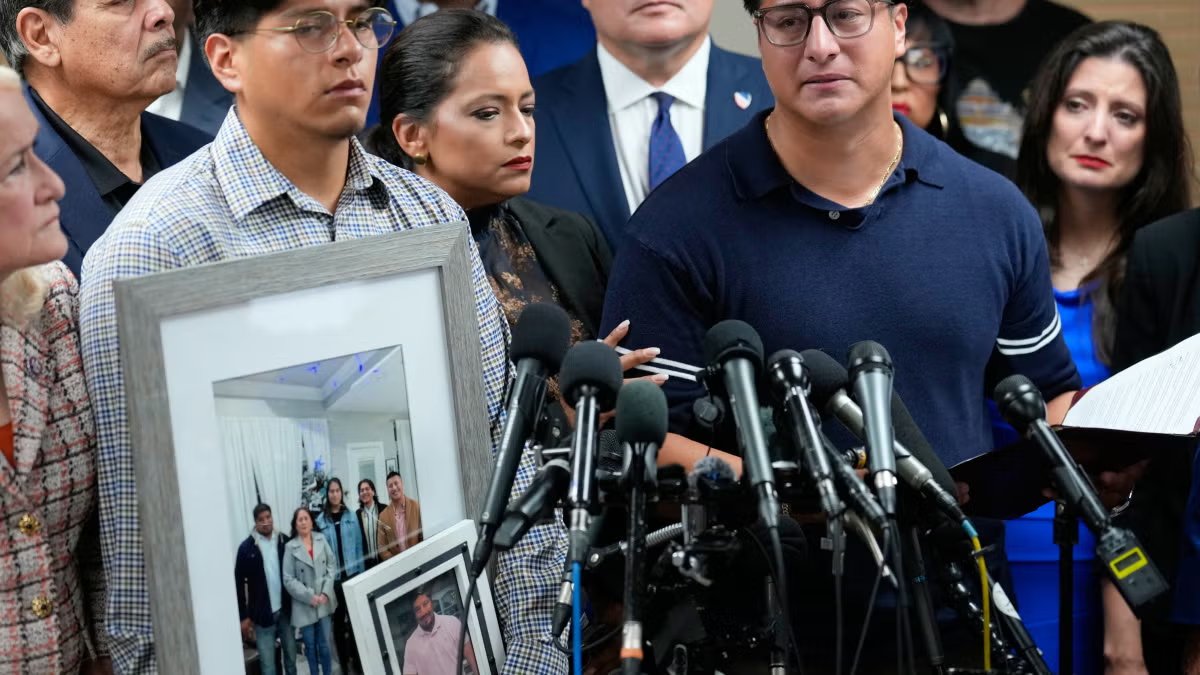
A US Immigration and Customs Enforcement (ICE) agent fatally shot Lorenzo Salgado Araujo in Houston, Texas on July 7. This is the latest in a string of shooting incidents involving federal immigration agents over the past two years.
Salgado, who had reportedly lived in the United States for nearly 35 years, leaves behind a wife and three children. One of his sons, Ronaldo, spoke at a press conference on July 8, describing his father’s dedication to their family and sharing that he and his brother had graduated from university thanks to their father’s “hard work and inspiration.”
While video footage of Salgado’s killing has yet to publicly surface, past ICE conduct gives rise to immediate concerns about both the incident itself and the prospects for a truly credible investigation.
The Department of Homeland Security (DHS) said ICE was conducting “a targeted enforcement operation” when Salgado “weaponized his vehicle in an attempt to run over an ICE law enforcement officer” before an ICE officer fatally shot him.
The language evokes the claims DHS advanced in other cases where agents shot drivers, including the January 7 fatal shooting of US citizen Renee Good in Minneapolis. In that case, DHS stated that Good “weaponized her vehicle in an attempt to kill [ICE officers],” a false claim contradicted by video evidence.
In September 2025, an ICE officer shot Silverio Villegas González near Chicago, claiming he “drove his car at law enforcement officers.” But CCTV footage called that account into question.
Authorities should immediately carry out a comprehensive, transparent investigation into Salgado’s killing and whether ICE officers complied with use-of-force policies. Given federal authorities’ repeated failures to credibly investigate similar incidents, including Good’s killing, local Houston authorities should investigate the killing as well, and federal authorities should share evidence with them.
Congress, meanwhile, should step up its oversight of DHS. Instead of expansively resourcing ICE while ignoring its deadly human rights abuses, Congress should hold oversight hearings, including on killings by federal immigration agents. They should also pass legislation imposing sweeping DHS reforms, such as robust investigation and reporting requirements and meaningful consequences for violations, including effective remedies for victims of abuse.
Facts Only
* A US Immigration and Customs Enforcement (ICE) agent fatally shot Lorenzo Salgado Araujo in Houston, Texas on July 7.
* Salgado lived in the United States for nearly 35 years and left behind a wife and three children.
* Ronaldo Salgado stated his father was dedicated to the family and shared that he and his brother graduated from university due to their father's "hard work and inspiration."
* The Department of Homeland Security (DHS) claimed ICE was conducting a "targeted enforcement operation" when Salgado "weaponized his vehicle in an attempt to run over an ICE law enforcement officer," which resulted in the shooting.
* This language is compared to previous cases, including the January 7 fatal shooting of US citizen Renee Good in Minneapolis, where DHS claimed Good "weaponized her vehicle in an attempt to kill [ICE officers]," a claim contradicted by video evidence.
* In September 2025, an ICE officer shot Silverio Villegas González near Chicago, claiming he "drove his car at law enforcement officers," but CCTV footage called that account into question.
* Authorities are urged to investigate Salgado’s killing and compliance with use-of-force policies by ICE officers.
* The text calls for Congress to increase oversight of DHS through hearings and legislation imposing reforms for investigations, reporting, and remedies.
Executive Summary
Full Take
The narrative presents a juxtaposition between an individual fatal shooting and the systemic practices surrounding federal immigration enforcement. The primary tension lies in the credibility gap concerning official accounts versus physical evidence. The text effectively pivots from reporting a specific violent act to alleging a pattern of behavior by federal agents, drawing parallels with prior incidents where agency justifications were immediately disputed by video or contradictory statements. This approach forces the reader to confront the institutional inertia suggested by repeated failures to credibly investigate similar events.
The structure suggests that individual accountability (Salgado’s death) is inseparable from systemic accountability (ICE conduct and Congressional oversight). The implicit pattern concerns a potential disconnect where official narratives, often employed in high-stakes enforcement scenarios, are presented without transparent evidentiary support. The call for concurrent local and federal investigation stems from the recognition that localized responses may be insufficient when federal agencies have demonstrated a tendency to manage public perception rather than ensure due process regarding use-of-force policies. The deeper implication is about cognitive sovereignty: if institutional failures consistently undermine reliable investigations, external mechanisms—like Congressional oversight—become essential for restoring legitimate accountability and ensuring that dignity is not solely contingent on the narrative provided by the enforcing body.
Bridge questions: What specific evidence exists regarding ICE protocols concerning vehicle use in enforcement operations? How can local law enforcement agencies establish independent investigative capacity when federal bodies consistently face scrutiny over similar matters? If official statements about operational necessity are frequently contradicted, what alternative frameworks for accountability must be prioritized over immediate procedural compliance?
Sentinel — Human
The text reads like advocacy journalism, weaving specific incident details with broader calls for accountability regarding federal law enforcement practices.