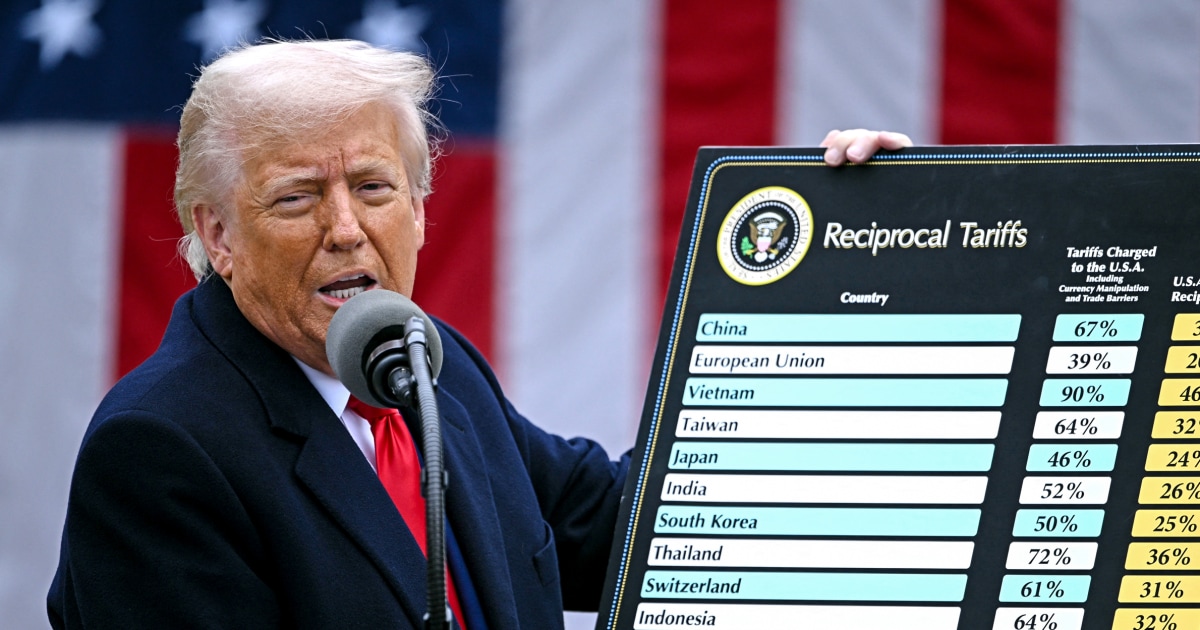
The Trump administration announced Wednesday that it will launch a wave of tariff-related investigations into more than a dozen U.S. trade partners, the next phase in President Donald Trump's sweeping global trade wars.
In a process that is likely to result in a fresh round of tariffs in the near future, the Office of U.S. Trade Representative is opening the formal probes into major trade partners that include the European Union, Mexico and China — each of which ranks among the top five sources of U.S. imports.
Singapore, Switzerland, Norway, Indonesia, Malaysia, Cambodia, Thailand, Korea, Vietnam, Taiwan, Bangladesh, Japan and India will also be the targets of investigations under the trade statute known as Section 301.
“These investigations will focus on economies that we have evidence appear to exhibit structural excess capacity and production in various manufacturing sectors, such as through larger, persistent trade surpluses or underutilized or unused capacity,” said U.S. Trade Representative Jamieson Greer on a call with reporters Wednesday.
“We expect that this investigation will uncover a variety of unfair trading practices,” Greer added.
Greer said the U.S. would also be moving to launch an investigation related to the import of goods made with “forced labor,” in a second announcement set for later this week.
Goods produced using forced labor are already banned from U.S. import under Section 307 of the Tariff Act of 1930. This ban was strengthened in 2021 when Congress passed the Uyghur Forced Labor Prevention Act, which specifically targeted goods made in the Xinjiang region of China.
Currently, the United States has a blanket 10% tariff in place on all trading partners that was imposed after the Supreme Court struck down many of President Donald Trump’s country-specific tariffs in late February.
The court found that Trump exceeded his presidential authority when he used the International Emergency Economic Powers Act to impose rapid-fire tariffs on scores of countries.
The current tariff was enacted under Section 122 of the Trade Act of 1974, which permits the tariff to remain in place for 150 days, but not longer.
Greer said his goal was for the investigations announced Wednesday to be wrapped up by the time that 150-day period ends.
“There are potential options for the president,” said Greer. “We are much more focused on doing the Section 301 investigations, and bringing them to conclusion as quickly as possible," he said.
“I would like to target them coming to conclusion before the [Section] 122 [tariff] expires," he added.
Trading partners named in the new action Wednesday are expected to fiercely protest the latest moves by the Trump administration. Especially after many of them have reached framework trade deals over the course of the past year.
Mexico, for example, is a party to the United States-Mexico-Canada trade pact, which Trump negotiated during his first term in office. It was not immediately clear how Wednesday’s announcement would impact that agreement.
The European Union, America's largest trade partner, reached a deal last summer that was announced in Scotland.
But the future of that agreement is currently in doubt, after the E.U. hit pause on the final ratification process in the wake of the Supreme Court decision and several other tense issues between the two allies.
One top member of the European Parliament said the Supreme Court ruling — paired with Trump’s new 10% duties — had created “pure tariff chaos.”
“No one can make sense of it anymore — only open questions and growing uncertainty for the EU and other US trading partners,” Bernd Lange, head of the European Parliament’s trade committee, wrote Feb. 22 on X.
The opening of an investigation into Switzerland will also likely draw scrutiny.
In January, at the World Economic Forum in the Swiss mountain village of Davos, Trump told attendees that he had imposed significantly higher tariffs on the country than its neighbors because of a personal grievance.
"The, I guess, prime minister, I don't think president ... called, a woman. And she was very repetitive," Trump said in a speech.
Describing Switzerland's then-president Karin Keller-Sutter, Trump said she, "kept saying the same thing over and over, 'we are a small country.'"
"And she just rubbed me the wrong way, I'll be honest with you," Trump recounted. He said that after hanging up, he decided the tariff on Switzerland would be 39%.
"Then all hell really broke out, and I was paid visits by everybody," he said, "Rolex came to see me."
Following those visits, the tariff rate was lowered to 15%.
Facts Only
The Trump administration announced tariff-related investigations into over a dozen U.S. trade partners, including the EU, Mexico, China, Singapore, Switzerland, Norway, Indonesia, Malaysia, Cambodia, Thailand, Korea, Vietnam, Taiwan, Bangladesh, Japan, and India.
The investigations are being conducted under Section 301 of U.S. trade law.
U.S. Trade Representative Jamieson Greer stated the investigations will focus on economies with structural excess capacity in manufacturing sectors.
A separate investigation into goods made with forced labor is planned for later this week.
The U.S. currently has a 10% blanket tariff on all trading partners, imposed after the Supreme Court struck down previous country-specific tariffs in late February.
The Supreme Court ruled that President Trump exceeded his authority when using the International Emergency Economic Powers Act to impose tariffs.
The current tariff is set to expire in 150 days under Section 122 of the Trade Act of 1974.
Greer aims to complete the investigations before the 150-day period ends.
Mexico is part of the United States-Mexico-Canada trade pact, negotiated during Trump’s first term.
The European Union reached a trade deal with the U.S. last summer, but ratification has been paused following the Supreme Court decision and new tariffs.
Bernd Lange, head of the European Parliament’s trade committee, criticized the tariffs as creating "pure tariff chaos."
President Trump previously imposed a 39% tariff on Switzerland, later reduced to 15%, citing a personal grievance with then-President Karin Keller-Sutter.
Executive Summary
The Trump administration has initiated a series of tariff-related investigations targeting over a dozen major U.S. trade partners, including the European Union, Mexico, China, and others like Singapore, Switzerland, and Japan. These probes, conducted under Section 301 of U.S. trade law, aim to identify unfair trading practices, particularly in manufacturing sectors with structural excess capacity. Additionally, a separate investigation into goods produced with forced labor is expected to be announced later this week. The current 10% blanket tariff on all trading partners, imposed after the Supreme Court struck down previous country-specific tariffs, is set to expire in 150 days. The administration aims to complete these investigations before that deadline.
The move has drawn criticism from affected trade partners, many of which have recently negotiated trade agreements with the U.S. The European Union, for instance, paused ratification of a trade deal following the Supreme Court decision and the new tariffs. Switzerland’s inclusion in the investigations is notable, given President Trump’s previous comments about imposing higher tariffs on the country due to a personal grievance. The administration’s actions reflect a broader strategy of aggressive trade policies, though their long-term impact on global trade relations remains uncertain.
Full Take
The Trump administration’s latest tariff investigations represent a continuation of its aggressive trade policy, framed as a response to structural imbalances and unfair practices. The strongest version of this narrative is that the U.S. is asserting economic sovereignty by targeting trade partners with persistent surpluses or underutilized capacity, while also addressing human rights concerns through forced labor investigations. The administration deserves credit for transparency in outlining its goals and timeline, though the effectiveness of these measures remains debated.
However, patterns of emotional exploitation and distortion are detectable. The framing of trade partners as inherently unfair—without nuanced discussion of mutual dependencies—risks stoking economic nationalism. Trump’s personal grievance with Switzerland’s leadership, cited as a reason for tariffs, introduces an element of arbitrariness that undermines the policy’s stated objectives. Additionally, the Supreme Court’s rejection of earlier tariffs suggests legal overreach, yet the administration’s pivot to a blanket tariff under Section 122 raises questions about consistency and long-term strategy.
Rooted in a paradigm of economic nationalism, this narrative assumes that unilateral tariffs can correct global trade imbalances without significant blowback. Historically, such policies have led to retaliatory measures and market instability, echoing the trade wars of the 1930s. The implications for human agency are mixed: while the U.S. asserts control over its trade policy, smaller economies and consumers may bear disproportionate costs through higher prices and reduced market access.
Bridge questions: How might these investigations affect ongoing trade agreements, such as the USMCA? What evidence would change your view on whether these tariffs are justified? Are there alternative policies that could address structural trade imbalances without escalating tensions?
Counterstrike scan: A coordinated influence campaign would likely amplify the narrative of "unfair trade" while downplaying retaliatory risks, using emotional triggers like national pride or economic anxiety. The actual content aligns partially with this pattern but includes enough procedural detail (e.g., legal timelines, specific trade statutes) to avoid outright manipulation. The personal anecdote about Switzerland, however, weakens the policy’s credibility and could be exploited to paint the administration as erratic.
Patterns detected: ARC-0024 Ambiguity (vague definitions of "unfair practices"), ARC-0043 Motte-and-Bailey (broad claims of structural imbalances without specific evidence).
Sentinel — Human
The article shows strong signs of human authorship, with natural variance in sentence structure, specific attributions, and idiosyncratic details that are unlikely to be AI-generated.