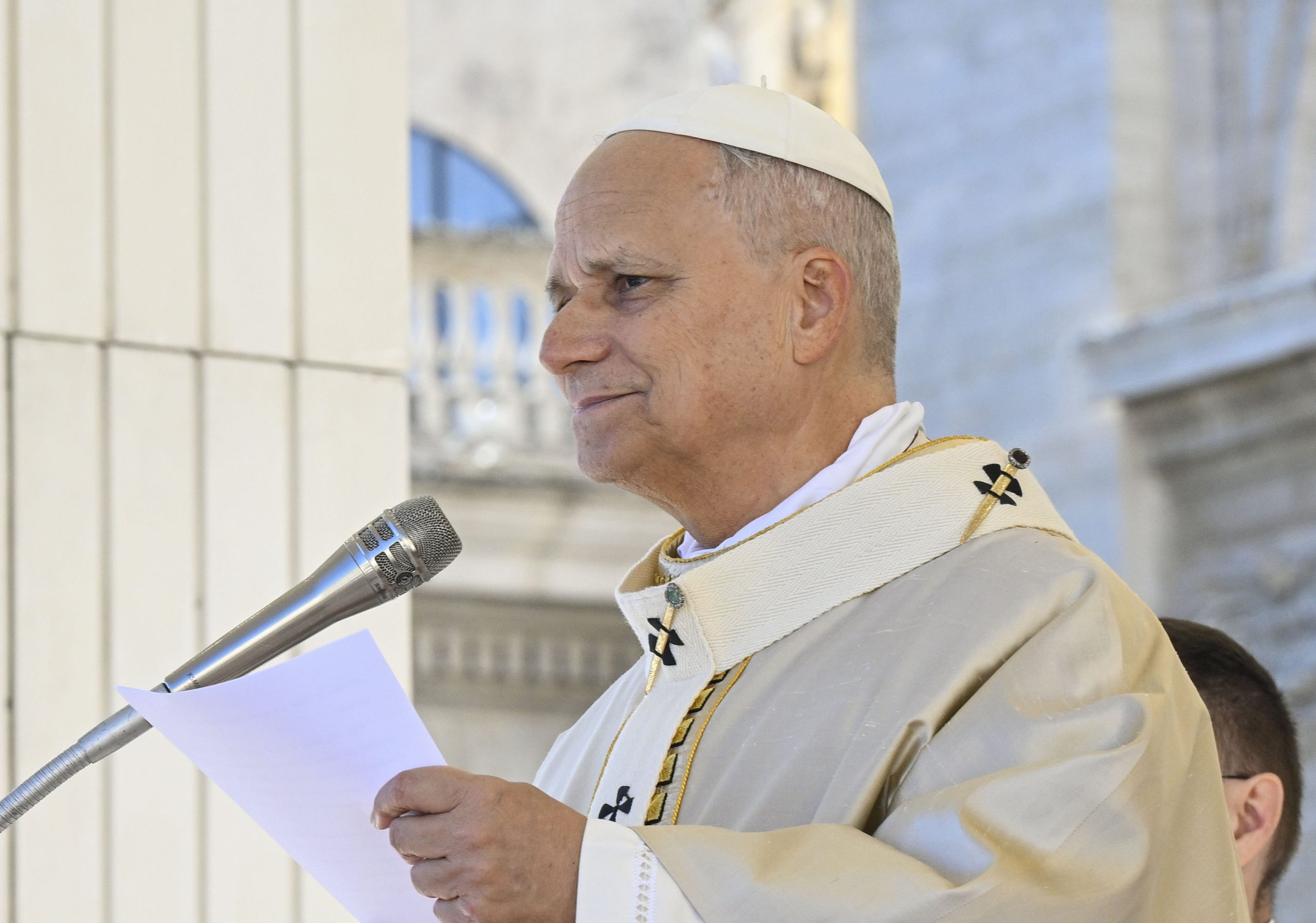
In another sign of his close attention to the ever-growing importance of artificial intelligence and the impact it will have on the future of humanity and the church, Pope Leo has approved the establishment of an inter-dicasterial commission at the Vatican on the subject.
The Vatican announced this today, May 16, and said the pope approved the new commission in a rescriptum—a papal decree in response to a matter presented to him—when he received Cardinal Michael Czerny S.J., prefect of the Dicastery for Promoting Integral Human Development, in audience on May 3.
The text, published today in Italian and signed by the cardinal, states that Pope Leo took this decision in the light of “the development of the phenomenon of Artificial Intelligence over the past decades and the most recent acceleration in its widespread use; its potential effects on human beings and on humanity as a whole; and the Church’s concern for the dignity of every human being, especially in relation to their integral development.”
It said the commission is composed of representatives from four Vatican dicasteries and three pontifical academies: the Dicastery for Promoting Integral Human Development, the Dicastery for the Doctrine of the Faith, the Dicastery for Culture and Education, the Dicastery for Communication, the Pontifical Academy for Life, the Pontifical Academy of Sciences and the Pontifical Academy of Social Sciences.
The head of each of those seven institutions will appoint a representative to the commission, the decree said, and any change to its composition will have to be approved by Pope Leo. He has entrusted the coordination of the commission to the Dicastery for Promoting Integral Human Development “for a term of one year, renewable if necessary,” the decree said. Subsequently, the pope will entrust this role to one of the other participating institutions, again for a period of one year.
The decree states that “it is the responsibility of the coordinating institution to facilitate collaboration and the exchange of information among the members of the group regarding activities and projects concerning Artificial Intelligence, including policies on its use within the Holy See, promoting dialogue, communion, and participation.”
For more than a decade now, the Vatican has been studying the development of artificial intelligence, periodically inviting experts in the field to give their input. In June 2024, Pope Francis was invited to address world leaders at the G7 summit on the topic of A.I. ethics, the first time a pope has ever been given this opportunity.
While different offices of the Roman Curia and various pontifical academies have on occasion addressed specific aspects of artificial intelligence in conferences and texts over the past decade or more, the Vatican’s attention to the subject had never been officially coordinated until now. With today’s decree, the first American pope has taken the important decision to coordinate these various efforts and integrate them under one inter-dicasterial commission.
Talking to Claude: Why Anthropic treats its chatbot like a person—and not a tool
Claude works like a person because it was trained on what people have done. Its greatest source of danger is that it could amplify the most dangerous parts of us.
What A.I. has to do with poverty and human dignity
How can we in the church ensure that the voices of the most vulnerable remain at the center of discussions about artificial intelligence?
Since his election as pope on May 8, 2025, Leo has spoken many times about artificial intelligence. Part of his first encyclical, anticipated to be released on May 25, is expected to be on the topic of artificial intelligence.
In a written response to a query from America, Cardinal Czerny welcomed the establishment of this commission as “a real sign of hope, to help the Roman Curia to address the challenges of artificial intelligence both internally and for the whole Church, and the whole world.” He recalled that the constitution for the reform of the Roman Curia, “Praedicate Evangelium,” calls on the relevant dicasteries to study “the major problems of the current age, so that the Church’s pastoral activity may be more effectively promoted and suitably coordinated.” He concluded: “Our dicastery is honoured to receive this charge from the Holy Father.”
Facts Only
* Pope Leo approved the establishment of an inter-dicasterial commission on artificial intelligence.
* The approval was made in a rescriptum received from Cardinal Michael Czerny S.J., prefect of the Dicastery for Promoting Integral Human Development.
* The decision was influenced by the development of Artificial Intelligence, its potential effects on human beings, and the Church’s concern for human dignity.
* The commission is composed of representatives from four Vatican dicasteries and three pontifical academies.
* The participating institutions are the Dicastery for Promoting Integral Human Development, the Dicastery for the Doctrine of the Faith, the Dicastery for Culture and Education, the Dicastery for Communication, the Pontifical Academy for Life, the Pontifical Academy of Sciences, and the Pontifical Academy of Social Sciences.
* The coordination of the commission is entrusted to the Dicastery for Promoting Integral Human Development for a term of one year, renewable if necessary.
* The coordinating institution is responsible for facilitating collaboration and information exchange on AI activities, including policies, dialogue, communion, and participation.
* The Vatican has studied the development of AI for over a decade, periodically inviting experts.
* Pope Francis was invited to address world leaders on A.I. ethics at the G7 summit in June 2024.
Executive Summary
Full Take
The establishment of an inter-dicasterial commission signifies a formal integration of technological and spiritual concerns within the central administrative structure of the Church. This move reflects a pattern where high-level spiritual authority addresses rapidly evolving secular phenomena like AI, attempting to frame technological development within the existing moral and pastoral framework. The process involves assigning formal coordination to the Dicastery for Promoting Integral Human Development, which shifts the locus of AI strategy from peripheral academic study to centralized, institutional policy.
The pattern observed is the attempt to manage an external, transformative force (AI) by embedding its regulation within established hierarchical structures (the Vatican). This challenges the boundaries between temporal, technological knowledge and eternal, spiritual concerns, requiring the Church to define AI ethics not just as a matter for secular policy, but as integral development. The implication is that the Church is positioning itself as a primary agent in defining the moral boundaries and human implications of AI, potentially leveraging its institutional weight to shape global discourse on technological ethics.
The concern over the dignity of every human being is central to the motivation, suggesting that the coordination is fundamentally an exercise in protecting vulnerable populations from the amplification of potentially dangerous technological trends. The question remains whether this formalized coordination truly centers the voices of the most vulnerable, or whether it risks transforming complex ethical questions into standardized administrative procedures, thereby reducing the lived experience of AI's impact to institutional mandates.
Sentinel — Human
The text exhibits the formal, detailed style of institutional reporting, lacking typical markers of generic, low-effort synthetic generation, suggesting human journalistic provenance.