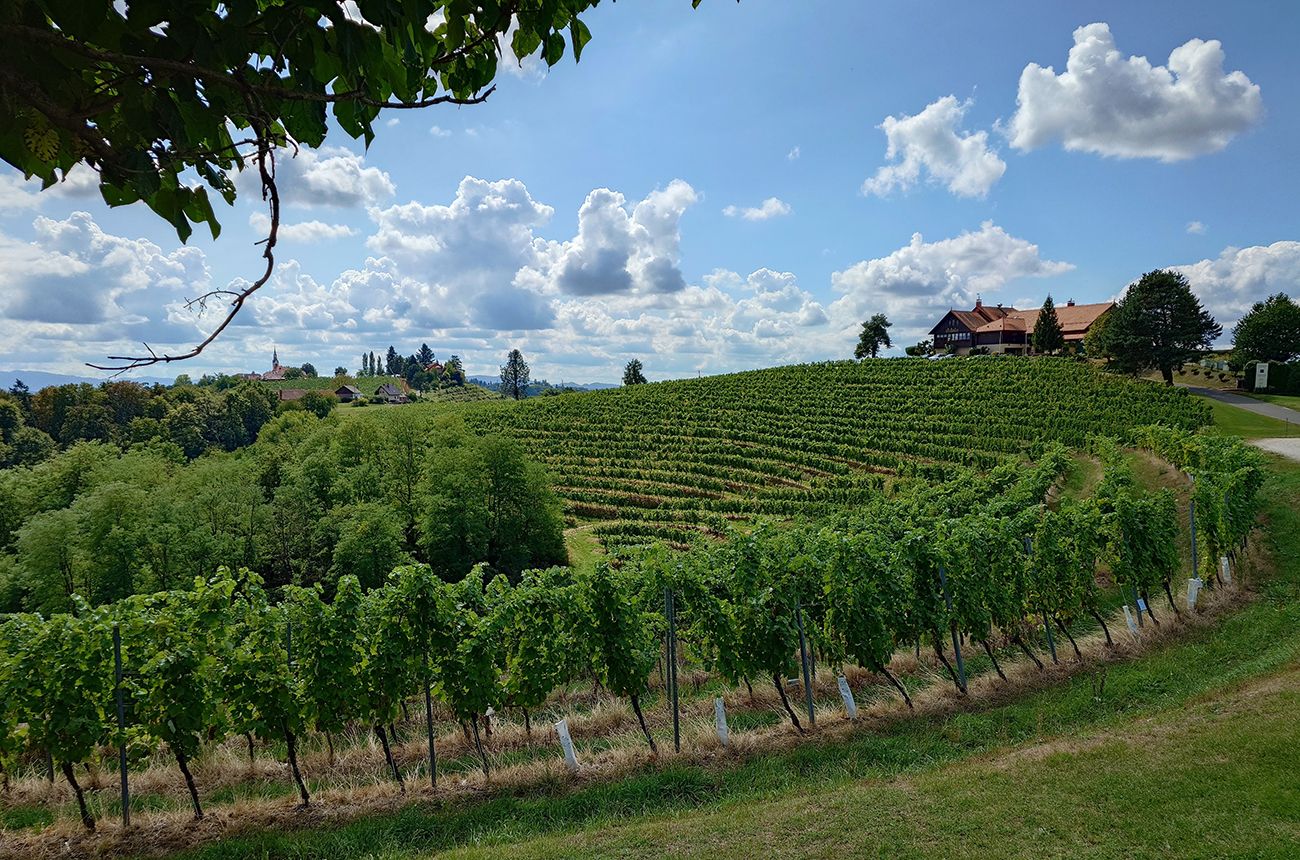
From century-old Furmint to gold-winning sparkling crafted from an indigenous red grape, follow Caroline Gilby MW as she uncovers a treasure trove of wines in this corner of Slovenia.
Get our daily fine wine reviews, latest wine ratings, news and travel guides delivered straight to your inbox.
You are now subscribed
Your newsletter sign-up was successful
There are very few places in the wine world capable of producing wines that can age gracefully for nearly a century, and the overshadowed eastern end of Slovenia would not be on most people's radar.
An astonishing tasting last September made quite the statement about adding Štajerska Slovenia (the Slovenian part of Styria) to the list of great wine regions.
The century-old Furmint
Over more than two decades of visiting Eastern Slovenia, I’ve tasted several impressive archive wines such as the fantastic 1971 Furmint and 1983 Pinot Blanc from Puklavec winery.
But the chance to taste a 1927 Šipon (the Slovenian name for Furmint) from Ptujska Klet was simply mind-blowing.
Slovenia was collectivised in the socialist era and almost everything produced before that time has been lost, however at Ptujska Klet some old bottles, going back to 1917, survived.
As co-owner Vit Mandl explained: ‘These wines survived the Second World War thanks to the foresight of Mr Pavel Ornig, son of the Mayor of Ptuj from 1894 to 1918.
‘A passionate wine enthusiast, Ornig was determined to preserve the finest vintages from the approaching turmoil of war.
Get our daily fine wine reviews, latest wine ratings, news and travel guides delivered straight to your inbox.
Mandl concluded: 'He anticipated the coming conflict and, just before the outbreak of World War II, sealed off three rooms within the cellar – and concealed the sealed walls behind large wooden barrels.’
There's not much information about how this wine was made – probably grapes from Haloze and aged in large wooden casks – but analysis shows alcohol was 10.9%, residual sugar 37.8 grams per litre and pH was 3.22.
To taste, it was a vivid deep gold, with stunning aromatics of lemon zest, steel, chamomile, fennel, chestnut honey and quince paste, showing no oxidation or tiredness and astonishingly alive and lingering.
Clearly not a young wine but tasting as though it was 15 to 20 years old, not nearly a century. A real credit to the combination of grapes, soils and climate and to those unknown winemakers.
The continental east
Eastern Slovenia is distinctly continental, with cooler nights than the Mediterranean west.
It lies where the warmth of the Pannonian Plain meets Alpine breezes from the north and vineyards are usually on steep slopes, often on terraces built in the Yugoslavian period to avoid frost pockets on the flatlands.
Wine likely arrived here with the Celts, long before the Romans. Historically, eastern Slovenia was regarded as a cool region, now more moderate, though it is still very much a white region with only 7% of priduction being red.
The area was slower than Western Slovenia to switch focus to quality dry wines (traditionally wines were made with sweetness to balance the sometimes fierce acidity).
But today’s wine scene offers bright, crisp and refreshing wines thanks to that acidity, though with better ripeness, giving great aromatics and fruit too – all perfect for consumers today.
Top white grapes to know
There are officially two regions: Podravje, which includes the large sub-region of Štajerska Slovenia (within this, the districts of Ljutomer-Ormož and Haloze are stunning and notable for wine quality) and the small north-eastern area of Prekmurje; and Posavje (including Bela Krajina, Dolenjska and Bizeljsko-Sremič).
Sauvignon Blanc produces great results here in a distinctive Central European style (closest to Austria's Styria), with more refined aromatics than the New World but more body than is typical in western Europe (names to watch: Verus, M-Vina, Kozinc, Kobal, Pullus, Marof, Domaine Ciringa, Vino Gross, Dveri Pax).
There is also some Pinot Grigio with real flavour, and fresh, zesty Riesling (Protner, Dveri Pax, Frešer, Verus), while the much-derided Laški Rizling (aka Graševina/Welschriesling) deserves another look (try Gaube, Frešer, Gjerkeš, Herga, Roka, Albiana).
Meanwhile, Slovenia is the world's second biggest grower of Furmint (Šipon), first mentioned in writing in 1678 (Hungary was earlier – in 1611) though the tradition here was always dry, not sweet wines.
Good names to try: Verus, Dveri Pax, Vino Gross, Kobal, Statera, Roka, Puklavec, Valcl (a personal project of Uroš Valcl, winemaker at Marof).
The sparkling interest
As part of reinventing Eastern Slovenia, producers have been moving away from traditional products like the sharply acid light red Cviček.
Sparkling wine has been a strong trend, now among the country’s best, capitalising on the cool climate and vibrant acidity.
A nondescript, local, light-bodied red grape called Žametovka or Žametna Črnina has found a new role for fine sparkling, led by producers like Domaine Slapšak, and joined by Kozinc and Albiana.
Slapšak’s vineyards at 500m are among the coolest in southeastern Europe, as the Gorjanci mountains block the Mediterranean's warmth.
Sparkling started here after Champenois François Botton joined the family, and 80% of its super-refined production is based on Žametovka, with the idea to express locality.
In Bizeljsko-Sremič, the family winery of Istenič is dedicated to sparkling wines but has taken a different view about local grapes.
The sadly missed late Miha Istenič was a passionate believer in the rare Rumeni Plavec as the key ingredient in the best sparkling wines, thanks to its relative neutrality, moderate alcohol and notable acidity (gaining him a DWWA gold medal in 2025).
The red grapes worth knowing
On the red front, the discovery that the grape best known as Blaufränkisch (Slovenian name: Modra Frankinja) may originate here has prompted renewed attention.
It's Slovenia's second most planted red grape, but isn't appreciated locally, though efforts are underway to highlight its quality and food-friendly, fresh, elegant reds.
In Bela Krajina, the Šuklje winery, run by a pair of academics and their family, has a special passion for Modra Frankinja and how it can be a ‘sponge for terroir’, according to Guillaume Antalick.
They are working hard on details of precise place, and their main site of Plešivica is Jurassic limestone (they see similarities with Montrachet), and recent selections from their Vrbanjka plot have been seriously impressive.
Other producers of Frankinja to keep an eye on: Marof, Valcl, Kobal, Kozinc, Klet Krško (‘Turn’), Frelih, Roka, Dveri Pax.
Visit Eastern Slovenia
Eastern Slovenia is a stunning place to visit – forests and hills everywhere, with hiking and cycling trails for the active.
A trip to Maribor (named the European Best Wine Capital for 2026 by European Best Destinations) should include a visit to the oldest vine in production in the world (four centuries old), as well as the hilltop castle at Sevnica and the oldest Slovenian town of Ptuj (stop at Kobal’s Vinoteka for a tasting).
Slovenia has a great food culture based on local ingredients: eat at Debeluh in Brežice for contemporary fine dining and Gostilna Repovž for great home-inspired farm-to-table cooking.
Time for Eastern Slovenia to come out into the light.
Easter Slovenian wines – eight to try
Related articles
North Adriatic: Wine without borders
The Greek grape varieties you should be drinking
Expert’s Choice: Sweet Tokaji
Istenič, Cuvée Natura Extra Brut, Bizeljsko-Sremič, Posavje, Slovenia, 2020
Low Intervention and no sulphites here. Straw gold with fine bubbles, inviting aromas of lemon, fresh baked shortbread, and biscuity, toasted almond autolysis. To taste,...
2020
PosavjeSlovenia
IsteničBizeljsko-Sremič
Join Decanter Premium to unlock all our wines tastings and notes
Join NowDveri Pax, Brut Vintage, Maribor, Podravje, Slovenia, 2014
2014 was a very cool year, producing perfect high-acid grapes for fine traditional sparkling. 96 months on lees has given this real class. Notes of...
2014
PodravjeSlovenia
Dveri PaxMaribor
Join Decanter Premium to unlock all our wines tastings and notes
Join NowVino Gross, Korže, Štajerska, Podravje, Slovenia, 2022
Inviting aromas of finger lime, bergamot, lemon balm, with a touch of gunflint. On the palate, there’s lovely juicy fruit, lemon verbena hints, citrus pith...
2022
PodravjeSlovenia
Vino GrossŠtajerska
Join Decanter Premium to unlock all our wines tastings and notes
Join NowVerus, Sauvignon Blanc, Ljutomer-Ormož, Podravje, Slovenia, 2025
A great example of why Eastern Slovenia is a special place for Sauvignon. It's beautifully expressive with jasmine, fresh cut grass and a touch of...
2025
PodravjeSlovenia
VerusLjutomer-Ormož
Join Decanter Premium to unlock all our wines tastings and notes
Join NowDomaine Ciringa, Fosilni Breg, Štajerska, Podravje, Slovenia, 2022
Demeter-certified, biodynamic, single-vineyard wine, right on the border with Austria. It’s delicate and fine on the nose, with hints of elderflower and green melon. On...
2022
PodravjeSlovenia
Domaine CiringaŠtajerska
Join Decanter Premium to unlock all our wines tastings and notes
Join NowZavec Brothers, Lost & Found, Štajerska, Podravje, Slovenia, 2022
A field blend from a single vineyard at 420m, with 15 days of skin contact, has resulted in this glowing amber wine with a bouquet...
2022
PodravjeSlovenia
Zavec BrothersŠtajerska
Join Decanter Premium to unlock all our wines tastings and notes
Join NowDoppler, Zeleni Silvanec, Štajerska, Podravje, Slovenia, 2022
Delicate, fresh, citrusy wine with light hints of melon, pineapple and mint tea. Refreshingly light, uncomplicated but pleasant summer wine.
2022
PodravjeSlovenia
DopplerŠtajerska
Join Decanter Premium to unlock all our wines tastings and notes
Join NowMarof, Mačkovci Modra Frankinja, Prekmurje, Slovenia, 2020
Inky purple wine with black cherry, bilberry, Darjeeling tea and a hint of cloves on the nose. It’s generously juicy, with vivid freshness, fine-grained tannins...
2020
PrekmurjeSlovenia
Marof
Join Decanter Premium to unlock all our wines tastings and notes
Join NowCaroline Gilby MW is a freelance writer and consultant, specialising in Central and Eastern Europe. Among others, she currently contributes to Hugh Johnson’s Pocket Wine Book, The Oxford Companion to Wine, and the World Atlas of Wine, and has previously written for Dorling Kindersley’s Wines of the World, The Wine Opus, and Tom Stevenson’s Wine Report. Prior to her career as a writer, Gilby spent seven years as a senior wine buyer at Augustus Barnet off-licences, where she became the first major buyer to import Hungarian wines to the UK. She initially studied plant biology, in which she holds a doctorate, but abandoned life behind the microscope for a career in wine soon after winning the Decanter-Macallan Malt Whisky Taster of the Year Award while still a student. Gilby passed her MW in 1992 and has been visiting and tasting the wines of Hungary, Czech Republic, Slovenia and Romania for over 20 years.
Facts Only
Caroline Gilby MW is a freelance writer and consultant specializing in Central and Eastern European wines.
The focus of the article is on Slovenian wines, particularly Modra Frankinja from Prekmurje and Zeleni Silvanec from Štajerska.
The article highlights the growth and potential of Slovenian wines in the global market.
Gilby has been visiting and tasting the wines of Hungary, Czech Republic, Slovenia, and Romania for over 20 years.
Executive Summary
Full Take
Steelman: The article presents a positive narrative about the growth and potential of Slovenian wines, focusing on specific grape varieties and regions. It highlights Gilby's long-term involvement with Eastern European wines and her expertise in the field.
Patterns detected: ARC-0043 Motte-and-Bailey (the article focuses on the positive aspects of Slovenian wine production while not explicitly addressing potential challenges or criticisms).
Root Cause: The narrative is driven by a desire to promote and celebrate Eastern European wines, particularly those from Slovenia.
Implications: The article may inspire increased interest in Slovenian wines among consumers and industry professionals, potentially boosting the country's wine exports.
Bridge Questions: What are some challenges facing Slovenian wine producers? How does the global market perceive Eastern European wines compared to those from more established wine regions? What strategies could be employed to further promote the growth of Slovenian wines?
Sentinel — Human
Sentinel analysis incomplete — partial response from fallback model.