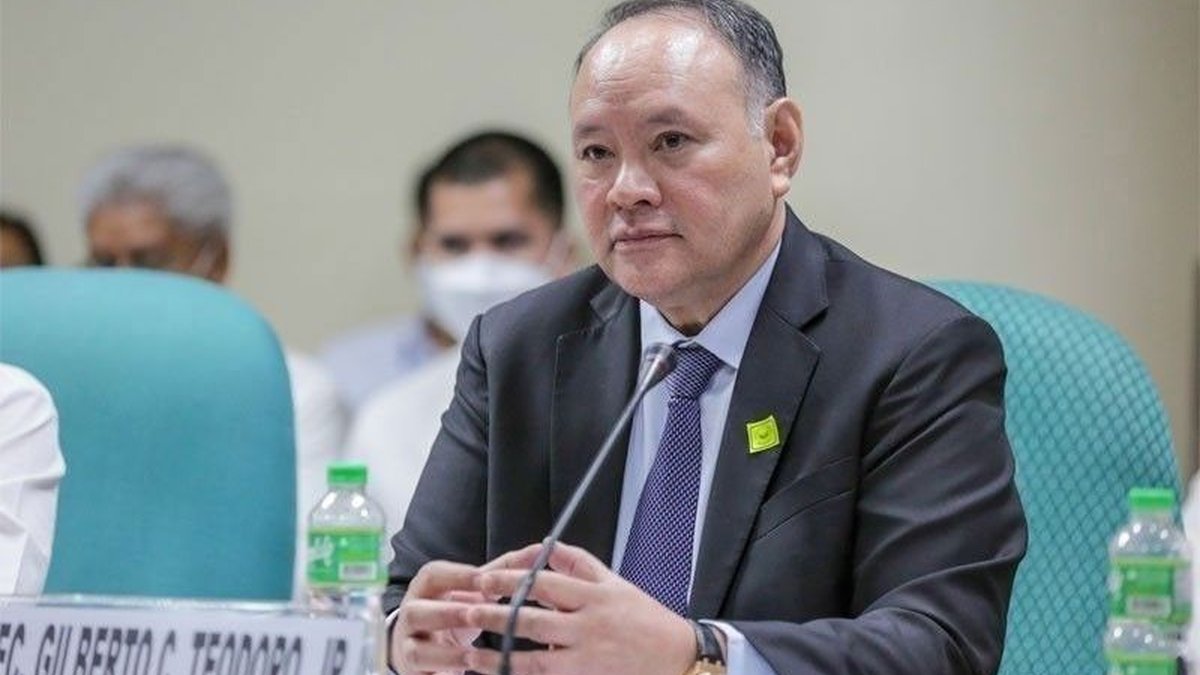
MANILA, Philippines — Countering Chinese aggression and protecting the country's maritime rights will require the defense budget to be raised as much as 4% of GDP, a move that will force trade-offs in other government sectors, Defense Secretary Gilberto Teodoro Jr. said Friday, July 10.
"We definitely need to realign," Teodoro told reporters on the sidelines of a Stratbase Institute forum marking the 10th anniversary of Manila's arbitral win over Beijing. "It’s not 'might.' We need to."
The Philippines currently spends about 1.3 to 1.4% of its GDP on defense, based on estimates that include pensions and other military items. The Department of National Defense's (DND) own budget this year stands at P305.87 billion.
"We need to ramp up to at least 2 to 3 to 4 percent of GDP," Teodoro told reporters.
At 2% of the country's roughly P31-trillion economy, based on the government's latest fiscal program, defense spending would reach about P620 billion a year. At 4%, it would spike to P1.2 trillion.
Raising the defense budget to Teodoro's target would force cuts in other government sectors, a reality the defense chief acknowledged.
Because "the budget is a finite item," Teodoro said, "more for one means less for another."
Asked where the additional funds could be sourced, the defense chief demurred: "That is up to somebody else. All I'm saying is we need to increase. And there are several ways."
Teodoro's call for bigger funding comes at a tight fiscal moment for the government. The Philippines is already facing a P1.66-trillion budget deficit this year, with economic growth targets for 2026 recently downgraded to 3.5% to 4.5%.
Speaking at the same event, Teodoro warned that the cost of resisting Beijing goes beyond military funding and cautioned how China-linked entities have already "captured" key industries.
'Free rider problem'
The defense chief argued that deterrence "needs more than commitment."
"It needs actual spending, and it means lessening an entitlement to the public and putting these entitlements into building a credible and resilient force," Teodoro said.
Teodoro argued a public unwilling to shoulder that cost — what he calls a "free-rider problem" — could doom the country's defense transition. Taken to an extreme, Teodoro said, resistance to increased spending is "probably the worst enemy that we have in our journey to building a credible deterrent posture."
The defense chief said Manila's neighbors are already raising defense spending toward 5% of GDP. He pointed to Indonesia — which does not have active maritime claims — recently acquiring 47 advanced Rafale fighter jets.
The Philippines has long leaned on alliances to offset its modest military. This year's Balikatan exercises drew more than 17,000 troops from seven countries — the largest in the drills' history, and proof, Teodoro told the forum, of the arbitral ruling's "potency."
The exercises followed a string of new Visiting Forces Agreements: an access agreement with Japan that took effect last September, and similar pacts with New Zealand, Canada and France, all on top of Manila's decades-long mutual defense treaty with the United States.
Japan is also transferring five Abukuma-class destroyer escorts to the Philippine Navy, under a deal confirmed this week.
Japan is handing over the ships at no purchase cost, but Teodoro said Friday the Philippines will shoulder the expenses of sailing them home, training crews, integrating systems and building berthing facilities he described as over three or four decades overdue.
'Capture' at home
Teodoro argued in his keynote that the threat from China is not confined to the sea.
"Agents or entities or nationals identified with the People's Republic of China" have captured parts of the country's critical infrastructure and retail trade, he said.
"In the most granular of levels, cartelization has occurred in certain commodities, not in rice, by them," Teodoro said.
The capture, he said, has become "a barrier to entry" for legitimate businesses trying to raise capital for the major industries the country needs to industrialize.
"And this we are at the forefront of combating," Teodoro said.
This is also why the military's shift to external defense cannot be total, he said, since internal security remains a principal responsibility of the Armed Forces of the Philippines under the law.
"If we are not resilient internally on a peace and order or a national security level, then our external defense initiatives necessarily are compromised," he said.
Asked if the 2016 arbitral ruling could be abandoned after the 2028 elections, Teodoro said: "Definitely the concern is there. The likelihood, I doubt, given the fact that the Filipinos already embrace the arbitral ruling."
"I do not think that any leader who goes against the arbitral award will have the mandate of the people," he added.
The award, Teodoro said, is "already beyond debate" as "part and parcel of our legal arsenal."
The ruling, handed down in The Hague on July 12, 2016, invalidated China's sweeping nine-dash line and affirmed the Philippines' sovereign rights over its exclusive economic zone.
Beijing has rejected it and continues to press its claims.
- Latest
- Trending
Facts Only
* Defense budget needs to be raised up to 4% of GDP to counter Chinese aggression and protect maritime rights.
* The Philippines currently spends about 1.3 to 1.4% of its GDP on defense, including pensions and other military items.
* The Department of National Defense's (DND) budget for this year stands at P305.87 billion.
* Raising spending to 2% of the economy would result in annual defense spending of about P620 billion.
* Raising spending to 4% of the economy would result in annual defense spending of P1.2 trillion.
* Teodoro stated that more funding for one area means less for another due to the budget being a finite item.
* Deterrence requires actual spending to build a credible and resilient force, addressing a "free-rider problem."
* China-linked entities have captured parts of critical infrastructure and retail trade within the country.
* The shift to external defense is compromised if internal security and peace and order are not resilient.
* Manila's neighbors are raising defense spending toward 5% of GDP, citing Indonesia's acquisition of fighter jets.
Executive Summary
Full Take
Sentinel — Human
The text reads like a factual report heavily reliant on direct quotes and contextual layering, characteristic of human journalistic reporting focused on policy and geopolitical developments.