Skip to content
Chimera readability score 51 out of 100, Graduate reading level.

Thursday marks five years since the July 2021 unrest claimed 354 lives and caused an estimated R50 billion in damage to South Africa’s economy.
Among those affected by the violent unrest is 44-year-old businessman and civil engineer, Taren Ramsaroop.
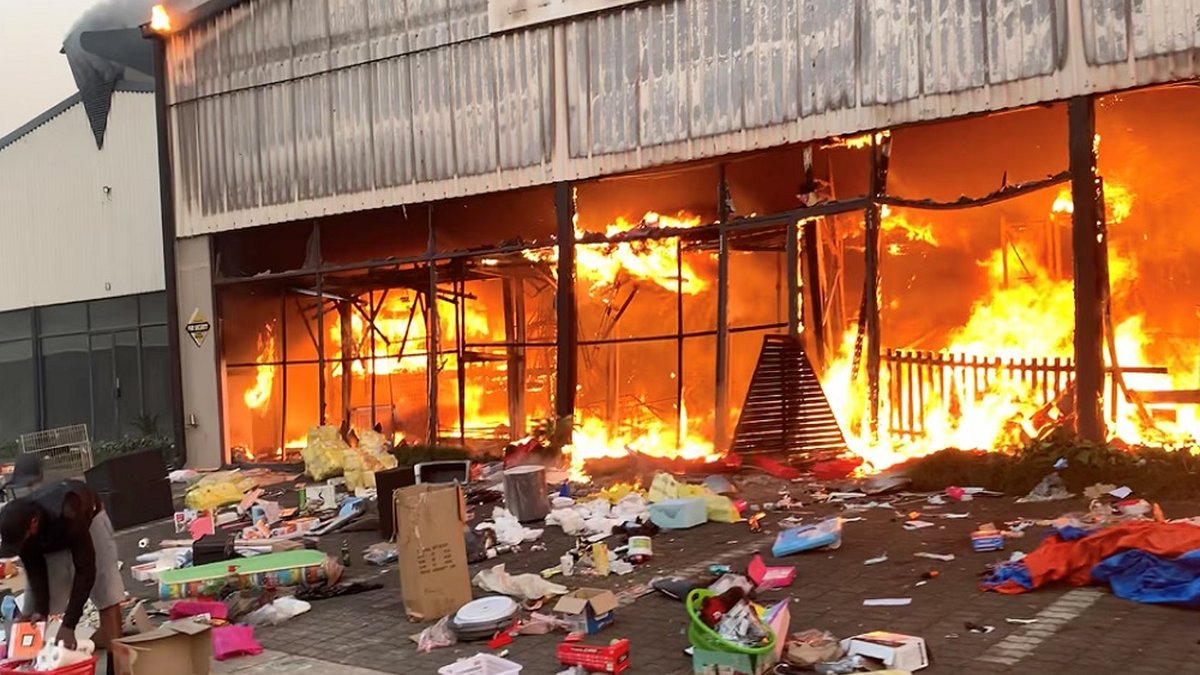
His autobody repair workshop in Phoenix, north of Durban, was burnt to the ground, along with 33 uninsured luxury sports cars.
The damages to his business cost him an estimated R40 million.
Ramsaroop says it was traumatising to watch everything he had built over decades go up in flames within hours.
“I had my wife, highly pregnant, due to give birth the very next day on the 13th of July, and basically, on the 12th of July, we get the news that my place is on fire. After that it was just chaos because I tried to get here and see what I could do, but there were more than 500 plus people torching, looting, burning the place down. Thirty-three sports cars in total, and approximate value of R40 million loss happened overnight with no insurance. One of the most difficult times of my life. Finances were depleted completely, but by the grace of God, goodwill and resilience, I was able to rebuild my place.”
VIDEO| Independent Crime Analyst, Willem Els says it remains unclear what the objective of the July 2021 unrest was:
Meanwhile, Ramsaroop says despite rebuilding his business, he cannot erase the trauma he suffered. He says last week’s nationwide protests against undocumented immigrants were enough to take him straight back to the events of July 2021.
“Last week, with the whole March and March, it was a flashback. It was me walking through the the same sort of feeling and a path that I went through five years ago. It cost me R100 000 in security to secure my premises. It cost me another R15 to R20000 to move all the vehicles out from here, so I got everything to safety because I did not want a repeat of what I experienced five years ago.”

Facts Only

* The July 2021 unrest claimed 354 lives and caused an estimated R50 billion in economic damage in South Africa.
* Taren Ramsaroop, a 44-year-old businessman and civil engineer, was affected by the unrest.
* Ramsaroop’s autobody repair workshop in Phoenix, north of Durban, was burnt to the ground.
* Thirty-three uninsured luxury sports cars were destroyed.
* The damages to Ramsaroop's business cost him an estimated R40 million.
* Ramsaroop experienced immediate loss and chaos when the fire occurred.
* Ramsaroop states he incurred R100,000 in security costs and R15,000 to R20,000 for moving vehicles to secure them after the event.

Executive Summary

The unrest of July 2021 resulted in 354 deaths and an estimated R50 billion in economic damage across South Africa. Taren Ramsaroop, a businessman and civil engineer, experienced significant loss during this event. His autobody repair workshop in Phoenix, north of Durban, was destroyed along with thirty-three uninsured luxury sports cars, resulting in an estimated R40 million in damages to his business assets. Ramsaroop described the event as traumatizing, recounting how he lost everything he had built over decades in hours. He noted that the immediate aftermath involved chaos as over 500 people were reportedly torching and looting the area. Despite rebuilding his business, Ramsaroop continues to experience trauma, drawing parallels between the recent nationwide protests against undocumented immigrants and the events of July 2021. He incurred costs for securing his property and moving vehicles following the unrest to prevent recurrence.

Full Take

The narrative juxtaposes catastrophic economic and physical destruction with profound individual psychological impact and the recurrence of trauma across subsequent public events. The story of Ramsaroop demonstrates how large-scale systemic violence translates directly into existential loss for individuals, particularly concerning assets built over a lifetime. The shift from immediate physical devastation to prolonged psychological haunting—where recent protests trigger memories of past trauma—highlights a failure in societal processing of historical events and the lingering effects of insecurity. The narrative presents an unresolved tension: the tangible rebuilding of material assets versus the intangible, persistent reality of trauma. This raises questions about whether economic recovery can substitute for psychological healing, and how communities process cycles of violence when political grievances are revisited. What mechanisms exist for integrating shared historical pain into present-day social contracts?

Sentinel — Human

Confidence

The text reads like a report synthesizing official data with deeply personal testimony, characteristic of human investigative journalism focused on specific incidents.

Signals Detected
low severity: Natural variation in sentence length and narrative flow, punctuated by direct quotation.
low severity: Strong emotional resonance tied to the personal testimony; the shift from objective reporting to subjective experience feels authentic.
low severity: The structure smoothly transitions between objective facts (statistics) and subjective experience (Ramsaroop's quotes).
low severity: Specific, highly detailed anecdotal claims tied to a named individual appear plausible in investigative reporting.
Human Indicators
Use of direct, emotionally charged first-person narrative from the subject (Ramsaroop) that contrasts with factual reporting.
Integration of specific, non-public details (names, exact losses, personal timeline) suggesting sourced investigation.
July 2021 unrest victim recalls loss and trauma five years on — Arc Codex