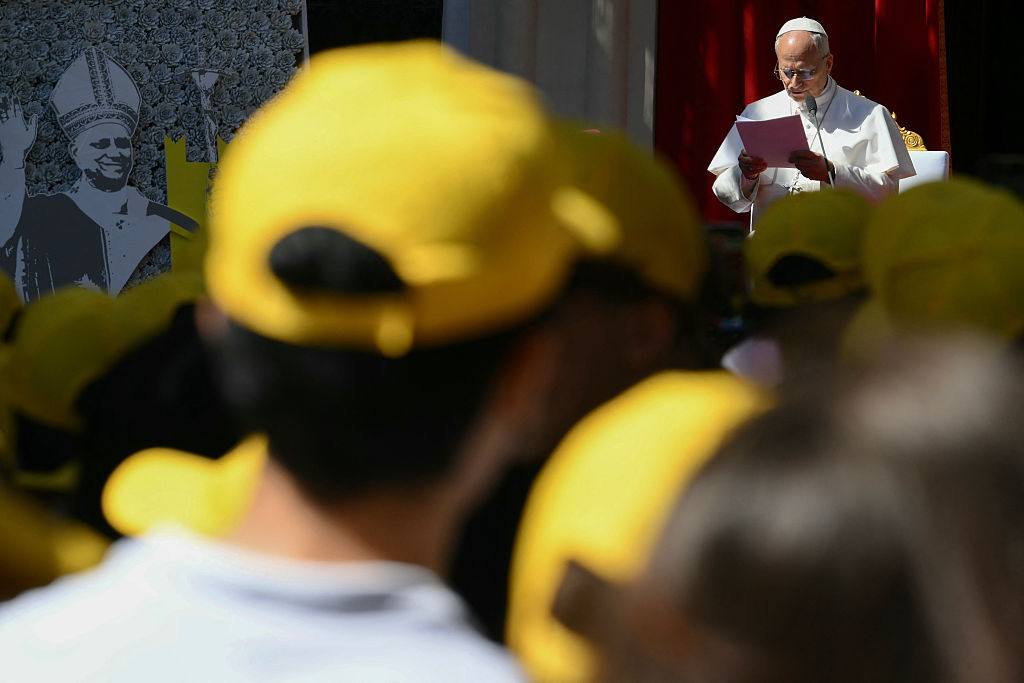
During his meeting with Catholics in Monaco, the second appointment of his whirlwind trip to the small country, Pope Leo XIV warned about the risks of reducing faith “to custom” and called on the faithful to be like Christ, defending the poor and marginalized against individualistic secularism.
The pontiff supported his reflections in the document Quo vadis, humanitas? of the International Theological Commission, published on March 4, 2026. The Latin phrase means “Where are you going, humanity?”
The pope met Catholics at the Cathedral of the Immaculate Conception of Monaco, built between 1875 and 1903 in the neo-Romanesque style.
The temple houses the tomb of some sovereigns of the principality, including Prince Rainier III and Princess Grace Kelly, an iconic American actress who became royalty after marrying Rainier III in 1956.
The Principality of Monaco is one of the last European countries to maintain Catholicism as a state religion, though its 1962 constitution guarantees freedom of worship and expression. In practice it means that Catholicism is taught in schools and that state ceremonies include a Mass.
In November of 2025 Prince Albert II vetoed a law passed by the National Council that sought to legalize abortion up to 12 weeks. He justified his decision by citing the Catholic identity of the principality and the need to maintain the current legal framework, which decriminalizes the termination of pregnancy only in exceptional cases
Based on the episode of the Gospel in which the Apostle John describes Jesus Christ as the righteous (cf. 1 Jn 2,1-2), the pope explained that the Church is called to be “lawyer”, that is, to defend man in his integrity and all human beings, promoting a comprehensive development that respects the dignity and ultimate goal of the person.
He asked the faithful to contemplate Christ as a “lawyer” and urged Christians to provide “passionate and generous” service in evangelization.
“Announce the gospel of life, hope and love; bring to all the light of the Gospel so that the life of every man and woman is defended and promoted from their conception to their natural end,” he said.
The pope arrived at the cathedral after his visit to the Princeʼs Palace, where the Monegasque sovereign family resides.
A living and prophetic faith
It is important, the pope pointed out, that the proclamation of the Gospel and the forms of faith “are preserved from the risk of being reduced to habit, even if it is good.”
“A living faith is always prophetic, capable of raising questions and offering provocations: Are we really defending the human being? Are we protecting the dignity of the person in the protection of life in all its phases? Is the current economic and social model really fair and inspired by solidarity?” he said.
Leo cited Pope Benedict XVIʼs encyclical Caritas in veritate published in 2009: “Is this model inhabited by the ethics of responsibility, which helps us to go beyond the ‘logic of the exchange of equivalent things and profit as an end in itself?’” he said.
Alert against secularism
The pontiff also warned about the “impulses of secularism,” which can reduce man to individualism and orient social life only towards the production of wealth.
The Holy Father asked for a new orientation based on the Gospel and to adopt the compassionate and merciful love of Christ.
Christ, he said, became a “lawyer” to defend the poor and sinners, freeing them from oppression and making them children of God and brothers among themselves.
“He does not come to condemn, but to offer mercy that purifies, heals, transforms and makes us part of the only family of God,” he stressed.
The Church, reflection of Godʼs love
The Pope praised the hospitality of Monaco, a small cosmopolitan state with cultural and socioeconomic diversity.
He recalled that in the Church there are no social classes: “Everyone is welcomed as people and children of God, and all are recipients of a gift of grace that drives communion, fraternity and reciprocal love.”
According to the pontiff, the first service that the Gospel must provide is “to enlighten the person and society, so that they discover their identity, the meaning of human life, the value of relationships and solidarity, as well as the ultimate end of existence and the destiny of history.”
This story was first published by ACI Prensa, the Spanish-language sister service of EWTN News. It has been translated and adapted by EWTN News English.
The Holy Father described the Monacan patron Saint Devota as “a courageous young woman who knew how to bear witness to her faith.”
Facts Only
Pope Leo XIV visited Monaco in 2026, meeting Catholics at the Cathedral of the Immaculate Conception.
The cathedral, built between 1875 and 1903 in neo-Romanesque style, houses the tombs of Prince Rainier III and Princess Grace Kelly.
Monaco’s 1962 constitution guarantees freedom of worship but maintains Catholicism as the state religion.
In November 2025, Prince Albert II vetoed a National Council law to legalize abortion up to 12 weeks, citing Monaco’s Catholic identity.
The pope referenced the 2026 document *Quo vadis, humanitas?* by the International Theological Commission.
He described the Church’s role as a "lawyer" defending human dignity, citing 1 John 2:1-2.
The pope warned against reducing faith to habit and criticized secularism for promoting individualism and wealth accumulation.
He called for a faith that questions societal structures and defends life from conception to natural death.
The pope praised Monaco’s hospitality and Saint Devota, the principality’s patron saint.
Catholicism is taught in Monaco’s schools, and state ceremonies include Mass.
The pope visited the Prince’s Palace before his address at the cathedral.
His message emphasized mercy, solidarity, and the rejection of profit-driven economic models.
Executive Summary
Pope Leo XIV visited Monaco in 2026, meeting with Catholics at the Cathedral of the Immaculate Conception, where he warned against reducing faith to mere custom and emphasized the Church’s role in defending human dignity, particularly for the poor and marginalized. He referenced the 2026 document *Quo vadis, humanitas?* from the International Theological Commission, framing his message around Christ as a "lawyer" for humanity. The pope also criticized secularism and individualism, urging a return to Gospel-based values of solidarity and compassion. Monaco, a Catholic state, maintains Catholicism as its official religion, though its constitution guarantees religious freedom. In 2025, Prince Albert II vetoed a law to legalize abortion up to 12 weeks, citing the principality’s Catholic identity. The pope’s visit included a stop at the Prince’s Palace and a reflection on Saint Devota, Monaco’s patron saint, as a model of courageous faith.
The pope’s address highlighted tensions between traditional Catholic values and modern secular trends, particularly in economic and social policies. His call for a "prophetic" faith challenged both the faithful and societal structures to prioritize human dignity over materialism. The context of Monaco—small, wealthy, and deeply Catholic—added a layer of contrast, as the principality balances its religious heritage with contemporary pressures, such as the abortion debate. The pope’s emphasis on evangelization and defense of life from conception to natural death aligned with broader Vatican positions, while his critique of secularism echoed concerns about cultural shifts in Europe.
Full Take
The strongest version of this narrative presents Pope Leo XIV as a moral leader reinforcing traditional Catholic values in a secularizing Europe, using Monaco—a symbol of wealth and tradition—as a backdrop to critique individualism and advocate for human dignity. The pope’s framing of the Church as a "lawyer" for the marginalized is compelling, grounding his appeal in scripture and theological documents like *Quo vadis, humanitas?*. The inclusion of Monaco’s 2025 abortion veto adds concrete stakes, illustrating the tension between religious identity and modern legal trends. The narrative’s strength lies in its coherence: a call to prophetic faith, a warning against secularism, and a defense of life, all tied to a specific cultural context.
However, the narrative also employs subtle framing that could nudge readers toward a binary view of faith versus secularism. The pope’s questions—"Are we really defending the human being?"—are rhetorically powerful but assume a shared definition of "defending" that may not be universally accepted. The reference to Monaco’s Catholic state religion, while factual, risks implying that religious governance is inherently virtuous without addressing potential drawbacks, such as limited pluralism. The emotional appeal to Saint Devota’s courage and the imagery of Christ as a merciful defender could be seen as leveraging moral urgency to bolster the Church’s authority.
Rooted in the paradigm of Catholic social teaching, this narrative assumes that secularism inherently devalues human dignity and that economic systems must be subordinate to religious ethics. Historically, this echoes the Church’s longstanding critique of modernity, from *Rerum Novarum* to *Caritas in veritate*. The unstated assumption is that societal progress requires a return to Gospel-centered values, which may overlook the role of secular institutions in advancing human rights.
Implications for human agency are mixed: the call for "prophetic" faith empowers individuals to challenge injustice, but the framing risks dismissing secular efforts to address poverty or inequality. The primary beneficiaries are the Church’s moral authority and communities aligned with its teachings, while costs may fall on those who see secular governance as a path to pluralism and individual freedoms. Second-order consequences could include heightened polarization in debates over abortion, economic policy, and the role of religion in public life.
Bridge questions: How might secular frameworks also promote human dignity without religious doctrine? What evidence would change the assessment that secularism necessarily leads to individualism? How do Monaco’s unique circumstances—wealth, small size, monarchical rule—shape the applicability of this message to broader Europe?
Counterstrike scan: A coordinated influence campaign would amplify the pope’s warnings as a clash between faith and secular decay, using emotional triggers (e.g., "defending the unborn") and authority signals (theological documents, papal office) to rally traditionalists. The actual content aligns with this playbook but stops short of demonizing secularism outright, focusing instead on internal Church renewal. No structural manipulation is detected; the narrative remains within the bounds of doctrinal advocacy.