Shock Line
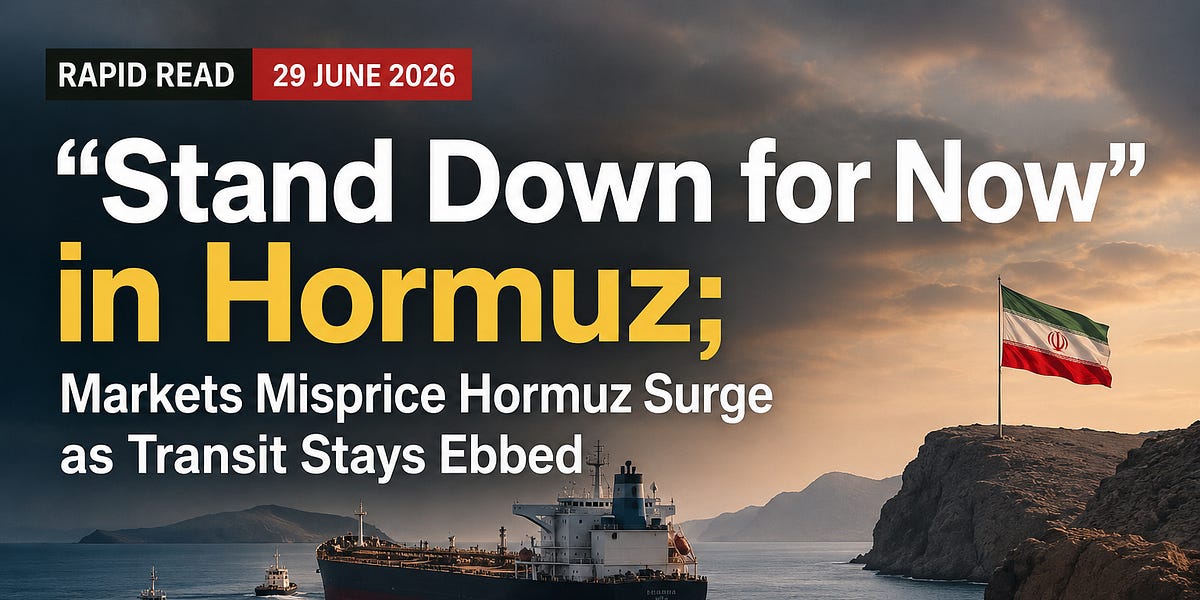
US Iran stand down opens Hormuz transit on paper while fresh attacks and threat elevation keep actual tanker movements suppressed.
What Changed (Last 24 Hours)
United States and Iran agreed to stand down from further attacks and permit free vessel transit through the Strait of Hormuz while technical talks on their memorandum of understanding resume in Qatar.
Joint Maritime Information Center elevated the regional threat level after incidents involving a Singapore flagged vessel and a Qatari oil carrier.
International Maritime Organization warned operators of lingering mines in primary Hormuz shipping lanes.
China expanded its export control blacklist to include additional Japanese entities amid ongoing technology and security disputes.
United States Federal Communications Commission broadened prohibitions on Huawei and ZTE equipment to cover legacy systems still deployed in networks.
Why This Matters (The System)
Hormuz Stand Down Regime
The Hormuz transit regime moved from active interdiction to a declared political stand down within the last day.
Commercial operators and insurers kept risk settings elevated and transits subdued despite the political agreement.
The hard anchor is JMIC threat elevation plus documented incidents on commercial hulls combined with unresolved mine warnings that now limit daily throughput.
What Breaks Next (Forward Risk)
If the stand down holds without additional incidents...
Dirty tanker operators will sustain longer Cape routings and elevated ballast legs, tightening available supply for Western Hemisphere crude movements and supporting wider Atlantic Pacific rate spreads.
Insurance syndicates will hold war risk premiums at elevated levels until mine clearance produces certified safe lanes, extending the timeline for full Hormuz volume recovery by weeks rather than days.
Gulf producers secure early optionality to increase liftings under the sanctions unwind framework but encounter delays as banks and charterers await formal compliance guidance that overlays prior restrictions.
Asian refiners face extended distillate inventory draws if VLCC inflows from the Gulf remain below the pace implied by the political agreement.
US telecom operators absorbing the expanded Huawei and ZTE legacy ban must accelerate equipment replacement programs that divert capital expenditure from network expansion into compliance driven swaps.
Japanese firms facing new Chinese export controls will accelerate diversification of advanced materials and equipment sources, raising near term procurement costs across semiconductor and clean technology supply chains.
Signal vs. Noise
Signal
The US Iran stand down agreement combined with Qatar talks that alters the legal baseline for Hormuz transits.
JMIC threat elevation and IMO mine warnings that impose immediate operational and insurance constraints on physical movements.
US legacy Huawei ZTE equipment ban expansion and China Japanese entity blacklist additions that modify regulatory conditions for critical infrastructure and technology trade.
Noise
Forward oil price curves pricing a rapid supply surge when confirmed inbound traffic stays modest and much activity involves previously stranded vessels exiting the Gulf.
Long cycle industrial announcements on AI investment totals and advanced nuclear fuel programs that do not alter daily chokepoint or sanctions enforcement constraints.
Downstream price commentary that lacks direct ties to physical flow changes in the last day.
The Line to Remember
Stand down agreements at chokepoints reset political permissions faster than physical clearance and financial risk systems can confirm safe operations.
Community Notes:
We are very happy to announce that we have a new YouTube page.
PLEASE go to www.YouTube.com/@GeopoliticsUnpluggedRapidRead and SUBSCRIBE.
Why You Should Upgrade to Paid:
This edition of Rapid Read lands at the precise moment when a US-Iran stand-down agreement risks creating more confusion than clarity about real energy flows and supply chain recovery. Paid subscribers receive the complete expert synthesis that explains how political permissions interact with operational, insurance, and regulatory realities at the Hormuz chokepoint, plus the full picture of second-order effects now building across tanker markets, Gulf production timing, Asian refining balances, and technology supply chains. You also unlock our quantified risk framework and contrarian market reading that together separate durable signals from temporary noise. Free readers will stay limited to surface headlines and fragmented updates without this integrated decision framework exactly when timing and positioning matter most. This edition summarizes 19 news stories and 7 Substack articles.
Upgrade to access the full Our Take section delivering a synthesized view of the stand-down’s impact on commercial operations and global supply chains; without it, you miss the expert integration of political, operational, and financial dimensions.
Receive our detailed Geopolitical Risk Scoreboard with risk levels, drivers, and potential impacts for the Hormuz situation and related developments; free readers lack this at-a-glance quantified framework.
Unlock the Contrarian Take that offers a different lens on market expectations for oil supply and the effects of overlapping regulations; missing it means relying solely on consensus narratives.
Gain the forward indicators to watch in the next 7 to 30 days for signs of de-escalation or renewed constraints; without these, you have no structured way to track evolving conditions at this critical chokepoint.
Sentinel — Human
The text demonstrates high coherence and structural sophistication consistent with human-authored geopolitical analysis, leveraging established frameworks to synthesize complex risk factors.