Perceptions are very important. Imagine you have a very good and nice neighbor. Nonetheless, for whatever reason, you believe he is bad and ill-intentioned. I’m sure you wouldn’t be so keen to engage proactively with him. If we were to go outside and ask Americans what they think of their neighboring Mexico, the net answer would be something like a polite but lukewarm “eh, good.” I say this because we actually went out and asked.
AmCham, the U.S.-Mexico Foundation and AMPIP, led by Echelon Insights, have been polling US voters’ attitudes towards Mexico for more than a year. Results are significantly important. Let’s go over some key figures.
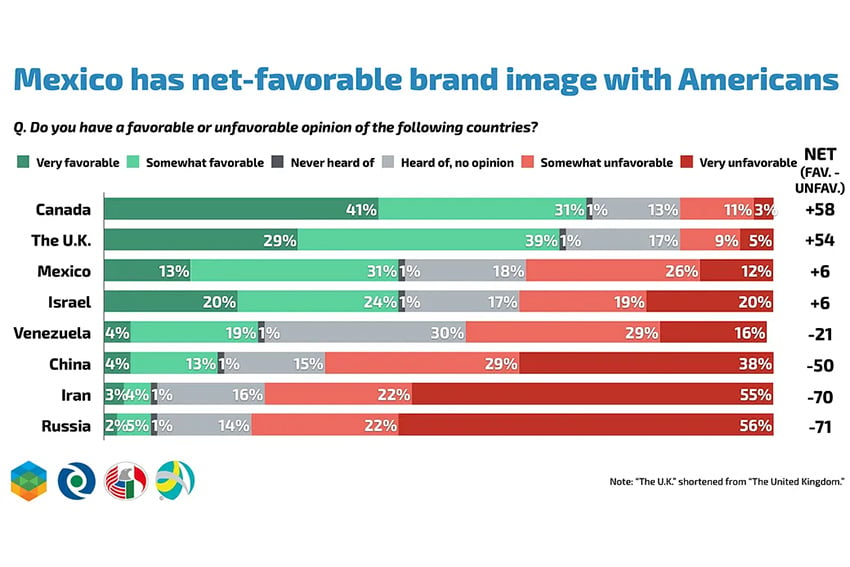
U.S voters give Mexico a net favorability of just +6 — better than China or Russia, miles behind Canada’s +58, same score as Israel and down from +20 just a year ago. The partisan gap is stark: Democrats see Mexico as a solid +47 “good neighbor,” independents +17, but Republicans sit at -23.
Overall, 40% call Mexico a good neighbor, while 28% say it’s a bad neighbor. That modest, slightly slipping score is the quiet battleground for everything this Regional Utopia series is about, particularly on the undecided bunch. As my friend and mastermind behind this polling, Enrique Perret, said: “The 18% of people without an opinion are the ones to convince that Mexico is a good neighbor.” We all need to work on that!
Thirteen percent of voters have a “very favorable” opinion of Mexico, 31% somewhat favorable, 1% have never heard of it (really?), 18% have heard of it but have no opinion. Then, 26% have a “somewhat unfavorable” opinion and last, a 12% have very unfavorable views on Mexico.
Positive notes going up, negatives going down
Even though the overall score has gone down, the bright spots are quietly getting stronger. When people view Mexico positively, they credit the things that hit closest to home: tourism between the two countries (now at 52%, up from 47% a year ago), the economic relationship that benefits the U.S. (holding steady at 45%) and cultural exchange (back to 43% after a December dip). Among those who already see Mexico as a good neighbor, those three factors land at a rock-solid 69-70%. In other words, the feel-good reasons for liking Mexico aren’t just holding — they’re gaining ground.
It is interesting to note the sharp comeback of “collaboration on law enforcement” after a 25% by the end of last year, gaining 8 pps to reach 33% favorability.
Even better still, the concerns are still real, but the sharpest edges are softening. Cartel activity remains the top “bad neighbor” complaint at 59% (stable over the past year), with fentanyl at 47% (down from 54%). Unauthorized migration is also trending down, from 46% to 35% and the worry about Mexican migrant workers “competing unfairly” has dropped sharply from 33% last year to just 21% now. Voters are increasingly separating the real, persistent problems from blanket narratives. This is truly remarkable: results matter!
There’s an interesting contradiction happening: while the overall favorability score has slipped a bit, the day-to-day trends that matter most to people — both the positives they credit and the specific negatives they fear — are moving in the right direction.
Migration is an interesting case. The border is apparently under control. Therefore, negative perceptions of it went down from 46% to 35%. Results matter, and they are noticed!
Trade, tariffs and USMCA
When asked whether trade with Mexico affects their cost of living, 39% say it makes things cheaper and only 17% say it makes things more expensive. Flip to tariffs on Mexican goods, however, and 61% expect higher grocery and electronics bills. Even Republicans have softened: the share worrying about cost-of-living pain from tariffs fell from 56% to 41% in the past year. People instinctively get that integration lowers prices and tariffs raise them. The economic argument is quite clear for most!
Yet, when it comes to the USMCA, awareness remains the weak link. This is the result that blows my mind the most: 8 out of 10 voters have heard nothing or just a little about the USMCA. Nearly half are unsure whether it should be extended this year. Yet when you ask what would make a “fair deal,” the answers cross party lines: lower prices on everyday goods (49-53%), American farmers selling more into Mexico and Canada (48-51%) and keeping supply chains in North America. Voters aren’t anti-trade; they’re pro-results that they can feel at the checkout line.
Final thoughts
These perceptions aren’t fluffy PR — they’re policy oxygen.
A negative brand score makes it easier for bad-neighbor rhetoric to stick during the 2026 USMCA review. It fuels tariff talk even when voters know, in their gut, that tariffs hit their own wallets.
Remember that policy does not always follow logical or economic rationality; it also follows politics. Politics is led by voters, voter sentiment and preferences. Going back to my initial example, you most likely prefer to work with the neighbor you like, rather than the one you think is not a good one.
The good news? We don’t need to invent affection — we need to amplify what’s already working and knock down the security fears that dominate the negative column. Independents are already moving in the right direction on the “good neighbor” question. Tourism, economic ties and cultural exchange are the three things voters already credit Mexico for when they like us. The World Cup is about to hand us the biggest shared ritual in a generation.
So we work on it on several fronts at once:
First, keep doubling down on the feel-good stuff: tourism flows, cultural exchange and turning every World Cup goal into a North American story.
Second, make the economic case relentless — lower grocery bills, American farmers selling more south of the border, supply chains that keep jobs and prices stable on both sides.
Third, deliver and visibly communicate concrete results on the security front (which, by the way, is yielding better results than ever in our history): joint cartel takedowns, fentanyl interdictions and migration management that voters can see.
Fourth, use the USMCA review itself as the communications moment: frame extension not as technocratic maintenance but as the practical enabler for reindustrialization, a mechanism to bring jobs back, making our neighborhood safer and also, as a way to keep prices down.
Mexico’s brand isn’t broken; it’s just under-marketed.
The data, the events and the mutual self-interest are all there. We must work on perceptions and PR as hard as we work on making USMCA work or any other policy initiative.
Thanks for reading!
Pedro Casas Alatriste is the Executive Vice President and CEO of the American Chamber of Commerce of Mexico (AmCham). Previously, he has been the Director of Research and Public Policy at the US-Mexico Foundation in Washington, D.C. and the Coordinator of International Affairs at the Business Coordinating Council (CCE). He has also served as a consultant to the Inter-American Development Bank. Follow his Substack here.
Facts Only
A poll by AmCham, the U.S.-Mexico Foundation, and AMPIP, led by Echelon Insights, measured U.S. voters' attitudes toward Mexico over more than a year.
Mexico's net favorability among U.S. voters is +6, compared to Canada's +58, China's lower score, and Russia's lower score.
Democrats rate Mexico as a good neighbor at +47, independents at +17, and Republicans at -23.
40% of U.S. voters call Mexico a good neighbor, 28% say it is a bad neighbor, and 18% have no opinion.
13% of voters have a "very favorable" opinion of Mexico, 31% "somewhat favorable," 26% "somewhat unfavorable," and 12% "very unfavorable."
Positive perceptions are linked to tourism (52%, up from 47%), economic benefits (45%), and cultural exchange (43%).
Concerns include cartel activity (59%, stable), fentanyl (47%, down from 54%), unauthorized migration (35%, down from 46%), and labor competition (21%, down from 33%).
Collaboration on law enforcement favorability increased from 25% to 33%.
39% of voters believe trade with Mexico lowers their cost of living, while 17% say it raises costs.
61% of voters expect tariffs on Mexican goods to increase grocery and electronics prices.
80% of voters have heard nothing or little about the USMCA, and nearly half are unsure whether it should be extended.
The poll highlights a slight decline in Mexico's overall favorability but improvements in specific areas like tourism and security perceptions.
Executive Summary
Full Take
This analysis of U.S. perceptions of Mexico reveals a fascinating tension between broad narratives and granular trends. The strongest version of the narrative acknowledges that while Mexico's overall favorability has dipped, the underlying drivers—tourism, economic ties, and cultural exchange—are strengthening. The partisan divide is stark but not surprising, with Democrats viewing Mexico far more favorably than Republicans. The data also shows a softening of negative perceptions around migration and labor competition, suggesting that concrete results (e.g., border management) are influencing voter sentiment. However, the low awareness of the USMCA is striking, given its economic significance. This gap between policy reality and public perception is a critical vulnerability, as it leaves room for simplistic or politicized narratives to dominate.
Patterns detected: none. The analysis avoids overt manipulation tactics, though it does frame the USMCA's low awareness as a missed opportunity rather than a systemic communication failure. The root cause of these perceptions likely stems from a combination of media framing, political rhetoric, and historical stereotypes about Mexico. The implications are significant: if negative perceptions harden, they could undermine economic integration and security cooperation, even when voters intuitively understand the benefits of trade. The 2026 USMCA review looms as a potential flashpoint, where rhetoric could outpace reality.
Bridge questions: How might U.S. media coverage of Mexico shift if economic and cultural ties were framed as national strengths rather than partisan issues? What would it take for the USMCA to gain broader public recognition, and could that reshape perceptions of Mexico as a partner rather than a problem? If security concerns continue to soften, could that create space for a more balanced narrative, or will other issues (e.g., migration) fill the void?
Counterstrike scan: A coordinated influence campaign would likely amplify partisan divides, exaggerate security threats, and downplay economic benefits to sow discord. The actual content does not match this pattern; instead, it presents data-driven insights and calls for better communication of Mexico's contributions. The focus on mutual self-interest and concrete results suggests a constructive rather than manipulative intent.
Sentinel — Likely Human
The text is a highly polished, data-driven analysis that displays strong logical coherence, characteristic of advanced LLM synthesis, used to pivot specific polling data into a forward-looking policy argument.