MONACO (OSV News) — In the principality known for super yachts and sports cars, Pope Leo XIV urged Monaco’s wealthy citizens to remember the poor and protect every human life, calling on them to remember that the Last Judgment “places the poor at its center.”
“Within your community, many people hold positions of considerable influence in the economic and financial spheres,” Pope Leo said in his speech from the balcony of the Prince’s Palace of Monaco March 28.
“The kingdom of God, to which Jesus dedicated his life … comes among us and shakes up the unjust configurations of power — those structures of sin that create chasms between the poor and the rich, between the privileged and the discarded,” he said.
Pope Leo became the first pope in modern history to visit Monaco March 28, traveling the streets of the famed Formula 1 Monaco Grand Prix Circuit by popemobile, instead of by race car, to meet the faithful of the tiny Catholic Mediterranean principality.
Flanked by Prince Albert II of Monaco and Princess Charlene on the palace balcony, Pope Leo addressed an elegantly-dressed Monégasque crowd in his first speech of the quick 13-hour trip to Monaco, the world’s second smallest state after Vatican City. The visit is Pope Leo’s first international journey of 2026 and only the second of his pontificate.
In his speech in the palace, Pope Leo entrusted the Catholic principality with the task of “protecting every human life” and deepening its “commitment to the social doctrine of the Church.”
Roman Catholicism is the official state religion of Monaco, where roughly 82% of the population is Catholic.
“You are among the few countries in the world to have the Catholic faith as a state religion,” Pope Leo said in his speech at the Prince’s Palace.
“This faith places us before the sovereignty of Jesus, who calls Christians to become in the world a kingdom of brothers and sisters — a presence that does not cast down but raises up, that does not separate but connects, always ready to protect every human life with love, at any time and in any condition.”
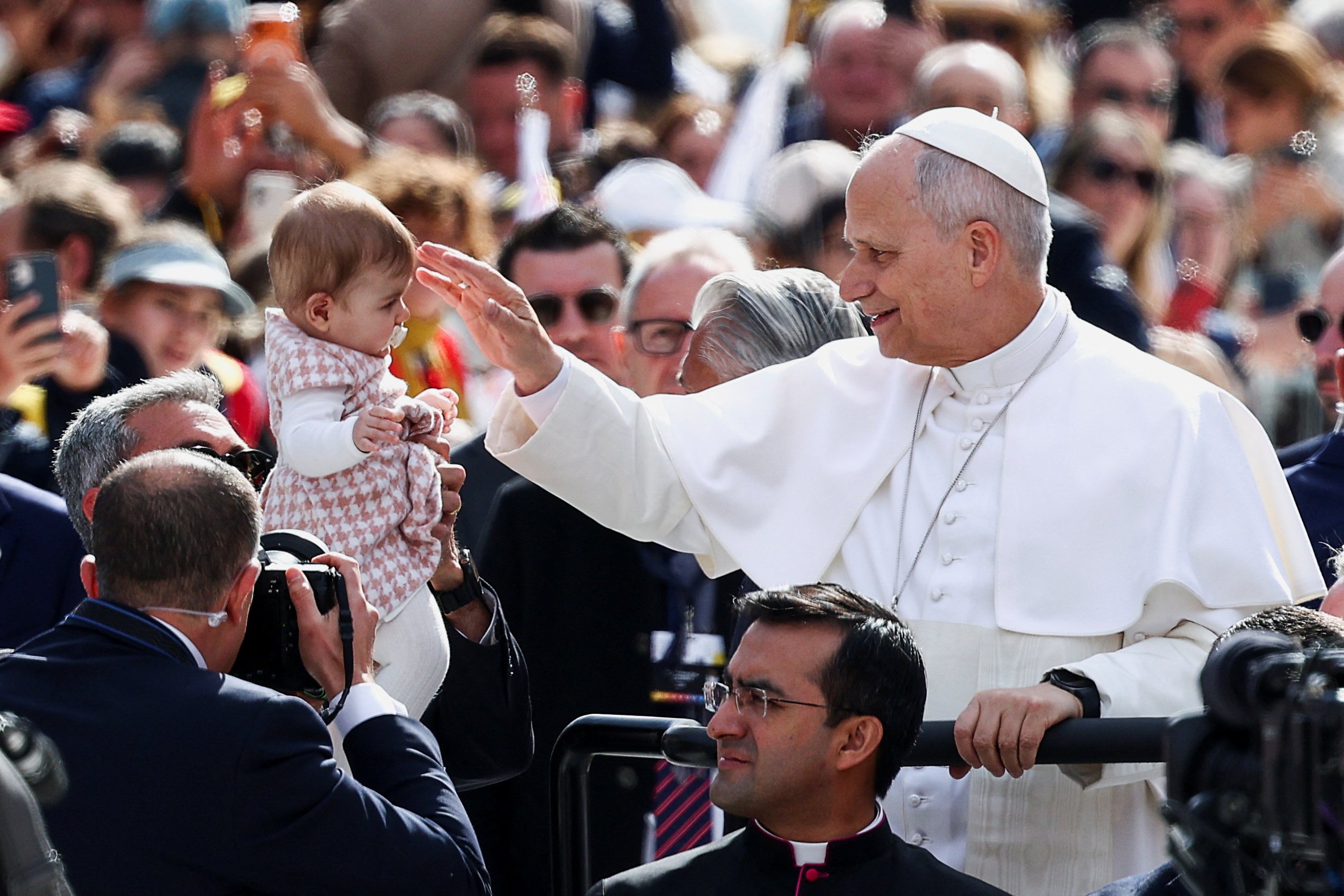
School children in yellow hats eagerly waved the flags of Monaco and Vatican City as Pope Leo traveled by popemobile through Monaco’s famed streets with panoramic views of the Mediterranean below. On the way, he stopped numerous times to bless babies.
At Monaco’s Cathedral of the Immaculate Conception in Monaco-Ville, the pope prayed midday prayer with the local Catholic community and members of the royal family, urging Monaco’s faithful to “proclaim the Gospel of life, hope and love.” The cathedral, consecrated in 1911 on the site of a parish church dating to 1252, contains the tombs of Monaco’s royal family, including Princess Grace Kelly, an Irish American Catholic actress from Philadelphia, who married Prince Rainier III there in 1956 and died in 1982.
“Bring the light of the Gospel to everyone so that the life of every man and woman may be defended and promoted from conception until natural death. Offer new pathways capable of stemming the tide of secularism, which risks reducing humanity to individualism and basing social life on the production of wealth,” Pope Leo said.
Catherine Sassi was among the local Monégasque Catholics who prayed midday prayer with Pope Leo.
“It’s a great pleasure, a great honor and we are so happy to welcome His Holiness Leo XIV,” Sassi told OSV News.
“It’s an amazing day,” she said. “I was so pleased to be able to live it with my family, my husband, my two children. And so it will be a day we will always remember.”
Pope Leo then made his way to the Church of St. Devota, one of Monaco’s most cherished religious sites. Dedicated to the patron saint of Monaco, an early Christian martyr from Corsica executed during the reign of the Roman Emperor Diocletian, the chapel lends its name to the first corner of the Formula 1 Monaco Grand Prix Circuit. At St. Devota, the pope met with young people and catechumens, including 70 adults preparing to receive the sacraments of baptism, first Communion and confirmation.
Inside the chapel, he spent a few moments in prayer before the Blessed Sacrament and paused to venerate the relics of St. Devota.
Under the bright Mediterranean sun, Pope Leo answered questions from young people and soon-to-be baptized catechumens about how to maintain hope in difficult times, witness to God’s love, and comfort those who feel abandoned by God.
In his speech Pope Leo pointed to the witness of both the ancient Roman martyr, St. Devota, and the modern millennial saint, St. Carlo Acutis.
Highlighting St. Carlo’s Eucharistic devotion, the pope told young people to make time for “prayer, moments of silence and reflection to quiet the frenzy of doing and saying, of messages, reels and chats, and to delve deeper into and savor the beauty of truly and genuinely being together.”
“Monaco is a beautiful country, but its true beauty comes from you, when you are able to look into the eyes of those who suffer or who feel invisible amid the city lights,” he told the young people and those preparing to come into the full life of the Catholic Church.
As Pope Leo was speaking about peace during his meeting with Monégasque youth, yachts in the nearby harbor were blowing their horns in the port. The pope laughed, saying, off-the-cuff, “We also desire peace.”
Pope Leo then attended a private lunch at the residence of Archbishop Dominique-Marie David of Monaco. It was a moment of rest before the day’s culminating event, a 3:30 p.m. Mass at Louis II Stadium.
“Dear young people, do not be afraid to give everything — your time, your energy — to God and to your brothers and sisters, to pour yourselves out completely for the Lord and for others,” the pope told the young crowd at the Church of St. Devota.
“Only in this way will you find an everlasting joy and an ever-deeper meaning in life,” he said. “The world needs your witness to overcome the errors of our time, face its challenges and, above all, to rediscover the sweet taste of loving God and neighbor.”
The day concluded with Mass at Louis II Stadium, the home ground of AS Monaco football club, before a crowd of approximately 15,000 faithful.
Arnold Atiomo Noudem, a 16-year-old high school student in Monaco, was among the thousands of people attending the Mass. He told OSV News that he believes religion is something that unites the very international population in Monaco, adding that he was “very excited that Pope Leo chose to come here.”
In his homily, Pope Leo appealed for peace in the face of war, saying, “Every life cut short wounds the body of Christ.”
“Let us not grow accustomed to the clamor of weapons and images of war,” he said. “Peace is not merely a balance of power; it is the work of purified hearts, of those who see others as brothers and sisters to be protected, not enemies to be defeated.”
In remarks after Communion at the papal Mass, Monaco’s Archbishop David addressed the pope for this affirmation of “how beautiful and luminous the Gospel of Christ is, how it can still give taste and meaning to our lives.”
The archbishop said Pope Leo has “encouraged us to face the challenges of our time without fear, aware that we carry a treasure capable of sustaining hope, ours and that of the world.”
“You have reminded our country that its identity does not consist solely in preserving an inheritance, but that it requires responsibility, selflessness and a sense of service,” he said.
“Encouraged by your presence and your words, we want to again say, ‘Yes, Jesus is the way,’” Archbishop David added. “And we want to walk together, covered by the power of the Holy Spirit, and we want to proclaim the way is open to all and for all. Jesus is the truth that enlightens, liberates and gives meaning to life.”
Pope Leo departed Monaco by helicopter around 5:30 p.m. and headed back for Vatican City.
He arrived in Rome hours later just in time for a packed Holy Week schedule that includes presiding over Palm Sunday Mass in St. Peter’s Square the following morning at 10 a.m.
This story has been updated.
Facts Only
Pope Leo XIV visited Monaco on March 28, 2026, marking the first modern papal visit to the principality.
The visit lasted 13 hours and was Pope Leo’s first international trip of 2026 and his second since becoming pope.
Pope Leo addressed a crowd from the Prince’s Palace balcony, flanked by Prince Albert II and Princess Charlene.
He urged Monaco’s wealthy citizens to remember the poor and protect human life, referencing the Last Judgment.
The pope traveled through Monaco’s streets in a popemobile, blessing babies and greeting crowds.
He prayed midday prayer at the Cathedral of the Immaculate Conception, which houses the tombs of Monaco’s royal family, including Princess Grace Kelly.
At the Church of St. Devota, Pope Leo met with young people and 70 catechumens preparing for baptism, first Communion, and confirmation.
He venerated the relics of St. Devota and answered questions about maintaining hope and witnessing to faith.
The pope celebrated Mass at Louis II Stadium before approximately 15,000 attendees.
In his homily, he called for peace, stating that war wounds the body of Christ.
Monaco’s Archbishop Dominique-Marie David thanked Pope Leo for affirming the Gospel’s relevance and encouraging responsibility.
Pope Leo departed Monaco by helicopter around 5:30 p.m. and returned to Vatican City for Holy Week events.
Monaco is the world’s second smallest state after Vatican City, with Catholicism as its official state religion.
About 82% of Monaco’s population is Catholic.
Executive Summary
Pope Leo XIV made a historic visit to Monaco on March 28, 2026, becoming the first modern pope to travel to the principality. Addressing an affluent audience from the Prince’s Palace, he emphasized the moral responsibility of the wealthy to protect the poor and uphold human life, framing this duty within the context of Christian teachings on the Last Judgment. The visit included a popemobile procession through Monaco’s streets, a prayer service at the Cathedral of the Immaculate Conception, and a meeting with young people and catechumens at the Church of St. Devota. The day concluded with a Mass at Louis II Stadium, where the pope called for peace and urged the faithful to resist secularism and individualism. Monaco, where Catholicism is the state religion, welcomed the pope with enthusiasm, with locals expressing gratitude for his message of unity and social responsibility. The trip, lasting just 13 hours, marked Pope Leo’s first international journey of 2026 and his second since assuming the papacy.
The pope’s remarks highlighted the tension between Monaco’s wealth and the Christian call to solidarity, while also celebrating the principality’s Catholic identity. His interactions with young people and soon-to-be baptized adults underscored themes of hope, Eucharistic devotion, and the challenges of modern secularism. The visit was framed as both a spiritual encouragement and a call to action, particularly in addressing global conflicts and the dignity of human life. Local leaders, including Archbishop Dominique-Marie David, echoed the pope’s emphasis on faith as a unifying force in Monaco’s diverse society.
Full Take
The strongest version of this narrative presents Pope Leo XIV’s visit to Monaco as a deliberate juxtaposition of spiritual values against material wealth, using the principality’s opulence as a backdrop to amplify his message of social justice and human dignity. The coverage highlights the pope’s strategic framing—invoking the Last Judgment and the "kingdom of God" to challenge economic inequality—while also celebrating Monaco’s Catholic identity. The emotional resonance of the visit is undeniable, from the imagery of the pope blessing babies to the symbolic weight of his Mass in a stadium named for a monarch. The narrative leans into the contrast between Monaco’s glamour and the pope’s call to humility, which could be seen as a form of constructive tension rather than manipulation.
Pattern scan: The article avoids overt distortion or bad faith tactics, but it does employ a subtle form of **ARC-0024 Ambiguity** by framing Monaco’s wealth as a neutral backdrop rather than interrogating the structural inequalities the pope critiques. The focus on individual moral responsibility (e.g., "protect every human life") risks obscuring systemic questions about how wealth concentration enables or hinders justice. Additionally, the **ARC-0043 Motte-and-Bailey** pattern appears in the dual emphasis on Monaco’s Catholic heritage as both a unifying force and a call to action—celebrating tradition while implying it demands radical change.
Root cause: The narrative assumes that moral appeals to the wealthy can bridge economic divides, a paradigm rooted in Christian social teaching but often critiqued for its reliance on voluntary charity over systemic reform. The unstated tension is whether Monaco’s elite will respond to spiritual exhortations or whether structural change requires more than rhetorical urgency.
Implications: For human agency, the pope’s visit empowers individuals to see their faith as a counterforce to secularism and individualism, but it also risks placing the burden of change on personal virtue rather than institutional accountability. The beneficiaries here are Monaco’s Catholic community, who gain spiritual affirmation, and the Vatican, which reinforces its moral authority. The costs may include missed opportunities to address how wealth itself is structured in places like Monaco.
Bridge questions: How might the pope’s message resonate differently in a less affluent nation? What systemic changes, beyond individual charity, could Monaco’s wealthy pursue to address inequality? Would the narrative shift if the focus were on tax policy or labor rights rather than moral appeals?
Counterstrike scan: A coordinated influence campaign might use this visit to sanitize Monaco’s image, framing its wealth as compatible with Christian values while deflecting criticism of its economic model. However, the article does not engage in such sanitization; it presents the pope’s critique as genuine and unfiltered. The content aligns more with journalistic coverage than propaganda, though the lack of critical follow-up on Monaco’s policies leaves room for unexamined assumptions.