Iran Contests Baku’s Influence Over Georgia’s Shia Community
Executive Summary:
- On June 22–24, Tasu’a commemorations in Marneuli and Tbilisi—featuring imagery of Iran’s Supreme Leader Ali Khamenei—sparked a political controversy in Georgia, with the opposition warning of an Iranian influence network in Kvemo Kartli and the government dismissing the claims as religious incitement.
- Since independence, Georgia’s ethnic Azerbaijani community, now 268,832 people, up 15.4 percent since 2014, has been bound to Baku by ethnic, cultural, and linguistic ties, a dynamic that reinforced Georgia–Azerbaijan cooperation. Iran’s growing use of shared Shia identity as an instrument of soft power now threatens to displace that traditional influence.
- The contest carries risks for both capitals, including the erosion of Baku’s cultural influence among Georgian Azerbaijanis, and a danger for Tbilisi that the politicization of a long-integrated community turns religious practice into a domestic fault line.
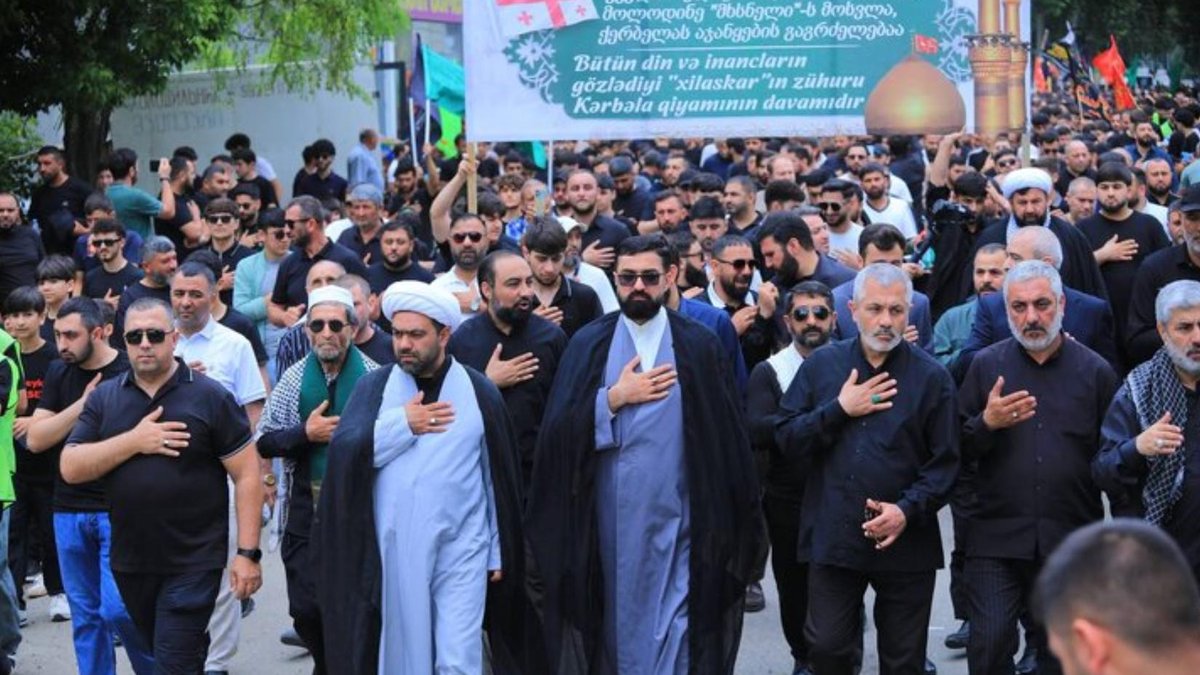
On June 22–24, Georgia’s Shiite community held the annual Tasu’a mourning processions commemorating Imam Hussein in Tbilisi and in the town of Marneuli, the center of the Kvemo Kartli region, which is densely populated by ethnic Azerbaijanis (Facebook/MarneuliNews.ge, June 24). Georgia’s Shiite community has observed the ritual for many years, although in recent years it has become more visible and larger in scale. This year, footage from the Imam Ali Mosque in Marneuli showing worshippers performing a religious chant in front of a poster of Iran’s Supreme Leader Ali Khamenei circulated widely (TV Pirveli, June 22). On social media, people raised the question, “Is this Iran or Georgia?” Certain elements of the event, including its visual style, religious symbols, attributes, and images of religious figures such as Ali Khamenei, were interpreted by some political circles and members of the public as reflecting growing Iranian cultural and religious influence.
The commemoration quickly became a political flashpoint. On June 22, the pro-Western opposition party “Droa!” issued a statement alleging the existence of an organized system of ideological indoctrination, radicalization, and recruitment of Georgian citizens, including children and young people, in Kvemo Kartli, backed by the Iranian regime. The party argued that Iranian influence in the region has reached a concerning level, that the Georgian government is creating conditions conducive to the expansion of an Iranian influence network, and that these developments threaten national security, stability, and peace (Interpressnews, June 22). The government categorically rejected these claims. On June 24, Deputy Speaker of Parliament Nino Tsilosani stated that Georgia faces no such foreign influence, accused opposition critics of attempting to incite hostility on religious grounds, and called for the free and peaceful practice of religion (Facebook/MarneuliNews.ge, June 24).
Coincidentally, on June 22, Georgia’s National Statistics Office released the results of the 2024 population census. According to the data, Muslims now make up 11.1 percent of Georgia’s population, or 437,458 people, an increase of 38,781, or 9.7 percent, over the 398,677 recorded in the 2014 census (Geostat, June 22). Over the past ten years, Georgia’s population has increased by 215,777 people, reaching 3,929,581. This growth was primarily driven by migration rather than natural population increase. Since the Muslim population grew faster than the population as a whole, its share rose from roughly 10.7 percent in 2014 to 11.1 percent in 2024.
Georgia has two major Muslim communities. The first consists of ethnic Georgians, who live primarily in the Autonomous Republic of Adjara. During Ottoman rule, part of the region’s population converted to Islam, and today, Adjara’s Muslim population is predominantly Sunni. The second, and larger, consists of ethnic Azerbaijanis, who practice Shia Islam and are concentrated in Kvemo Kartli and areas around the capital. The growth of Georgia’s Muslim population coincides with the expansion of this community. The census recorded 268,832 ethnic Azerbaijanis, up from 233,024 in 2014, an increase of 35,808, or 15.4 percent. The overwhelming majority are Georgian citizens, with around 8,000 holding Azerbaijani citizenship (Geostat, June 22). Ethnic Azerbaijanis are widely regarded as an integral part of Georgian society, although some do not speak the state language, and their religious affiliation has traditionally not been viewed as a national security concern.
Following independence, the Azerbaijani-populated areas came under dual influence from both Tbilisi and Baku. While their state affiliation was with Georgia, their ethnic, cultural, and linguistic ties were closely linked to Azerbaijan. This situation contributed to sustained cooperation between Georgia and Azerbaijan. A particularly notable example is that prior to Georgia’s national elections, Baku was seen as supporting the ruling parties. This was done in various ways, including the role of the State Oil Company of the Republic of Azerbaijan (SOCAR), whose representatives were reportedly active in the region. The company has periodically denied allegations of involvement in political activities or of exerting pressure on local Azerbaijanis in support of Georgia’s ruling party (1tv, October 26, 2018).
That dynamic now appears to be shifting, and seemingly not in Baku’s favor. Reports from several Georgian media outlets indicate that Iran has recently intensified efforts to strengthen its cultural and religious presence in Kvemo Kartli and the Azerbaijani-populated areas around Tbilisi. Some local observers argue that it is precisely shared adherence to Shiism that makes Iran attractive to Georgian Azerbaijanis in a way that secular Baku and Sunni-majority Türkiye cannot easily replicate (Radio Tavisupleba, December 26, 2025). Tehran is increasingly leveraging religious and cultural ties as an instrument of its soft power among Georgia’s Shiite population, gradually displacing the cultural influence of both Azerbaijan and Türkiye.
The small town of Marneuli is gradually becoming a focal point of this competition. During the same days that the mourning processions were held, the newly appointed Turkish ambassador visited the region on June 23 for introductory meetings with the leaders of the region’s administration (Facebook/TürkiyeinGeorgia, June 23). Until recently, for most members of this community, whose population has been steadily increasing, Islam primarily functioned as a religious and cultural identity rather than a tool of political mobilization. Some external actors may now be seeking to use religion to expand their influence by transforming religious identity into a tool of political leverage. Such a development could, over time, create new challenges for both Tbilisi and Baku. For Georgia, this would relate to issues of domestic stability and national security, while for Azerbaijan it could result in the erosion of its traditional cultural and humanitarian influence among Georgian Azerbaijanis if religious affiliation begins to displace their longstanding ethnic and cultural ties with Azerbaijan.