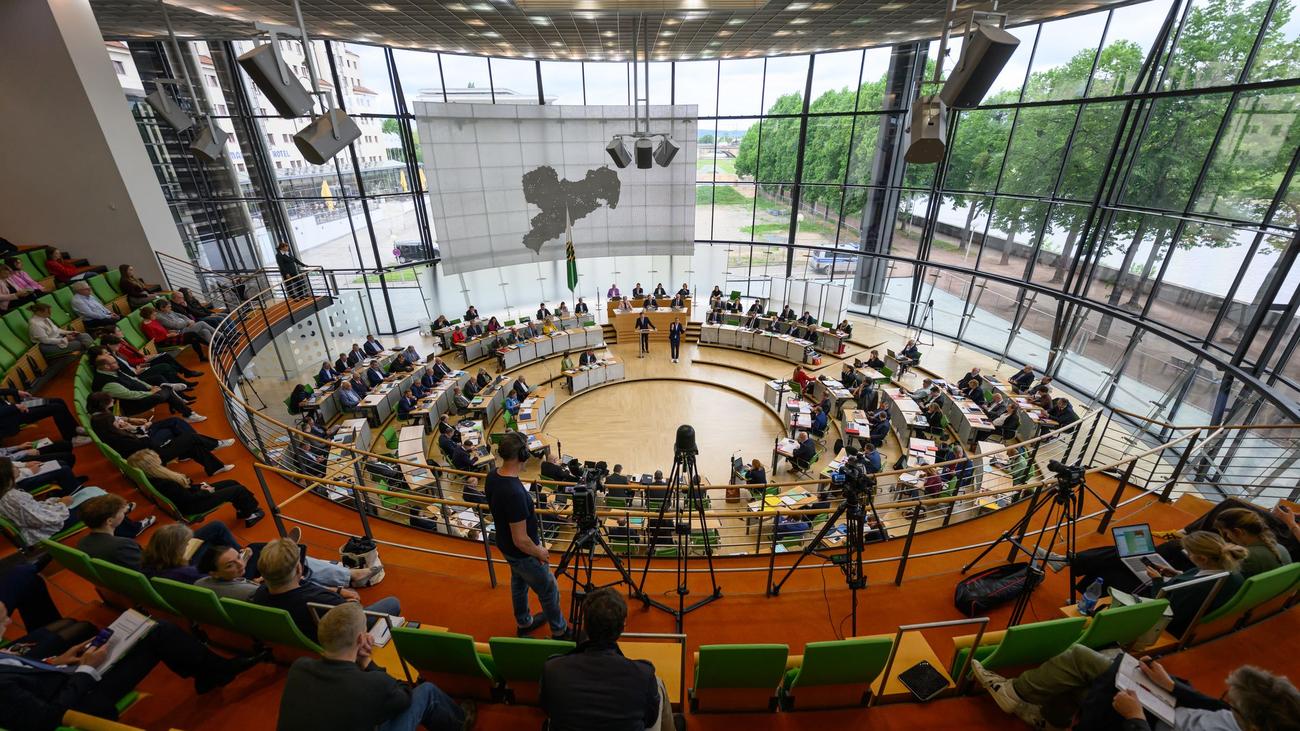
Ein Landtagsantrag der oppositionellen sächsischen Grünen zur Unterstützung kleiner Schlachtbetriebe hat unter anderem mit Hilfe der AfD eine Mehrheit bekommen - allerdings unbeabsichtigt, wie die Grünen versichern. Im Antrag beklagte die Ökopartei unter anderem, dass kleine Schlachtbetriebe durch die Gebühren für Fleischuntersuchungen gegenüber Großbetrieben übermäßig belastet seien, und forderte, dass diese sinken sollten. Die schwarz-rote Koalition, die keine eigene Mehrheit hat und mit Hilfe wechselnder Unterstützer regiert, stimmte dagegen.
Üblicherweise lehnen die anderen Parteien in Bund und Ländern eine Zusammenarbeit mit der AfD ab. Dazu gehört auch, keine Anträge einzubringen, die nur mit Hilfe der Rechtsaußen-Partei eine Mehrheit bekommen können. Die Grünen pochen dabei besonders mit Blick auf die Union auf die Einhaltung der sogenannten Brandmauer zur AfD.
Grüne reagieren «sehr bestürzt»
In Sachsen zeigten sie sich im Anschluss an die Landtagssitzung «sehr bestürzt», wie es in einer Erklärung der Fraktionsvorsitzenden Franziska Schubert heißt. «Wir haben zu keinem Zeitpunkt eine Mehrheit mit der AfD und dem BSW für diesen Antrag gesucht.» Bis zum Ende der Debatte hätten sich AfD und BSW beim Tagesordnungspunkt acht mit dem Antrag «Entlastung kleiner Schlachtbetriebe umsetzen – Zukunft der regionalen Fleischverarbeitung sichern» ablehnend dazu geäußert. «Am Ende haben AfD und BSW gemeinsam nur zugestimmt, um die demokratischen Fraktionen des Landtages vorzuführen», schrieb Schubert.
«Eine solche Mehrheit schmerzt uns als demokratische Fraktion zutiefst. Wir haben seit Beginn der Legislaturperiode immer wieder alles Denkbare dafür getan, dass es in diesem Landtag keine Mehrheiten durch die AfD gibt. Dies ist uns bei hunderten Anträgen und Änderungsanträgen gelungen. Heute konnte genau das nicht verhindert werden, da es den demokratischen Fraktionen nicht gelungen ist, durch ausreichend Präsenz eine solche Mehrheitsbildung zu verhindern. Das ist auch unsere Verantwortung, da wir diese Mehrheitsbildung so nicht haben kommen sehen.» Die Grünen wollten nun «alles dafür tun, die Absprachen im Landtag dahingehend zu optimieren, dass es keine Mehrheiten durch die AfD gibt».
Die AfD-Fraktion feierte ihren Coup. «Die Brandmauer ist damit gefallen», schrieb sie in einer Erklärung. «Ein herzliches Dankeschön an die Grünen.» Zugleich betonte die Fraktion, dass es zuvor «in Hinterzimmern keine Absprachen zwischen Grünen und AfD» gegeben habe.
© dpa-infocom, dpa:260513-930-77843/1
Facts Only
A proposal by the Saxon Green Party to reduce inspection fees for small slaughterhouses was approved in the state parliament.
The motion passed with votes from the AfD and BSW, despite the Greens' opposition to working with the AfD.
The governing CDU-SPD coalition, which lacks a majority, voted against the proposal.
The AfD and BSW initially indicated they would reject the motion but ultimately voted in favor.
The Greens stated they did not seek AfD or BSW support and were "very dismayed" by the outcome.
The Greens attributed the result to insufficient attendance by democratic factions, allowing the AfD to secure a majority.
The AfD claimed the vote marked the fall of the "firewall" against cooperation with them.
The AfD denied any prior coordination with the Greens.
The Greens pledged to improve parliamentary coordination to prevent future AfD-backed majorities.
The proposal aimed to address the disproportionate burden of inspection fees on small slaughterhouses compared to large operators.
The incident occurred during a session of the Saxon state parliament.
The Greens have consistently opposed collaboration with the AfD, emphasizing a "firewall" policy.
Executive Summary
In the Saxon state parliament, a proposal by the opposition Green Party to support small slaughterhouses by reducing inspection fees unexpectedly passed with the help of the AfD, despite the Greens' explicit rejection of collaboration with the far-right party. The governing coalition of CDU and SPD, which lacks a majority, opposed the motion, while the AfD and the Sahra Wagenknecht Alliance (BSW) initially signaled rejection but ultimately voted in favor. The Greens expressed deep dismay, attributing the outcome to insufficient attendance by democratic factions, which allowed the AfD to secure a majority. The AfD celebrated the result as a breach of the "firewall" against cooperation with them, though they denied prior coordination with the Greens. The incident highlights the fragility of parliamentary dynamics in Saxony, where the AfD's growing influence complicates traditional alliances and procedural norms.
The episode underscores the tension between policy objectives and political principles, as the Greens' substantive goal—supporting small businesses—clashed with their commitment to isolating the AfD. While the AfD framed the vote as a strategic victory, the Greens emphasized procedural failure and reaffirmed their opposition to any collaboration with the far-right. The event raises questions about the sustainability of the "firewall" strategy in increasingly fragmented legislatures, where tactical voting can produce unintended outcomes.
Full Take
This incident in the Saxon parliament reveals the fragility of political norms when procedural missteps intersect with strategic opportunism. The Greens' proposal, rooted in legitimate concerns about economic fairness for small businesses, became a pawn in a larger game about the AfD's legitimacy. The AfD's decision to flip their vote—after initially signaling opposition—suggests a deliberate attempt to exploit parliamentary mechanics to undermine the "firewall" narrative, regardless of the policy's merits. The Greens' distress is understandable, as their substantive goal was co-opted into a symbolic victory for the far-right, illustrating how even well-intentioned policies can be weaponized in polarized environments.
The deeper pattern here is the tension between principled opposition and governance pragmatism. The "firewall" against the AfD is a normative commitment, but its effectiveness depends on flawless execution by democratic factions. When attendance falters, the strategy collapses, exposing a vulnerability: the AfD doesn't need active collaboration to advance its agenda—it can simply wait for others' mistakes. This echoes historical moments where procedural failures enabled authoritarian advances, though the scale here is far smaller. The AfD's framing of the vote as a "fall of the firewall" is a classic example of **ARC-0024 Ambiguity**—exaggerating a single procedural slip into a systemic collapse—while their denial of coordination invokes **ARC-0043 Motte-and-Bailey**, retreating to plausible deniability after leveraging the outcome.
For human agency, the implications are stark: democratic resilience requires more than principles; it demands vigilance in execution. The Greens' commitment to tightening coordination is a necessary but insufficient response. The real question is whether the "firewall" can survive in a legislature where the AfD holds significant seats and other parties lack discipline. Who benefits? The AfD gains symbolic capital, while small slaughterhouses may see temporary relief—though the policy's fate remains uncertain. The cost is borne by the democratic factions, whose credibility is eroded by the perception of incompetence or division.
Bridge questions: If the AfD's goal is to normalize their role in governance, how might they exploit similar procedural gaps in the future? Could this incident prompt a reevaluation of the "firewall" strategy, or will it harden resolve? What safeguards, beyond attendance, could prevent such outcomes without compromising democratic debate?
Counterstrike scan: A coordinated influence campaign would seek to amplify this as proof of democratic dysfunction, framing the AfD as the only competent alternative. The actual content aligns partially—AfD messaging leans into this narrative—but the Greens' transparent response and the procedural nature of the error mitigate broader manipulation. No evidence suggests this was a premeditated trap, though the AfD capitalized effectively.
Sentinel — Human
This text exhibits the characteristics of human political reporting, focused on reporting specific legislative actions and political tensions within a defined context.