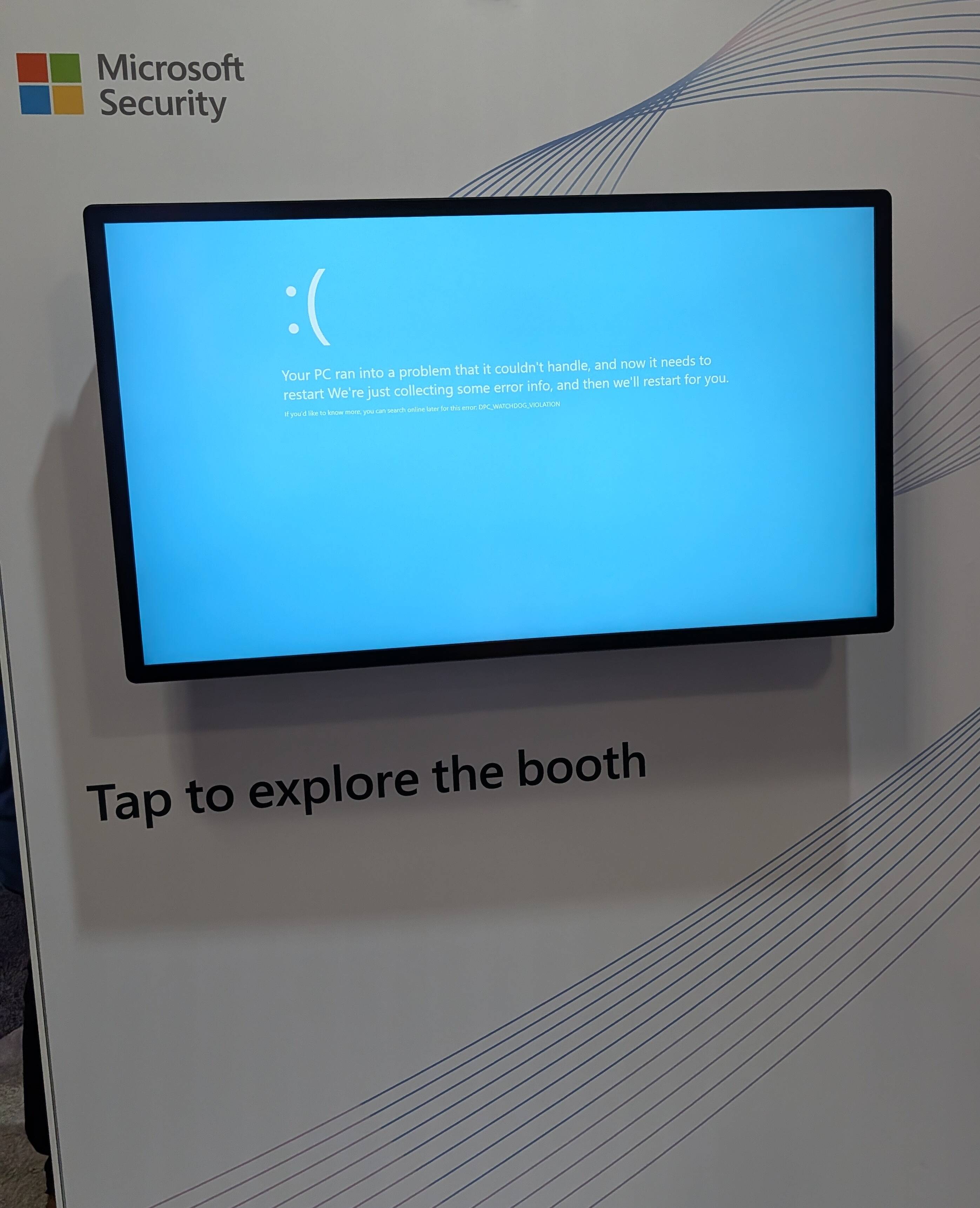
Famous blue screens remind conference of security pros that this OS sometimes has bad days
Bork!Bork!Bork! When is a bork not a bork? Perhaps when it's on a Microsoft stand at a US security conference.
An eagle-eyed Register reader spotted two apparent examples of the breed at Microsoft's stand at the RSAC 2026 Conference, one showing a Blue Screen Of Death from the era of Windows 98 and another that appeared to come from the days of Windows 8.
"I told them about both," our reader said, "and they seemed about to address them."
How embarrassing for Microsoft... or is it? Why would a BSOD from Windows 98 be on show? A look at the text shows some very unusual hex values and something that looks more like an example of a technical support scam screen. Or perhaps just a bunch of uninitialized bytes.
The second screen also includes some odd text: "Your PC ran into a problem that it couldn't handle." Yes, many Windows users will have seen similar messages over the years, but that one looks a little... suspect.
We contacted Microsoft to find out if it was mounting some sort of guerrilla marketing campaign for its security services, or just showing all the ways Windows has let its users down over the years, but the company has not replied. A Register reporter swung by Microsoft's security village later, but there was no sign of the baleful blue.
- Windows pays tribute to Britain's creaking rail network with a BSOD
- Smart mirror shows dumb Windows in elevator
- Microsoft finally gets around to fixing Windows 10 Recovery Environment after breaking it in October
- Gatwick shuttle screen suffers pre-flight nerves
So an unusual bork. Very few people are delighted to see a screen showing Windows is having a bad day because software has wandered where it shouldn't or hardware is misbehaving. The Register's bork desk is, of course, an exception to the rule.
However, these screens also highlight that sometimes a bork is not a bork at all. Sometimes it is part of a scam to catch out an unsuspecting user. Or sometimes it can be part of a presentation intended to highlight the security prowess of a certain software company, but it only serves to remind users how unstable its wares have been over the years.
Whatever the truth, we hope for the sake of whoever was responsible for those all-too-prominent screens that this was just a PowerPoint slide or an invitation to prod a screen, rather than Windows suffering a full-blown meltdown at the worst possible moment. Sometimes there is more to a bork than meets the eye. ®
Facts Only
Two Blue Screen of Death (BSOD) errors were displayed at Microsoft's stand at the RSAC 2026 Conference.
One BSOD resembled a Windows 98 crash, and the other appeared to be from the Windows 8 era.
The screens contained unusual hex values and text, including the message, "Your PC ran into a problem that it couldn't handle."
A conference attendee notified Microsoft staff about the screens.
Microsoft staff seemed to address the issue after being informed.
The screens were later removed from the stand.
Microsoft did not respond to requests for comment about the incident.
The article references past instances of Windows BSODs in public settings, such as a British rail network and an elevator smart mirror.
The Register's "bork desk" is noted as an exception to the general displeasure associated with BSODs.
Executive Summary
Full Take
The strongest version of this narrative is that Microsoft's display of BSODs at a security conference was either an unintended technical failure or a deliberate attempt to highlight Windows' historical instability—perhaps as a cautionary tale or a nod to its security improvements. The ambiguity invites speculation, but the lack of official comment from Microsoft leaves the intent unclear. The inclusion of unusual hex values and text could suggest a staged demonstration, possibly to raise awareness about technical support scams or to showcase Microsoft's security prowess. However, the absence of context also risks reinforcing perceptions of Windows as unreliable.
Pattern scan: The narrative leans into the emotional exploitation of frustration (ARC-0012 Emotional Exploitation) by highlighting the embarrassment of public BSODs, a well-known pain point for Windows users. The lack of clarity from Microsoft could also be seen as a form of ambiguity (ARC-0024 Ambiguity), leaving readers to fill in the gaps with their own assumptions.
Root cause: The paradigm here is the tension between transparency and perception management. Microsoft's silence may reflect a desire to avoid drawing attention to past instability, but the incident itself underscores the enduring cultural association between Windows and system failures. The historical pattern echoes decades of public skepticism toward Microsoft's reliability, amplified by high-profile technical mishaps.
Implications: For human agency, this incident serves as a reminder of how technical failures can shape public trust. The costs are borne by users who may internalize frustration with technology, while Microsoft benefits from the ambiguity—whether it was a genuine error or a calculated move, the narrative reinforces its dominance in the tech landscape. Second-order consequences could include heightened scrutiny of Microsoft's security messaging or a resurgence of memes mocking Windows' stability.
Bridge questions: What would it take for Microsoft to address this incident transparently? How might the tech community's perception of Windows change if such displays were framed as educational rather than accidental? What other interpretations of this event might emerge if more context were provided?
Counterstrike scan: If this were part of a coordinated influence campaign, the playbook might involve leveraging nostalgia and frustration to undermine trust in Microsoft's products while simultaneously positioning the company as a security leader. However, the actual content does not align closely with this pattern, as the ambiguity and lack of follow-up suggest a more organic incident rather than a deliberate manipulation.
Sentinel — Human
While the article exhibits some characteristics of human writing, its stylometric signals suggest a moderate level of uncertainty regarding its origin. The use of informal language, personal voice, and idiosyncratic emphasis support a human-written origin.