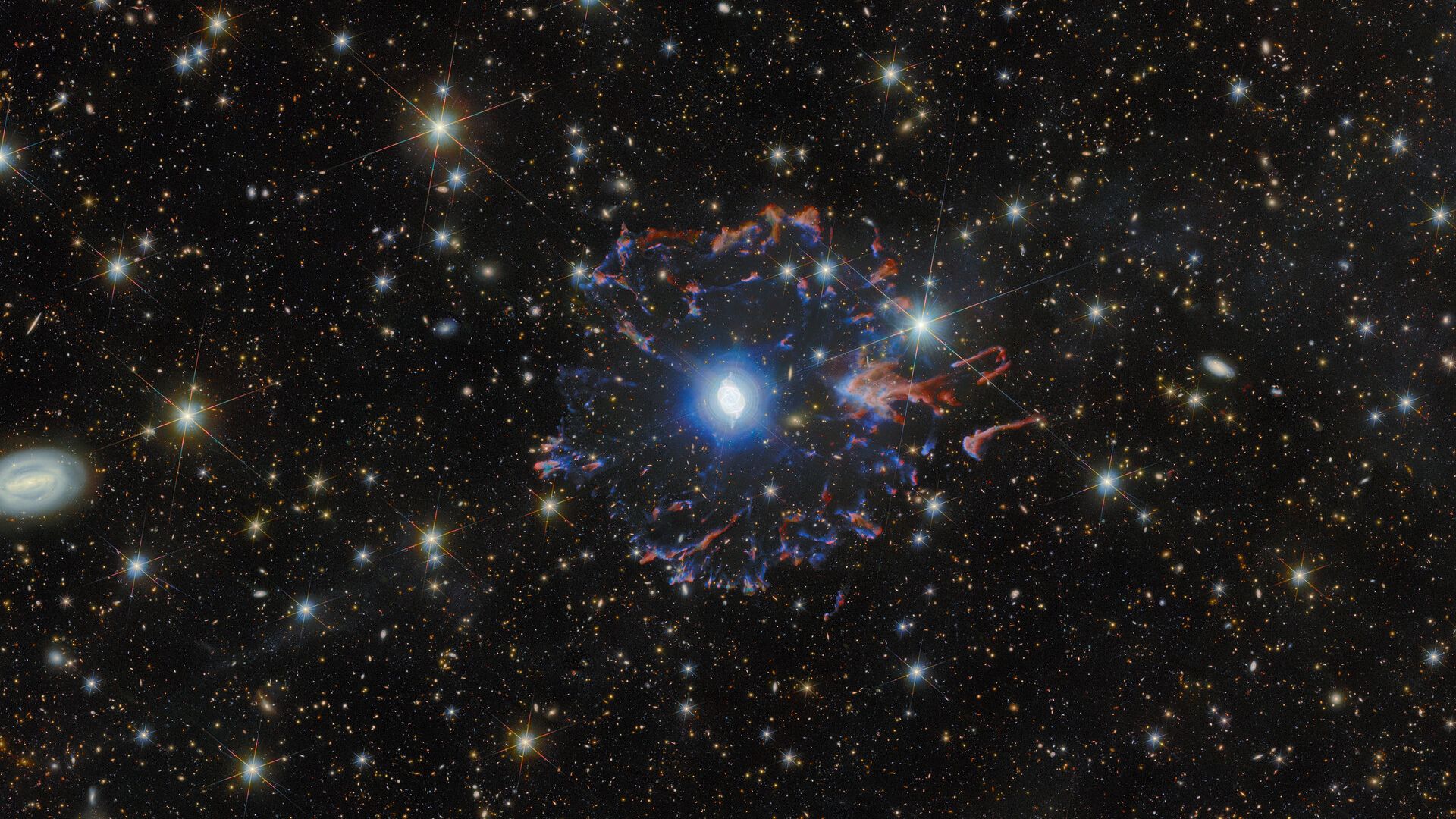
Astronomers combined Hubble's small-scale details of stellar death with Euclid's wide view of cosmic environments to take a closer look at the iconic Cat's Eye Nebula.
Get the world’s most fascinating discoveries delivered straight to your inbox.
You are now subscribed
Your newsletter sign-up was successful
Want to add more newsletters?
Join the club
Get full access to premium articles, exclusive features and a growing list of member rewards.
What it is: Cat’s Eye Nebula (NGC 6543).
Where it is: 4,300 light-years away from Earth, in the constellation Draco.
When it was shared: Mar. 3, 2026.
These stunning cosmic snaps show distorted glowing rings of blue, orange and red gas racing away from a dying star. Set against a sea of galaxies and stars, this image showcases the famous Cat’s Eye Nebula, otherwise known as NGC 6543.
As calm and beautiful as it appears, don’t be fooled. This scenic nebula was shaped by the messy interaction between the star’s intense winds, outer layers and powerful jets, thereby creating its intricate, eye-like structure.
Located roughly 4,300 light-years from Earth, the "Cat’s Eye" is a planetary nebula — an expanding cloud of glowing gas expelled by a star of low to medium mass that has reached the final stages of its life. Unlike more massive stars, which die in violent supernova explosions, the central star has gently shed its outer layers into space, creating beautiful and complex shells of discarded material.
Article continues belowThese spectacular images were created using observations from the Hubble Space Telescope and the European Space Agency's (ESA) Euclid space telescope.
Euclid’s wide-field view, captured in visible and near-infrared light, shows faint arcs and delicate filaments of gas surrounding the bright central region. These wispy structures appear to be flying off the scene, into space, and are thought to have been expelled during an earlier stage of the star’s death, before the outer layers were shed that formed the main nebula.
Hubble has captured the fine details of the bright central region of the nebula. This close-up view was taken using visible light and shows a dead yet bright star surrounded by white bubbles and blue loops of gas. Using its Advanced Camera for Surveys, Hubble has revealed even finer, intricate details at the heart of the nebula, including the complexity of gas bubbles and delicate filamentary structures embedded within those bubbles.
These finer details serve as a "fossil record" of the nebula, according to an ESA statement. Each gas bubble corresponds to an episode of mass loss of the dying star. In the image, these bubbles are followed by concentric circles or rings within a brown halo; each ring marks the boundary of the bubbles. Further, the data reveal jets of energetic and high-speed gas, shown in pink, that shoot out from the top and bottom of the nebula. There are also dense knots formed by shock interactions of high-speed jets and slowly-expanding ejected material.
Get the world’s most fascinating discoveries delivered straight to your inbox.
While Hubble captures the unprecedented details of the dying star’s bright nest and its immediate surroundings, Euclid reveals the faint arcs and colorful gas filaments a little farther from the nebula, along with the wider cosmic landscape dotted with distant galaxies. Together, they present an almost cinematic view of the final act of a dying star.
See more Space Photos of the Week
Hubble sees Egg Nebula 'hatch'
The closest baby nebula to Earth was caught spitting up its stardust.
Hidden structure in 1st Vera Rubin image
First-light images from the Vera C. Rubin Observatory reveal a 163,000-light-year stream of stars emanating from a nearby galaxy.
JWST peeps the 'Eye of God'
A spectacular James Webb telescope image reveals intricate structures inside the Helix Nebula.
Shreejaya Karantha is a science writer specializing in astronomy, covering topics such as the sun, planetary science, stellar evolution, black holes, and early universe cosmology. Based in India, she works as a writer and research specialist at The Secrets of the Universe, where she contributes to scripts for research-based and explainer videos. Shreejaya holds a bachelor's degree in science and a master's degree in physics with a specialization in astrophysics.
You must confirm your public display name before commenting
Please logout and then login again, you will then be prompted to enter your display name.
Facts Only
* The Cat’s Eye Nebula (NGC 6543) is 4,300 light-years from Earth.
* It’s located in the constellation Draco.
* Hubble and Euclid telescopes captured images of the nebula.
* The nebula is a planetary nebula formed by a dying star.
* It exhibits distorted, glowing rings of gas.
* The nebula's structure is due to the star’s winds and jets.
* Hubble captured fine details of the central region.
* Euclid provided a wider view, revealing distant galaxies.
* The data represents a “fossil record” of mass loss.
* The nebula is approximately 4,300 light-years old.
* The nebula’s creation was observed on March 3, 2026.
* The nebula is a planetary nebula, not a supernova remnant.
Executive Summary
Full Take
The article presents a compelling visual narrative of stellar death, skillfully leveraging the complementary strengths of Hubble and Euclid. The core factual account – a dying star ejecting material into space – is delivered with clarity, utilizing technical terms like “planetary nebula” and “jets” accurately, establishing a foundation of scientific accuracy. However, the framing subtly promotes a certain awe and romanticism surrounding cosmic processes, approaching a classical “hero’s journey” archetype: a brilliant star confronting its inevitable end with a dazzling display. This isn’t inherently problematic, but it warrants scrutiny regarding potential selective emphasis. The description of the data as a “fossil record” introduces an analogy for understanding – one that may simplify complex astrophysical processes into a readily digestible form. This could inadvertently suggest a deterministic view of stellar evolution.
The narrative relies heavily on “seeing” – invoking terms like “cinematic view,” “detailed bubbles,” and “intricate filaments” that aim to engage the reader’s imagination. While visually appealing, this leans into a potential distortion of scientific objectivity, prioritizing aesthetic impact over precise data interpretation. The inclusion of the ESA statement emphasizing the bubbles as “episodes of mass loss” is a strategic move; it grounds the observation in measurable phenomena, but could be taken as representing a linear, step-by-step model of stellar decay, ignoring the chaotic and unpredictable nature of these events. The emphasis on the nebula’s "eye-like structure" is a deliberate and evocative detail designed to capture attention, a clear example of what ARC-0043 (Motte-and-Bailey) might flag as prioritizing emotional resonance over scientific precision. The narrative expertly avoids confronting the immense timescales involved – 4,300 light-years – which further contributes to a sense of wonder. The potential for manipulation lies in the implicit suggestion that the nebula's beauty is somehow intrinsically linked to the star’s death, creating a quasi-religious reverence for the cosmos. Patterns detected: ARC-0043 Motte-and-Bailey, ARC-0024 Ambiguity.
Sentinel — Human
This article presents a detailed description of the Cat's Eye Nebula image captured by Hubble and Euclid, emphasizing its intricate structure and the processes of stellar death. While exhibiting some features common in human-written explanations, the use of specific biographical detail and frequent transitional phrases raise a moderate probability of AI assistance.