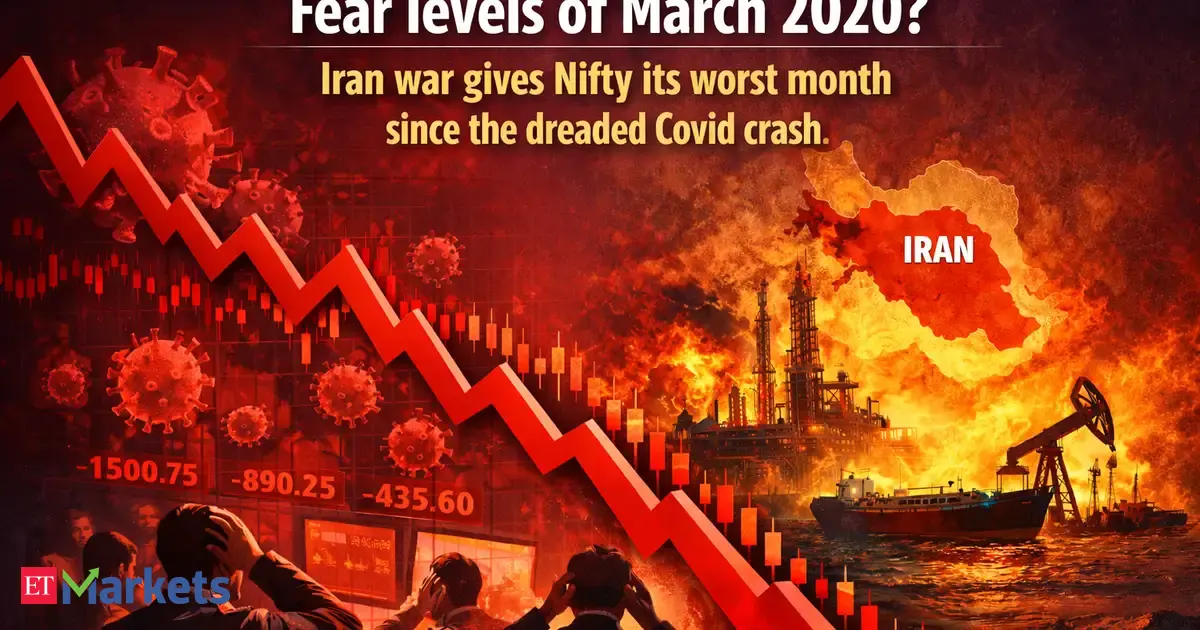
The current slide also marks the second-worst monthly fall for the Nifty in the last ten years, underlining the intensity of the sell-off that has gripped Dalal Street.
The sharp correction has unfolded over the past week as escalating conflict in West Asia, particularly the ongoing Iran war, triggered a surge in crude oil prices and heightened global risk aversion. India, which imports nearly 85% of its crude oil requirements, remains particularly sensitive to any disruption in Middle East supply chains.
Also read:Explained: Why traders aren’t holding on to gold since Middle East war despite safe haven appeal
With Brent crude hovering near $100 per barrel, concerns have grown around the impact on inflation, corporate margins and the rupee. The Strait of Hormuz, through which a large portion of India's oil imports pass, has emerged as a key geopolitical flashpoint as the conflict intensifies.
The market fall has also been aggravated by heavy foreign institutional investor selling. FIIs have already sold nearly Rs 40,000 crore worth of Indian equities so far this month, putting sustained pressure on largecap stocks and dragging benchmark indices lower.
The BSE Sensex is on track to close the current week down by nearly 4,000 points, while the Nifty has dropped about 5% in just five trading sessions. The sell-off has been widespread, including in the broader market. Just on Friday, the Nifty small and midcap indices fell close to 3%.
Beyond the Iran conflict, analysts say concerns around global growth and sector-specific headwinds have also contributed to the market weakness. The rapid adoption of artificial intelligence globally has raised questions about the near-term outlook for India's IT services sector, which has seen underperformance in recent months as investors reassess demand visibility.
Fundamentals remain strong
Despite the current volatility, fund managers say the underlying fundamentals of the Indian economy remain intact. According to Sorbh Gupta, Head-Equity at Bajaj Finserv AMC, corporate earnings have shown strong momentum over the past few quarters, providing a more supportive foundation for markets.
Recent results indicate a broad-based recovery in profitability across sectors. Profit growth for the Nifty 500 companies rose about 16% year-on-year in Q3FY26, marking the strongest earnings expansion in eight quarters.
Gupta noted that improving earnings visibility could help stabilise equities once the current wave of global uncertainty subsides.
Domestic macroeconomic indicators have also shown signs of improvement. Credit growth has returned to double-digit levels, suggesting stronger demand for loans and improving liquidity conditions. Consumption trends have begun to recover following tax and policy support, while earlier rate cuts by the Reserve Bank of India have helped lower borrowing costs for both companies and consumers.
Over the longer term, markets have historically absorbed geopolitical shocks relatively quickly. Axis Mutual Fund pointed out that Indian equities have navigated multiple global crises over the past decade -- from regional conflicts to wars and economic disruptions -- with only temporary drawdowns before fundamentals reasserted themselves.
However, the near-term outlook remains closely tied to geopolitical developments.
If tensions in the Middle East escalate further, crude oil prices could remain elevated, potentially triggering higher inflation, pressure on the rupee and margin compression for sectors such as aviation, chemicals, paints and oil marketing companies.
Also read: $100 crude gives Rs 20 lakh crore shock to Nifty bulls this week. Best time to buy the fear?
India's strong foreign exchange reserves and strategic petroleum reserves offer some cushion against external shocks, but markets are likely to remain volatile as investors track developments in the region, analysts say.
(Disclaimer: Recommendations, suggestions, views and opinions given by the experts are their own. These do not represent the views of Economic Times)
(What's moving Sensex and Nifty Track latest market news, stock tips, Budget 2025, Share Market on Budget 2025 and expert advice, on ETMarkets. Also, ETMarkets.com is now on Telegram. For fastest news alerts on financial markets, investment strategies and stocks alerts, subscribe to our Telegram feeds .)
Subscribe to ET Prime and read the Economic Times ePaper Online.and Sensex Today.
Top Trending Stocks: SBI Share Price, Axis Bank Share Price, HDFC Bank Share Price, Infosys Share Price, Wipro Share Price, NTPC Share Price
(What's moving Sensex and Nifty Track latest market news, stock tips, Budget 2025, Share Market on Budget 2025 and expert advice, on ETMarkets. Also, ETMarkets.com is now on Telegram. For fastest news alerts on financial markets, investment strategies and stocks alerts, subscribe to our Telegram feeds .)
Subscribe to ET Prime and read the Economic Times ePaper Online.and Sensex Today.
Top Trending Stocks: SBI Share Price, Axis Bank Share Price, HDFC Bank Share Price, Infosys Share Price, Wipro Share Price, NTPC Share Price
Facts Only
The Nifty has recorded its second-worst monthly fall in the last ten years.
Escalating conflict in West Asia, particularly the Iran war, has triggered a surge in crude oil prices.
Brent crude is hovering near $100 per barrel.
India imports nearly 85% of its crude oil requirements.
The Strait of Hormuz is a key geopolitical flashpoint for India's oil imports.
Foreign institutional investors (FIIs) have sold nearly Rs 40,000 crore worth of Indian equities this month.
The BSE Sensex is down nearly 4,000 points this week, while the Nifty has dropped about 5% in five trading sessions.
The Nifty small and midcap indices fell close to 3% on Friday.
Corporate earnings for Nifty 500 companies rose about 16% year-on-year in Q3FY26.
Credit growth in India has returned to double-digit levels.
India's foreign exchange reserves and strategic petroleum reserves provide some cushion against external shocks.
Executive Summary
Full Take
The narrative presents a strong case for the market downturn being driven by geopolitical tensions and their economic ripple effects. It rightly highlights India's vulnerability to oil price shocks and the role of foreign investor sentiment in amplifying volatility. The inclusion of corporate earnings data and macroeconomic indicators provides a balanced counterpoint, suggesting resilience beneath the surface. However, the framing leans heavily on the immediate crisis, with less emphasis on structural factors like domestic policy responses or long-term growth drivers. The repeated references to "fear" and "shock" could subtly reinforce a narrative of fragility, even as the data shows underlying strength.
Patterns detected: ARC-0024 Ambiguity (in the tension between short-term volatility and long-term fundamentals), ARC-0043 Motte-and-Bailey (emphasizing geopolitical risks while downplaying systemic resilience).
Root cause: The narrative assumes markets are primarily reactive to external shocks rather than proactive in pricing in fundamentals. This echoes historical patterns where short-term panic overshadows long-term trends, but it risks underestimating India's policy buffers and investor adaptability.
Implications: While the analysis acknowledges India's economic resilience, it could inadvertently amplify investor anxiety by focusing on downside risks. The beneficiaries of this narrative are likely short-term traders and risk-averse investors, while long-term holders may face unnecessary pressure. Second-order consequences include potential overreactions in sectors like IT, which faces separate challenges from AI adoption.
Bridge questions: How might India's strategic petroleum reserves mitigate prolonged oil price spikes? What role could domestic institutional investors play in countering FII outflows? Would a de-escalation in West Asia lead to a proportional market recovery, or have other factors gained dominance?
Counterstrike scan: A coordinated influence campaign would amplify fear around geopolitical risks while downplaying India's economic fundamentals to trigger panic selling. The actual content balances these elements, with clear acknowledgment of resilience, suggesting no alignment with such a playbook.
Sentinel — Human
The article shows strong signs of human authorship, with specific data points, named sources, and promotional elements typical of financial journalism. Minimal stylometric or coherence red flags suggest low likelihood of synthetic generation.