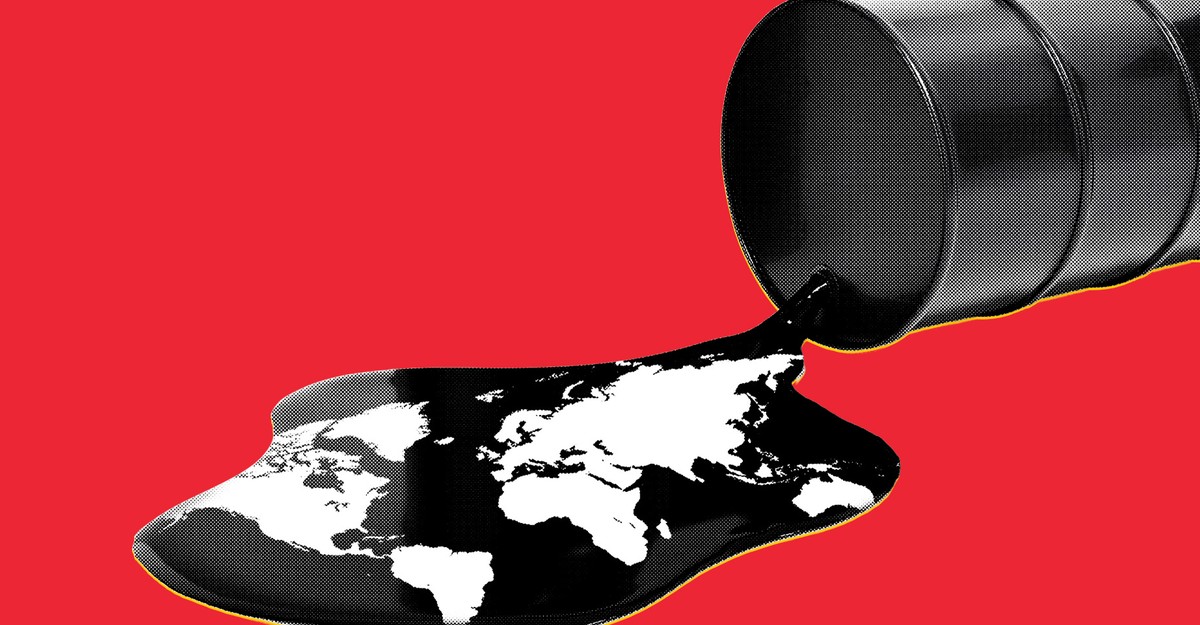
The U.S. is flirting with economic and geopolitical disaster in the Strait of Hormuz.
The Iran war has already created the “largest supply disruption in the history of the global oil market,” according to the International Energy Agency, and the situation could still get much worse. Iran has vowed to sink any ship trying to pass through the Strait of Hormuz, the waterway responsible for carrying a fifth of the world’s oil supply. And according to The Wall Street Journal, the U.S. Navy has turned down requests to escort ships through the strait, deeming such efforts too dangerous. In a Wednesday interview with Fox News, Secretary of Energy Chris Wright said that the strait would reopen “hopefully in the next few weeks.” Note the adverb.
Before the United States attacked Iran, crude oil was trading at around $65 a barrel. Yesterday it hovered in the $90 to $100 range. How much higher could it go? Ebrahim Zolfaqari, a spokesperson for Iran’s Khatam al-Anbiya military-command headquarters, has declared that the world should “get ready for oil to be $200 a barrel.” According to several energy experts, if the strait remains closed for even a month—if the U.S. and Israel don’t swiftly defeat Iran’s navy and neutralize its sabotage ability—that might not be hyperbole. In that scenario, sustained higher oil prices could plunge the world into a recession, raise borrowing costs, alter the outcome of ongoing wars, and shift the balance of global-power competition in favor of Russia and China. “We would be entering a completely different world,” Meghan O’Sullivan, the director of the Geopolitics of Energy Project at Harvard Kennedy School, told me.
For America, the most obvious consequence of a prolonged energy crisis would be higher prices, and not just for gas. Oil is also a crucial input to just about every sector of the U.S. economy: the fertilizers needed to grow food, the fuel used to fly planes and deliver Amazon packages, the chemicals and plastics used to produce manufactured goods. When the cost of oil goes up, in other words, the cost of basically everything goes up.
Historically, consumers tend to respond to big energy-price shocks by cutting back on spending in other areas. When the economy is humming, that isn’t such a big deal. But right now the job market is already weakening, economic growth is already slowing, and consumer spending is already falling. Several economists told me that, in this environment, a sudden pullback in consumer spending could trigger a full-on recession. Faced with less demand from consumers, companies, which have already stopped hiring new workers, might begin laying off their existing ones. Laid-off workers would pull back even more on spending, which would lead in turn to more layoffs and even less spending, and so on. That cycle would be likely to persist even after the original oil shock is resolved.
In normal times, the Federal Reserve might limit the damage by slashing interest rates to stimulate the economy. But if the central bank is simultaneously worried about an inflationary spiral, it would be far more likely to keep rates high, or raise them even higher, to bring prices under control—a move that could make an economic contraction even more severe. (Perhaps in anticipation of this exact situation, the interest rates on U.S. government bonds and home mortgages, which are determined by the market, have risen since the Iran conflict began.)
The geopolitical implications of $200-a-barrel oil are not any better from an American perspective. The country that would benefit most from a prolonged oil crisis is Russia. Unlike in the U.S., the Russian state directly controls most of its country’s immense oil resources, meaning that the spike in prices would produce a huge windfall for President Vladimir Putin’s government. That money could be used to dampen the impact of Western economic sanctions or directly fund the war effort in Ukraine. The fact that so many countries would be desperate for oil would also give Putin added leverage in negotiations over the outcome of that war, O’Sullivan said. Already, Donald Trump has temporarily waived some sanctions on the sale of Russian oil, and his administration is considering lifting more of them.
What about America’s greatest geopolitical adversary? In the short term, China would find itself in a more precarious position. It is the world’s largest importer of oil and buys more than half of its supply from the Middle East. That makes it extremely vulnerable to a global supply crisis. But in the long run, China has two big things going for it. The first is that it has accumulated the world’s largest excess reserve of oil—about 1.2 billion barrels, equivalent to nearly four months of seaborne imports—in anticipation of a moment like this one. The second is that it has spent the past three decades developing alternative energy sources. As Jason Bordoff, the founding director of Columbia University’s Center on Global Energy Policy, points out in a Foreign Policy essay, more than half of the cars sold in China today are electric, it is home to nearly half of the nuclear reactors under construction worldwide, and almost all of the country’s growth in electricity demand has been met with green-energy sources.
For this reason, several experts told me, a prolonged oil crisis could ultimately strengthen China’s geopolitical position. A seismic shock to the global energy system would push world leaders to rethink their own dependence on foreign oil imports. Fear about energy security could accomplish what fear of climate change never could. “If oil remains on this roller coaster, folks will absolutely look for alternatives,” Bob McNally, the president of Rapidan Energy Group, a leading energy consultancy, told me. “The main selling point for oil has always been that it is stable. But it isn’t looking so stable right now.”
That kind of shift would make other nations more reliant on China. The country produces more than 60 percent of the world’s wind turbines, more than 70 percent of the world’s lithium-ion batteries and electric vehicles, more than 80 percent of the world’s solar panels, and about 90 percent of the processed rare-earth minerals that are essential inputs to those technologies. Europe and Canada have long considered the prospect of depending on China for those resources to pose an unacceptable risk. An extended oil crisis caused by an American-led war might change that calculus. “I don’t think it would be crazy after all of this for countries to start viewing China as the least bad option in a menu of lots of bad options,” Bordoff told me.
These are just some of the consequences we can predict; the most significant might be the ones we can’t. The energy crisis of the 1970s in the U.S. is often credited with assisting in the destruction of the New Deal order and ushering in a libertarian economic revolution. Who knows what revolutions would be inspired, what institutions would crack, or what political forces would be empowered this time around.
Facts Only
The U.S. is engaged in a conflict with Iran, which has disrupted global oil markets.
The Strait of Hormuz, responsible for 20% of global oil supply, is at risk of closure due to Iranian threats.
The U.S. Navy has refused to escort ships through the strait, citing danger.
Oil prices have risen from $65 to $90–$100 per barrel since the U.S. attacked Iran.
Iran’s military spokesperson warned that oil could reach $200 per barrel if the strait remains closed.
The International Energy Agency called the disruption the "largest supply disruption in the history of the global oil market."
U.S. Secretary of Energy Chris Wright stated the strait may reopen "hopefully in the next few weeks."
Higher oil prices could trigger a recession by reducing consumer spending and increasing borrowing costs.
Russia would benefit from higher oil prices, as its state-controlled oil sector would gain significant revenue.
China, the world’s largest oil importer, has stockpiled 1.2 billion barrels of oil and leads in renewable energy production.
Over half of China’s new car sales are electric, and it dominates global production of wind turbines, solar panels, and lithium-ion batteries.
A prolonged oil crisis could push nations to reduce oil dependence, increasing reliance on China for alternative energy technologies.
Executive Summary
Full Take
The strongest version of this narrative highlights a plausible cascade of economic and geopolitical consequences from a prolonged oil crisis, grounded in verifiable facts about supply chains, energy markets, and state actors' strategic interests. It credibly outlines how higher oil prices could destabilize the U.S. economy, empower adversaries like Russia and China, and accelerate a global energy transition. However, the framing leans heavily on fear appeals (e.g., "economic and geopolitical disaster," "completely different world") and speculative worst-case scenarios, which may amplify anxiety without proportional evidence. The piece also assumes a direct causal link between U.S. military action and Iran’s retaliation, without exploring alternative explanations or Iran’s domestic political calculations.
Patterns detected: ARC-0024 Ambiguity (vague timelines like "hopefully in the next few weeks"), ARC-0043 Motte-and-Bailey (shifting from concrete oil price risks to broader, unproven claims about "revolutions" and "institutions cracking").
The root cause paradigm is a zero-sum geopolitical competition, where energy dominance equates to power. Unstated assumptions include the inevitability of U.S. decline if oil prices remain high and the inevitability of China’s rise as the sole beneficiary of a green energy transition. This echoes Cold War-era resource nationalism, where control over critical commodities dictates global influence.
For human agency, the narrative underscores vulnerability—consumers face higher costs, workers risk layoffs, and nations may surrender sovereignty to China’s energy dominance. Yet it also implies agency in adaptation: the crisis could force a reckoning with fossil fuel dependence. Second-order consequences include potential shifts in alliances (e.g., Europe tolerating Chinese energy dominance) and the erosion of democratic resilience if economic pain fuels populist backlash.
Bridge questions: How might Iran’s domestic politics constrain its ability to sustain a strait closure? Could renewable energy adoption in the West outpace China’s dominance, or is this a foregone conclusion? What historical precedents (e.g., 1970s oil shocks) does this narrative overlook or misapply?
Counterstrike scan: A coordinated influence campaign would amplify fear of economic collapse, frame the U.S. as reckless, and position China as the inevitable savior. The actual content aligns partially—it emphasizes U.S. vulnerability and China’s strength—but stops short of overt propaganda, as it also acknowledges China’s short-term risks and includes expert skepticism. No clear structural alignment with a malicious playbook.
Sentinel — Human
The article exhibits strong human authorship signals, including a distinct narrative voice, nuanced analysis, and specific expert attributions. No significant stylometric or coherence red flags suggest synthetic generation.