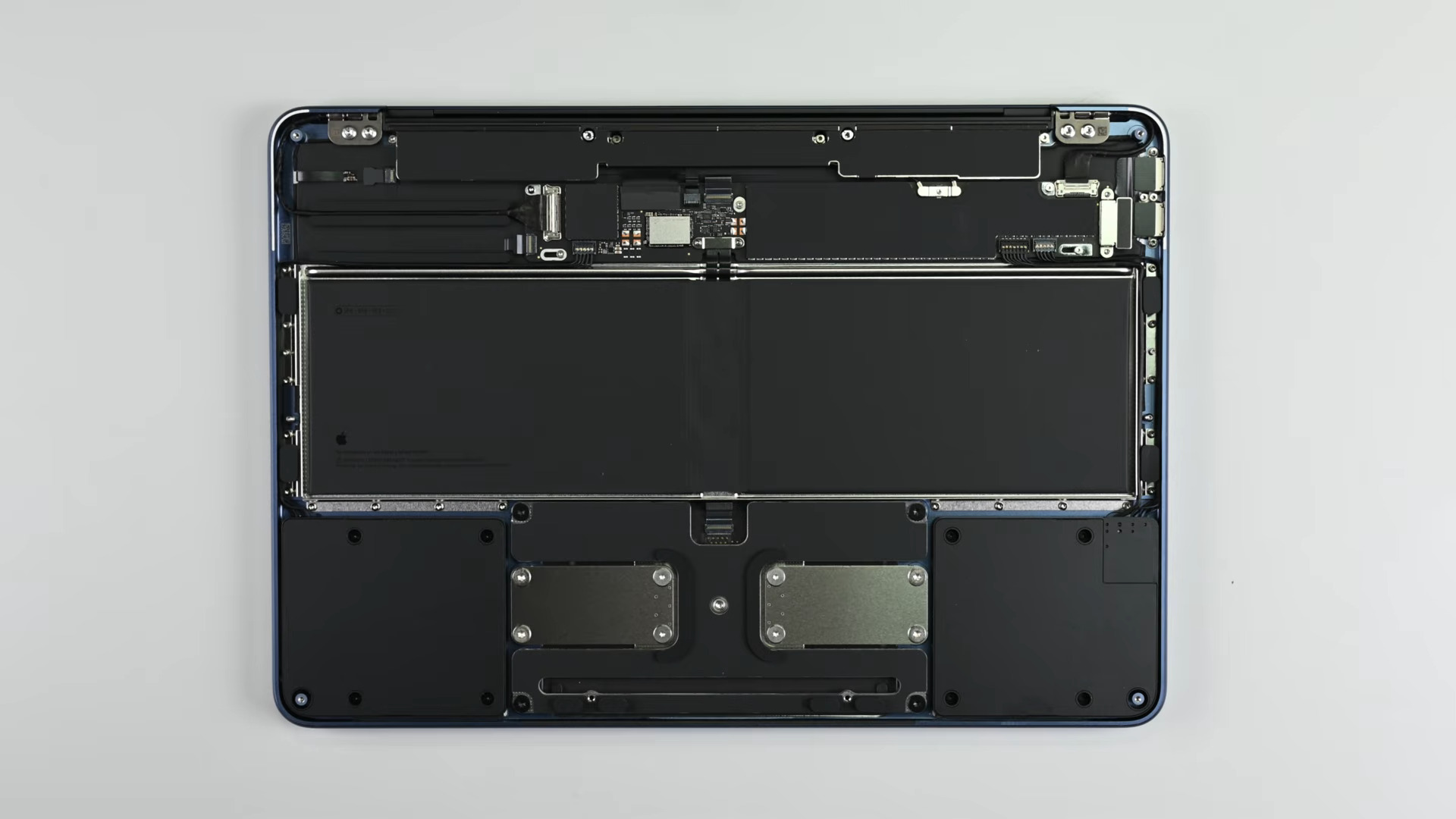
The common narrative around device design is that you can have repairability or a low price, but that they are inversely proportional to each other. Apple’s new budget MacBook Neo seems to attempt a bit of both.
Brittle snap-fit enclosures or glue can make a device pop together quickly during manufacture, but are a headache when it comes time to repair or hack it. Our friends at iFixit tore down the Neo and found it to be the most repairable MacBook since the 2012 unibody model. A screwed in battery, and modules for many of the individual components including the USB ports and headphone jack make it fairly simple to replace individual components. Most of those components are even accessible as soon as you pop the bottom cover instead of requiring major surgery.
As someone who has done a keyboard replacement on a 2010 MacBook, the 41 screws holding the keyboard in brought back (bad) memories. While this is a great improvement over Apple’s notoriously painful repair processes, we’re still only looking at an overall 6/10 score from iFixit versus a 10/10 from Framework or Lenovo.
The real story here is that these improvements from Apple were spurred by Right-to-Repair developments, particularly in the EU, that were the result of pressure from hackers like you.
If you want to push a Neo even further, how about water cooling it? If you’d rather have user-upgradeable RAM and storage too in a Mac, you’ve got to go a bit older.
That’s the first mac I’d consider buying tbh… definitely not for me but if someone really wants to get into that ecosystem…
Or it was necessary because the motherboard is from a Cellphone 🤷🏼♂️
Also here to point out that Apple has a tablet with a laptop/desktop processor, and now a laptop with a Cellphone processor.
And Valve is still going to beat them to x86 gaming on an ARM, what a wacky time to live. The M1 or M2 (or M3 or M4) would have been a great time to make their products play PC games, as it is arguably a contender for graphics processing power (and has Vulkan?). But hey, maybe with the M5. Also crazy considering they literally needed a translation layer when they switched from Intel to their own silicon, so they aren’t completely oblivious to the concept. But I guess the money is spent on . . . VR development?
They don’t want x86 games on their platform, nor do they want Vulkan. They want ARM native games using Metal.
Haha, Lenovo is well known for repairability sonce before Framework, so this is more of a return to form for them.
Why HP and Dell still refuse to make their commercial grade laptops repairable is beyond me. It’s not just the design, Dell is notorious for confusing naming schemes and completely different and incompatible wiring and connectors among different specifications of the same laptop.
Lenovo however will give you part numbers for free online, not even a sign-in required and is famously cross compatible.
I sometimes get myself into confusing situations where I have swapped a Gen6 laptop for a Gen8 lid, and one is a faster 4 core with slower DDR4 while the other is a one-year 6 core with lower latency DDR3. But unlike Dell I usually always wind up with a functional laptop.
I like passively cooled performant laptops and this is as far as I know the best one available today. I just wish it ran Linux not Mac OS so docker could run without VM overhead. I hope this gets Asahi Linux one day.
I am holding out for an M7 Mac under the jackboot of European repairability mandates
Facts Only
Apple released a budget MacBook Neo with improved repairability features.
iFixit conducted a teardown of the MacBook Neo, rating it 6/10 for repairability.
The Neo’s design includes a screwed-in battery and modular components like USB ports and the headphone jack.
The device is the most repairable MacBook since the 2012 unibody model.
Right-to-Repair regulations, particularly in the EU, influenced Apple’s design changes.
Framework and Lenovo laptops score 10/10 on iFixit’s repairability scale.
Lenovo provides accessible part numbers and cross-compatibility for repairs.
HP and Dell are criticized for confusing naming schemes and incompatible components in their commercial laptops.
Apple’s MacBook Neo uses a mobile processor, contrasting with its tablets that use laptop/desktop processors.
Apple has not prioritized x86 gaming or Vulkan support, focusing instead on ARM-native games using Metal.
Some users express interest in running Asahi Linux on the Neo to avoid macOS and reduce VM overhead.
Speculation exists about future Apple models, such as an M7 Mac, under stricter EU repairability mandates.
Executive Summary
Apple’s new budget MacBook Neo represents a notable shift in the company’s approach to device repairability, blending affordability with easier maintenance—a departure from the long-standing trade-off between the two. A teardown by iFixit revealed the Neo as the most repairable MacBook since 2012, featuring a screwed-in battery and modular components like USB ports and the headphone jack, accessible by simply removing the bottom cover. Despite these improvements, it scored a 6/10 on repairability, lagging behind competitors like Framework and Lenovo, which achieve perfect scores. The changes align with growing Right-to-Repair pressures, particularly from EU regulations, driven by advocacy from hackers and repair communities.
The discussion also highlights broader industry trends, contrasting Apple’s progress with Lenovo’s long-standing repairability practices and criticizing HP and Dell for their opaque part systems and inconsistent designs. Commentary on Apple’s hardware strategy—such as using mobile processors in laptops and avoiding x86 gaming support—suggests a deliberate push toward ARM-native ecosystems, prioritizing Metal over Vulkan. The conversation extends to speculative hopes for future models, like an M7 Mac under stricter EU mandates, and the potential for Asahi Linux support to enable better Linux compatibility.
Full Take
The strongest version of this narrative highlights Apple’s incremental but meaningful progress toward repairability, acknowledging external pressures like EU regulations and grassroots advocacy as key drivers. It also contrasts Apple’s approach with industry leaders like Lenovo, framing the Neo as a step forward while critiquing the company’s broader ecosystem control—such as its avoidance of Vulkan and x86 gaming. The discussion reflects a tension between corporate priorities (e.g., Metal over Vulkan) and user demands for openness and flexibility.
Patterns detected: ARC-0024 Ambiguity (implied criticism of Apple’s motives without direct evidence), ARC-0043 Motte-and-Bailey (praising repairability while critiquing broader ecosystem choices as a "bait-and-switch").
Root cause: The narrative echoes the broader conflict between planned obsolescence and user agency, with Apple’s shifts reflecting regulatory and cultural pressure rather than voluntary corporate ethics. The assumption that repairability and affordability are inherently opposed is challenged, but the deeper question—whether Apple’s concessions are strategic or sincere—remains unanswered.
Implications: For users, the Neo offers more repair options but still locks them into Apple’s ecosystem. For the industry, this could signal a slow shift toward repairability, though competitors like Lenovo demonstrate it’s possible without sacrificing performance. The second-order effect may be increased scrutiny of Apple’s software policies (e.g., Metal exclusivity) as hardware becomes more open.
Bridge questions: How much of Apple’s repairability improvements are driven by regulation versus genuine user demand? What would it take for Apple to embrace Vulkan or x86 gaming support, and what barriers (technical or strategic) stand in the way? If Lenovo can achieve 10/10 repairability, why can’t Apple match that standard?
Counterstrike scan: A coordinated influence campaign might amplify praise for Apple’s repairability while downplaying its ecosystem restrictions, framing it as a "win" to deflect criticism. However, the actual content balances praise with critique, avoiding overt manipulation. The speculative tone about future models (e.g., M7) could be exploited to create unrealistic expectations, but the discussion remains grounded in current facts.
Sentinel — Human
The text shows signs of human authorship due to variable sentence length, personal anecdotes, colloquial language, and opinionated tone. However, there are no obvious stylometric, coherence, or fabrication indicators suggesting artificial intelligence involvement.