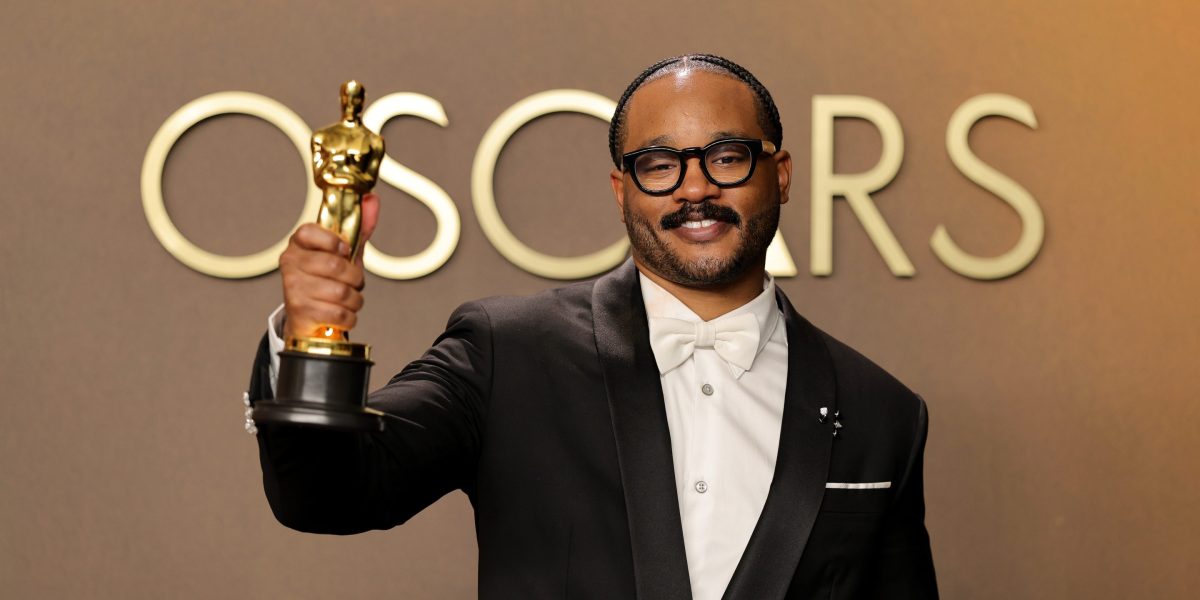
At Sunday night’s Oscars, fan-favorite Sinners struck gold and walked away with four wins. The horror film’s star Michael B. Jordan triumphed as best actor, and its director, Ryan Coogler, took home the award for best original screenplay. But just one decade before the $365 million worldwide box-office success was sweeping the awards ceremony, its director was drowning in student loans.
“I was 200 grand in debt for film school. It was bad,” Ryan Coogler revealed on the WTF With Marc Maron podcast last April. “We don’t come from no money.”
It was 2015, and Coogler was on the verge of breakout success—but his wallet didn’t show it.
At the time, the director had already filmed the critically acclaimed film Fruitvale Station with Jordan. With the A-list actor as his muse, the budding filmmaker took on the tall task of creating a Rocky spinoff series, also starring Jordan: Creed.
He began shooting the first movie in the series, which went on to make $42.6 million in its opening weekend on a $35 million budget.
But the $200,000 in student loans from attending Southern California’s School of the Cinematic Arts was still burning a hole in his pocket. “I wasn’t making no money,” he added.
How Ryan Coogler went from $200K in debt to a $25M net worth
The 39-year-old director’s win with Creed marked the first of many to come: Creed II and Creed III also shattered ticket sales expectations; Black Panther and its sequel Wakanda Forever did well over $2 billion at the worldwide box office; Judas and the Black Messiah was nominated many times for Golden Globes and Academy Awards; and four time Oscar-winner Sinners brought in at least $365 million at global box offices.
While he didn’t confirm whether or not his student debt has been wiped clean yet, Coogler is far past worrying about his repayment plan.
After making some of the biggest superhero and sports films, his net worth is estimated at roughly $25 million. None of it may have ever happened if it weren’t for Coogler confiding in his girlfriend at the time—now wife—about how his creative-writing teacher recognized his potential as a screenwriter.
“[My wife] bought me a screenwriting software, Final Draft,” Coogler said. “I found something that I really loved.”
The world’s most successful people often have rags-to-riches stories
Coogler’s start as a burgeoning creative riddled with debt isn’t an uncommon story. Some of the world’s most successful people have their own rags-to-riches story of how they managed to turn things around.
Queen of television Oprah Winfrey is known for her glitzy audience giveaways and sizable $3.2 billion net worth. She grew up in rural Mississippi in extreme poverty, raised by a single mother. Even when she discovered her passion for radio at just 17, she faced skepticism over her ability to anchor, deemed “unfit for television.” She was demoted from news to daytime TV—which actually proved to be a huge success for the media personality. Thus was born The Oprah Winfrey Show, which reeled in $300 million yearly during its peak. Winfrey later negotiated ownership of the series in 1986, solidifying that her run-ins with poverty would now be a thing of the past.
Do Won Chang, cofounder and CEO of Forever 21, also had rocky beginnings before finding major success. He and his wife, Jin Sook, immigrated to the U.S. from South Korea—their first jobs in L.A. being dishwashing for a coffee shop, and manning a gas station on the side. Chang noticed that most of the men driving the snazziest cars worked in the garment industry, so he took a job at a clothing store. That was the start of his $81 billion love connection with fashion.
“I came here with almost nothing,” Chang said in a 2016 interview with Forbes. “I’ll always have a grateful heart toward America for the opportunities that it’s provided me.”
Airbnb’s Brian Chesky is worth nearly $9.2 billion today—and it’s a far cry from nearly living on the streets back in his twenties. In 2007, Chesky had a problem: He didn’t have enough to cover rent. So he and his roommates hatched a plan that would inspire his empire. They turned their apartment into a bed-and-breakfast, blowing up air mattresses to accommodate guests. Now the CEO’s short-term rental company is worth $78 billion.
“We’re conditioned to avoid taking risks at all the wrong times. Right after college, we’re told to do the safe thing,” Chesky wrote for Fortune in 2014. “But that’s not how life works, and it’s the wrong way to think about risk. Inevitably, things change as you get older.”
A version of this story was published on Fortune.com on April 28, 2025.
Facts Only
Ryan Coogler directed the Oscar-winning film *Sinners*, which won four awards, including Best Actor for Michael B. Jordan and Best Original Screenplay for Coogler.
Coogler attended the School of the Cinematic Arts and accumulated $200,000 in student loan debt.
In 2015, Coogler directed *Creed*, starring Michael B. Jordan, which grossed $42.6 million in its opening weekend on a $35 million budget.
Coogler’s films include *Fruitvale Station*, *Creed II*, *Creed III*, *Black Panther*, *Black Panther: Wakanda Forever*, and *Judas and the Black Messiah*.
*Black Panther* and its sequel grossed over $2 billion worldwide.
*Sinners* earned at least $365 million at the global box office.
Coogler’s estimated net worth is approximately $25 million.
Oprah Winfrey grew up in poverty in rural Mississippi and later built a media empire, with her show earning $300 million yearly at its peak.
Do Won Chang, cofounder of Forever 21, immigrated to the U.S. from South Korea and initially worked as a dishwasher and gas station attendant.
Brian Chesky, CEO of Airbnb, started the company after struggling to pay rent, turning his apartment into a bed-and-breakfast.
Airbnb is now valued at $78 billion.
The article was published on Fortune.com on April 28, 2025.
Executive Summary
Ryan Coogler, director of the Oscar-winning horror film *Sinners*, has achieved remarkable success, with his films grossing billions worldwide and earning critical acclaim. However, his journey began with significant financial struggles, including $200,000 in student loan debt from attending the School of the Cinematic Arts. Despite early financial hardship, Coogler's career took off with *Fruitvale Station* and the *Creed* series, leading to blockbuster hits like *Black Panther* and *Judas and the Black Messiah*. His estimated net worth now stands at $25 million, a stark contrast to his earlier financial strain.
The article also highlights other rags-to-riches stories, such as Oprah Winfrey, who overcame poverty to build a media empire, and Do Won Chang, cofounder of Forever 21, who started as a dishwasher before entering the fashion industry. Airbnb CEO Brian Chesky’s early struggles with rent led to the creation of a $78 billion company. These narratives underscore the theme of perseverance and seizing opportunities, though they also reflect broader systemic challenges like student debt and economic mobility.
While the stories are inspiring, they raise questions about the accessibility of such success. Not everyone with talent or ambition achieves similar outcomes, and structural barriers often play a role. The article presents these cases as exceptions rather than the norm, acknowledging both individual resilience and the role of luck or timing in these trajectories.
Full Take
The strongest version of this narrative celebrates individual perseverance and the transformative power of opportunity. Ryan Coogler’s journey from crippling student debt to directing billion-dollar franchises is framed as a testament to talent, hard work, and a bit of luck—like his wife gifting him screenwriting software. Similarly, the stories of Oprah Winfrey, Do Won Chang, and Brian Chesky reinforce the idea that systemic barriers can be overcome through grit and innovation. The article acknowledges the role of structural challenges (e.g., poverty, immigration struggles) but ultimately centers on personal agency as the driving force behind success.
However, this framing risks oversimplifying systemic inequality. The pattern here aligns with **ARC-0012: Survivorship Bias**, where exceptional success stories are highlighted while the vast majority who face similar obstacles but don’t achieve breakthroughs are ignored. The narrative also subtly employs **ARC-0024: Ambiguity** by presenting these cases as universally replicable without interrogating the unique privileges (e.g., Coogler’s early collaboration with Michael B. Jordan) or timing (e.g., the rise of superhero films) that enabled them. The emotional appeal of "rags-to-riches" stories can obscure the fact that such outcomes are statistically rare and often dependent on uncontrollable factors.
Rooted in the American Dream paradigm, this narrative assumes that meritocracy is the primary driver of success, downplaying the role of systemic advantages like networks, capital access, or cultural trends. The implication is that failure to achieve similar success reflects a lack of effort rather than structural limitations. This can inadvertently justify inequality by suggesting that anyone can "make it" if they try hard enough, ignoring the reality of diminishing economic mobility.
For human agency, these stories can inspire but also create unrealistic expectations. Who benefits? Media outlets and platforms thrive on aspirational content, while the broader public may internalize blame for not achieving similar outcomes. The second-order consequence is a cultural narrative that undermines collective solutions to systemic issues like student debt or wage stagnation.
Bridge questions: What structural changes would make such success stories less exceptional? How might these narratives differ if they centered on those who didn’t "make it"? What role does luck play in these trajectories, and how is it often conflated with merit?
Counterstrike scan: A coordinated influence campaign would amplify these stories to discourage systemic critique, framing success as purely individual and failure as personal inadequacy. The actual content aligns with this pattern but stops short of explicit manipulation—it celebrates resilience without denying systemic challenges. However, the lack of counter-narratives (e.g., data on median outcomes for film school graduates) leaves room for misinterpretation.
Patterns detected: ARC-0012 Survivorship Bias, ARC-0024 Ambiguity
Sentinel — Human
The article exhibits strong human stylistic markers, including erratic sentence structure, emotional phrasing, and specific attributions, with no significant signs of synthetic generation.