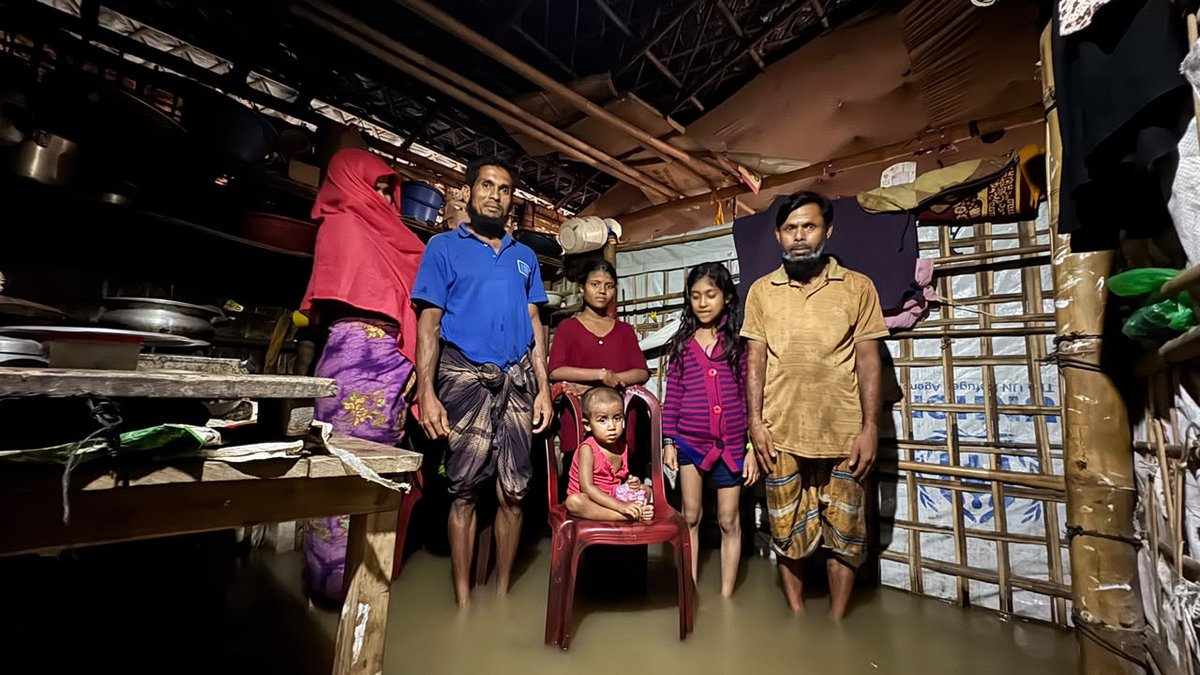
Landslides triggered by heavy rains have killed more than a dozen people in the past few days, including children and women in the Rohingya camp in Cox’s Bazar, southeast Bangladesh.
The Office of the Refugee Relief and Repatriation Commissioner in Bangladesh has confirmed that eight people have died so far after a landslide struck a girls’ school on July 8.
“Eight people have died in today’s incident, seven of whom are students and one teacher. Four died on the spot and the other four died in hospital,” Mizanur Rahman, the Refugee Relief and Repatriation Commissioner, told Crux Now.
He also said at least five students are still receiving treatment in hospital.
Fire services and other forces are still carrying out rescue operations with the help of locals, Rahman said, although he not confirming how many students were in the Madrasa during the incident.
The incident was the result of flooding caused by several days of continuous rain.
Most of the areas where the Rohingya live were mountainous and forested, but the forests have been cleared to build settlements for the Rohingya on hillsides and slopes.
Earlier, at least 12 people died in a landslide in Cox’s Bazar district on Thursday, including eight Rohingya refugees.
Forty-three-year old Abdul Ahmed, a Rohingya refugee whose camp was hit by a landslide, told Crux Now that many Rohingya are now in fear, with water rising in the low-lying areas and higher ground more susceptible to landslides.
“I think we should move to safer places from all the areas that are at risk,” Ahmed said.
During the monsoon season, Caritas Bangladesh implements a range of preparedness, risk reduction, and emergency response measures to help keep Rohingya communities safe from landslides, flooding, and water, sanitation, and hygiene (WASH)-related public health risks.
These include identifying and closely monitoring high-risk landslide-prone areas, coordinating regularly with Site Management Support, the Camp-in-Charge, and humanitarian partners, and supporting slope protection measures around vulnerable locations.
To ensure uninterrupted essential services during emergencies, Caritas pre-positions fuel for water supply systems and desludging operations, maintains critical WASH infrastructure, and carries out rapid repairs to damaged water networks and sanitation facilities when needed.
The Rohingya are a Muslim minority living in the Buddhist-majority state of Myanmar, and have long faced oppression.
Most of the Rohingya at the Bangladesh camps have arrived from Myanmar since August 2017, when the military began conducting clearance operations after a series of rebel attacks in Myanmar’s Rakhine state.
The Rohingya have been denied citizenship in Buddhist-majority since 1982.
The population density of the camps is staggering: About 103,600 per square mile, more than 40 times the average population density in the rest of Bangladesh, which is already one of the most crowded countries on earth.
Refugees live in side-by-side plastic huts, each just a little larger than 100 square feet, and some holding a dozen residents.
Sentinel — Human
This text reads like human-sourced reporting that synthesizes emergency updates with relevant background information regarding the Rohingya population and humanitarian response efforts.