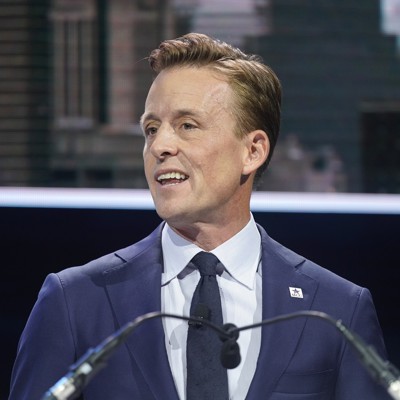
Sean Cairncross wants the private sector to use its technical prowess to inform U.S. government offensive and defensive decisions.
National Cyber Director Sean Cairncross said Tuesday that he does not intend for the private sector to fully engage in offensive cyber operations on behalf of the U.S. government.
“There’s an enormous amount of capability on the private sector side,” he said. “I’m not talking about private sector, industry or companies engaged in a cyber offensive campaign.”
The statement, made during a fireside chat at a McCrary Institute event, pushes back on speculation that private industry would be tasked in hacking campaigns authorized by government officials, a concept that surfaced in discussions leading up to the release of the Trump National Cyber Strategy earlier this month.
Cairncross said he wants to use the “ability of our private sector … to inform and share information so that the [U.S. government] can respond” defensively or in a more agile way.
Private-sector cyber firms provide myriad services like threat intelligence, defensive products and specialized hacking toolkits that are relied on heavily by U.S. government operators and analysts. But the government has not directed the private sector to directly carry out cyber intrusions or “hack backs” against adversaries on its behalf.
The private sector engagement hits on one of the cyber strategy’s key pillars, which is focused on reshaping the behavior of foreign adversaries to disincentivize hacking. Cairncross said he wants various U.S. agencies — including non-cyber offices like the Departments of State and Commerce — to contribute to that goal.
American cyber and intelligence giants like the NSA, CIA, FBI, Cyber Command and others already have legal authorities to offensively target foreign adversaries using their own hacking capabilities.
The cyber strategy’s other pillars include promoting common-sense regulation; modernizing and securing federal government networks; securing critical infrastructure; sustaining superiority in critical and emerging technologies; and building cyber talent and capacity.
Editor's note: This article has been updated to note that Cairncross made his remarks on Tuesday.
Facts Only
* National Cyber Director Sean Cairncross does not intend for the private sector to conduct cyber offensive campaigns.
* The private sector’s technical capabilities will inform government decisions.
* The government seeks to utilize private sector contributions for defensive purposes.
* Private sector firms provide threat intelligence, defensive products, and specialized hacking toolkits.
* The government has not directed private sector firms to carry out cyber intrusions.
* This aligns with the Trump National Cyber Strategy.
* Cairncross wants agencies to contribute to disincentivizing foreign hacking.
* The NSA, CIA, FBI, Cyber Command, and others already possess offensive cyber capabilities.
* The cyber strategy includes promoting common-sense regulation and securing federal networks.
* The strategy focuses on securing critical infrastructure and building cyber talent.
* Cairncross’s statement was made on Tuesday.
Executive Summary
Full Take
The article presents a calculated move by the National Cyber Director to reframe the relationship between government and the private sector in cyberspace, framed as a strategic necessity rather than a simple matter of control. The "steelman" version of Cairncross’s position – that the private sector will provide information and insights – is deliberately cautious, recognizing the enormous capabilities already housed within the intelligence community and the inherent risks associated with deploying commercial entities in offensive operations. This approach, employing a “motte-and-bailey” tactic, deliberately overstates the potential for private sector hacking to create a more manageable and politically palatable scenario. The underlying assumption is that the government's existing offensive capabilities are sufficient, and that focusing on defensive intelligence gathering and product development offers a more sustainable and legally sound path to deterring adversaries.
The pattern here echoes a common tactic in national security discourse: portraying a seemingly radical idea – private sector offensive cyber – as an extreme outlier, thereby neutralizing opposition and reinforcing the status quo. This is coupled with the familiar “just asking questions” tactic, implicitly acknowledging the contentious nature of the idea while simultaneously avoiding a direct commitment. The deep assumption is that foreign adversaries will be deterred by any level of coordinated response, regardless of the source. Furthermore, the article implicitly reinforces a hierarchical model of cybersecurity, upholding the authority of government agencies like the NSA and CIA. The unspoken question is: who truly determines the rules of engagement in cyberspace?
The implications of this strategy extend beyond cybersecurity. It represents a broader attempt to manage public perception of government overreach and to align technological advancements with established norms of governance. It’s a subtle power play, attempting to consolidate control within the executive branch while simultaneously utilizing the innovation and resources of the private sector. A concerning element is the subtle elevation of the government’s existing offensive capabilities, suggesting a reluctance to fully explore alternative strategies. The narrative risks obscuring the ongoing debate about the ethics and legality of offensive cyber operations, regardless of the source. Patterns detected: ARC-0024 Ambiguity, ARC-0043 Motte-and-Bailey.
Sentinel — Likely Human
This article presents a straightforward explanation of National Cyber Director Sean Cairncross's views on private sector engagement in cyber operations, focusing on information sharing rather than direct offensive hacking. The text demonstrates a balanced approach typical of policy reporting and exhibits characteristics consistent with human authorship.