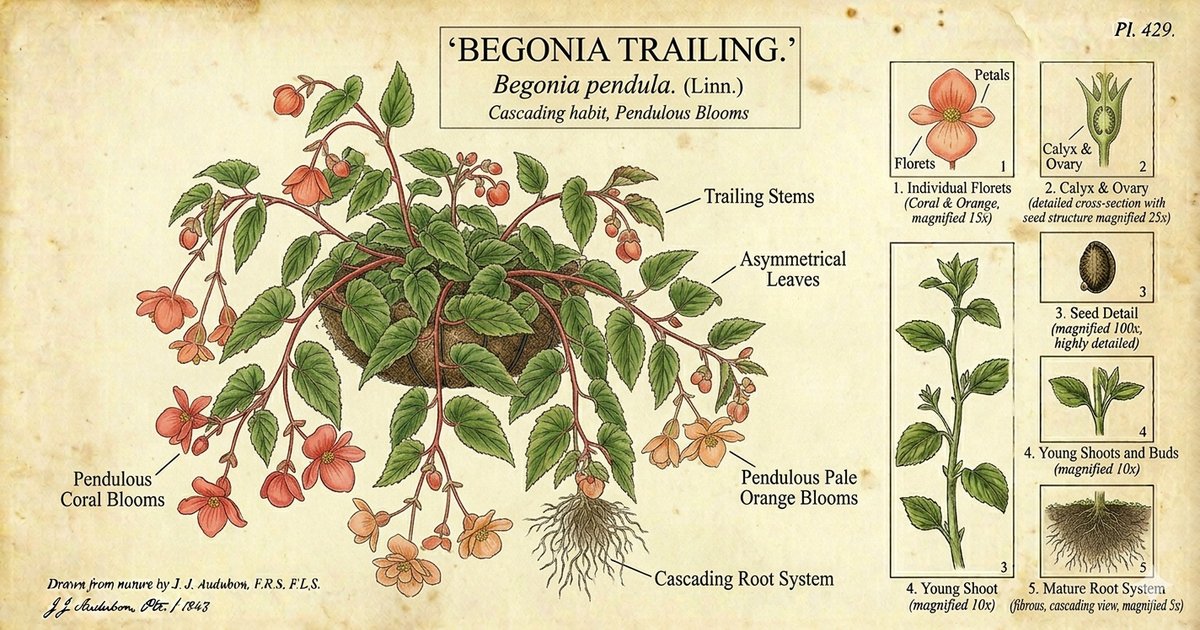
While the fibrous-rooted varieties provide the stalwart foundation of the garden, the Trailing Begonia (Begonia pendula) offers a masterclass in fluidity and movement. In the microclimates of a Fort Collins garden, these plants are the undisputed stars of the "hanging" landscape. With their asymmetrical, pointed foliage and heavy, pendulous blooms, they create a cascading effect that softens the rigid lines of architecture and provides a splash of tropical luxury to the coolest corners of the home.
The Architecture of the Cascade
The Trailing Begonia is biologically engineered for verticality. Unlike its mounding cousins, its stems are designed to lose structural rigidity as they grow, allowing gravity to pull the plant into a lush, over-the-edge drape. The flowers themselves are often multi-layered and heavy with nectar, hanging like ornate lanterns from delicate pedicels. This habit makes them the functional equivalent of a "spiller" in container design, but with a sheer floral density that few other shade plants can match.
Navigating the High Plains Shade
To maintain the pendulous beauty of Begonia pendula in Northern Colorado, one must account for our low humidity and specific light quality:
The Goldilocks Light Zone: Trailing Begonias are the true aristocrats of the shade. They are far more sensitive to our intense UV than the "Wax" varieties. The ideal placement is a spot that receives "bright indirect light"—think of a north-facing patio or deep under the protection of a covered porch. If the leaves begin to show brown, "crispy" edges, it is often a sign of wind-scorch or accidental direct sun exposure during our punishing midday hours.
Hydration for Weight: Because these plants are often grown in hanging baskets or coco-coir liners, they are prone to drying out faster than their in-ground counterparts. However, the stems are succulent and brittle; too much water can lead to "damping off" at the soil line. For the best results, use a high-quality potting mix with excellent drainage and water only when the surface feels dry. Maintaining a consistent moisture level is key to keeping those heavy bloom clusters from dropping prematurely.
The Ultimate Hanging Focal Point
In the context of a "home and garden" aesthetic, the Trailing Begonia is a "thriller" and "spiller" combined. While many gardeners pair them with the fine texture of Bacopa, they are bold enough to stand entirely on their own. Their saturated corals, oranges, and reds provide a high-contrast pop against the neutral tones of Larimer County stone and wood. For those looking to transform a shaded entryway into a lush, welcoming gallery, the pendulous begonia remains the gold standard for high-altitude elegance.
Facts Only
Actors: Gardeners, Trailing Begonias (Begonia pendula)
Actions: Cultivating, maintaining
Events: Casual gardening in Fort Collins, Colorado
When: Unspecified
Where: Fort Collins, Larimer County, Colorado
Executive Summary
In the context of a Fort Collins garden in Northern Colorado, the Trailing Begonia (Begonia pendula) is celebrated for its cascading effect that softens architectural lines and adds a touch of tropical luxury to shaded areas. This plant is biologically designed for vertical growth and has heavy, pendant blooms, making it ideal as a "spiller" in container design. To maintain the pendulous beauty of Trailing Begonias in Northern Colorado's specific microclimate, gardeners should provide them with bright indirect light and consistent moisture levels. The article also suggests that these plants can stand alone as a focal point due to their bold colors contrasting with the neutral tones of Larimer County stone and wood.
However, it is important to note that these plants are sensitive to UV light and prone to drying out faster than in-ground counterparts because they are often grown in hanging baskets or coco-coir liners. Overwatering can lead to "damping off" at the soil line.
In summary, Trailing Begonias are a popular choice for shaded areas in Fort Collins gardens due to their cascading effect and heavy, pendant blooms. To ensure their growth and health, gardeners should provide them with bright indirect light, consistent moisture levels, and consider their sensitivity to UV light and susceptibility to drying out.
Full Take
In analyzing the article, it is important to consider the context and implications for gardeners in specific climates. The article highlights the unique characteristics of the Trailing Begonia that make them ideal for shaded areas in Fort Collins gardens. However, it also provides valuable insights into the plant's sensitivity to UV light and susceptibility to drying out, which are crucial factors for gardeners to consider when cultivating these plants.
Furthermore, the article serves as a reminder of the importance of understanding the specific needs of different plants in various microclimates. In this case, the Trailing Begonia is adapted to vertical growth and requires bright indirect light and consistent moisture levels. This understanding can help gardeners make informed decisions about their plant choices and provide optimal conditions for their growth.
Finally, it is worth noting that the article positions the Trailing Begonia as a bold focal point in contrast with other plants like Bacopa. This perspective encourages gardeners to experiment with different textures and colors to create visually striking landscapes. However, it also raises questions about the role of color and contrast in gardening aesthetics and how this might vary across cultures and individual preferences.