The House on Friday night passed a bill to fund the Department of Homeland Security until May 22.
Why it matters: House GOP leaders' decision not to act on a Senate-passed plan has stoked tensions between House and Senate Republicans and raised questions about the path forward for ending the DHS shutdown, now well into its second month.
The Senate's plan would fund DHS through Sept. 30, but without money for Immigration and Customs Enforcement and Customs and Border Protection.
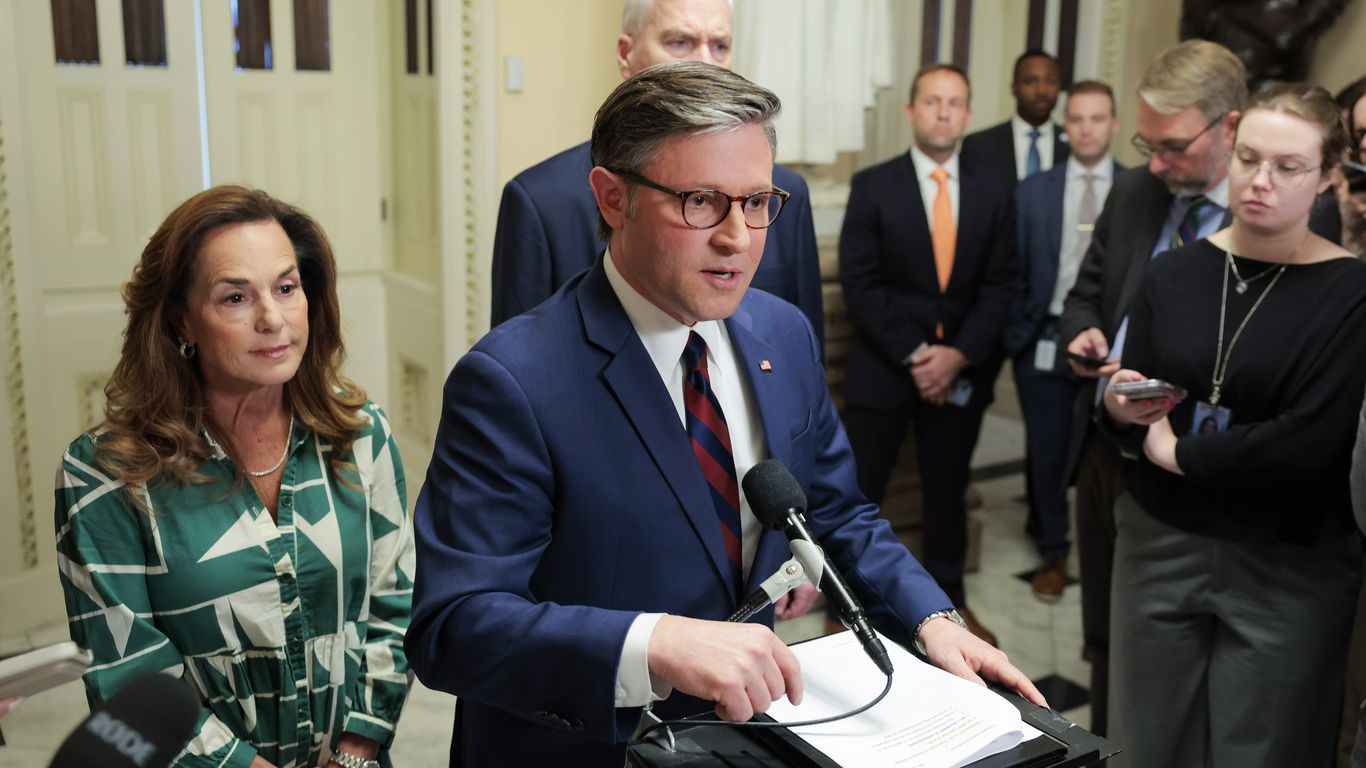
Speaker Mike Johnson (R-La.) instead advanced an eight-week stopgap that fully funds DHS, including ICE and CBP.
The vote was 213-203, with three House Democrats joining all Republicans in support.
Democratic Reps. Don Davis (N.C.), Marie Gluesenkamp Perez ( Wash.) and Henry Cuellar (Texas) voted yes.
Catch up quick: The Senate voted in the early hours of Friday morning to pass a bill that would reopen all of the Department of Homeland Security, excluding funding for ICE and CBP.
Senate Majority Leader John Thune (R-S.D.) had signaled that Republicans plan to address those agencies later through reconciliation, with only GOP votes.
Johnson called the Senate-passed bill a "joke," noting the lack of border security funding.
Senate Democrats have already made clear they will oppose the House's short-term DHS funding bill.
What's next: The Senate, which just left for a two-week recess, will have to determine whether its members will return to Washington and take up the House-passed bill.
Facts Only
Actor: House of Representatives, Senate, Speaker Mike Johnson (R-La.), Senate Majority Leader John Thune (R-S.D.)
Action: Passed bills, advanced a stopgap bill
Event: The House and Senate passed bills to fund DHS; the House advanced an eight-week stopgap bill that funds ICE and CBP
Timeline: Friday night, early hours of Friday morning
Location: Washington, D.C. (implied)
Institutions: Department of Homeland Security, Immigration and Customs Enforcement, Customs and Border Protection
Executive Summary
Full Take
The ongoing shutdown of the U.S. Department of Homeland Security has resulted in a standoff between the House and Senate Republicans over funding for ICE and CBP. The Senate's initial plan to exclude funding for these agencies sparked criticism from Speaker Mike Johnson, who described it as a "joke" due to its lack of border security funding. However, the House-passed bill, which fully funds DHS, including ICE and CBP, has been met with opposition from Senate Democrats. The situation highlights the divergent priorities between the two parties in relation to immigration enforcement and border control.
Patterns detected: ARC-0043 Motte-and-Bailey, ARC-0024 Ambiguity (The articles present conflicting versions of funding for ICE and CBP).
As the standoff continues, it is important to consider the underlying assumptions about immigration and border security that drive these policy differences. Additionally, one might question the long-term implications of these decisions on the overall effectiveness of DHS agencies and their impact on U.S. citizens and immigrants alike.
Bridge questions: What are the primary reasons for the disagreement between House and Senate Republicans over funding for ICE and CBP? How will this standoff affect the future of immigration policy in the United States? What perspectives are missing from the current narrative?
Sentinel — Human
The text appears to be written by a human journalist, displaying natural variations in sentence length and a lack of mechanical transitions. However, the possibility of AI assistance cannot be completely ruled out due to the absence of a distinct personal voice or stylistic fingerprint.